Monticello, VA 2024
Becky, (my wife) and I visited the center of Thomas Jefferson’s world, called Monticello, in the summer of 2024. His celebrated home in the Virginia countryside was his “essay in Architecture”, and his autobiography, elegantly reflecting its designer’s wide-ranging interests.
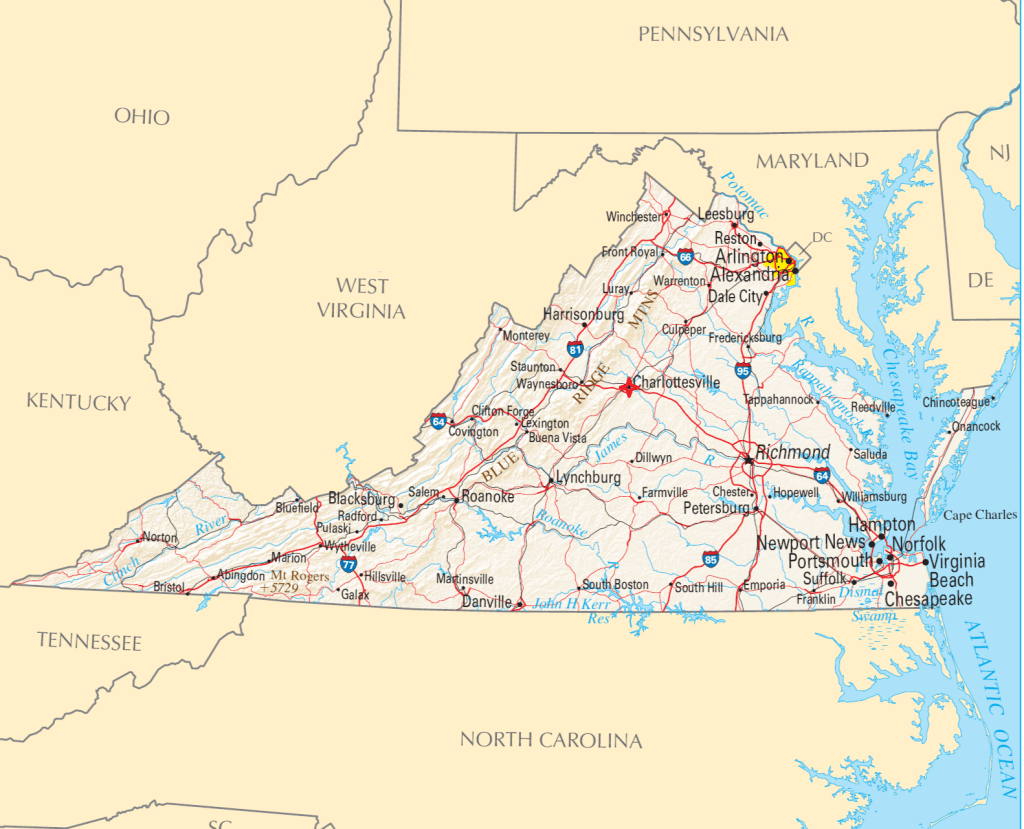
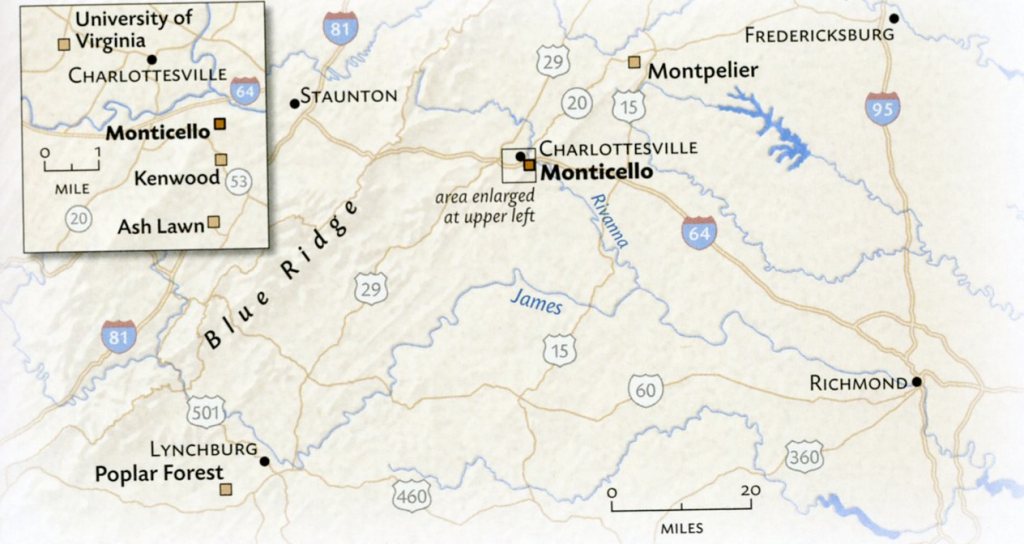
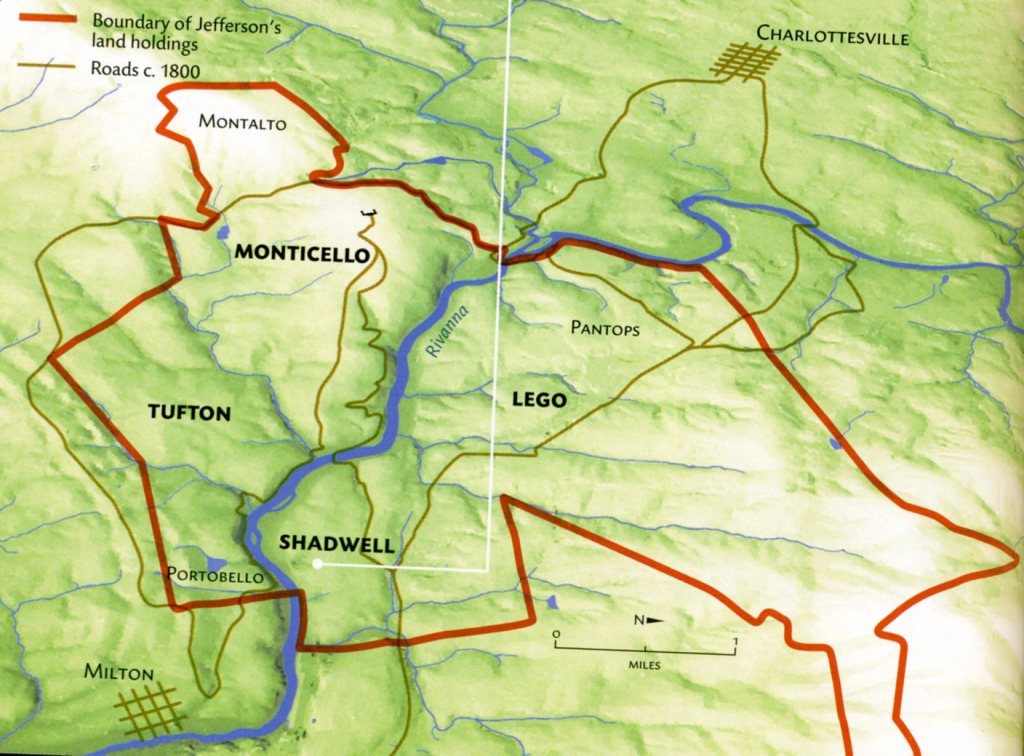
Imaged above & below, Monticello was located southeast of Charlottesville, Virginia. We drove in on I-64 from Richmond.
Thomas Jefferson was the essential architect of American life. He was our primary president, philosopher, connoisseur, diplomat, educator, innovator, farmer, and scientist. Relentlessly interested in the hopes of humanity, he gave us the epic words of the Declaration of Independence. His home and masterpiece, Monticello is the touchstone for all who seek to explore the enduring meaning of “Life, Liberty and the pursuit of Happiness”.
Pictured below, Monticello was the center of Jefferson’s world; to understand him, you must experience Monticello. It comprised a house, an ornamental landscape, a farm, and a revolutionary garden, including orchards and vineyards where Jefferson experimented with more than 300 varieties of fruits and vegetables. Monticello was also a working plantation, where the paradox of slavery stood in stark relief to the ideals of liberty expressed by Jefferson in the declaration.
Becky and I first arrived at the David M. Rubenstein Visitor Center to book our day-tour tickets, (imaged above). We visited the Carl and Hunter Smith Educational Center & watched an introductory film called, “Thomas Jefferson’s World”. There we learned the amazing the amazing life of Thomas Jefferson. Thomas Jefferson was born on April 13, 1743, at Shadwell, a plantation on a large tract of land near-by, (imaged below). His father, Peter Jefferson (1708-57), was a successful planter and surveyor and his mother, Jane Randolph Jefferson (1720-76), came from a prominent Virginia family. Thomas was their third child and eldest son; he had six sisters and one surviving brother.
In 1762, Jefferson graduated from the College of William and Mary in Williamsburg, Virginia, where he reportedly enjoyed studying for 15 hours, then practicing violin for several more hours on a daily basis. Jefferson began working as a lawyer in 1767. As a member of colonial Virginia’s House of Burgesses from 1769 to 1775, Jefferson, who was known for his reserved manner, gained recognition for penning a pamphlet, “A Summary View of the Rights of British America” (1774).
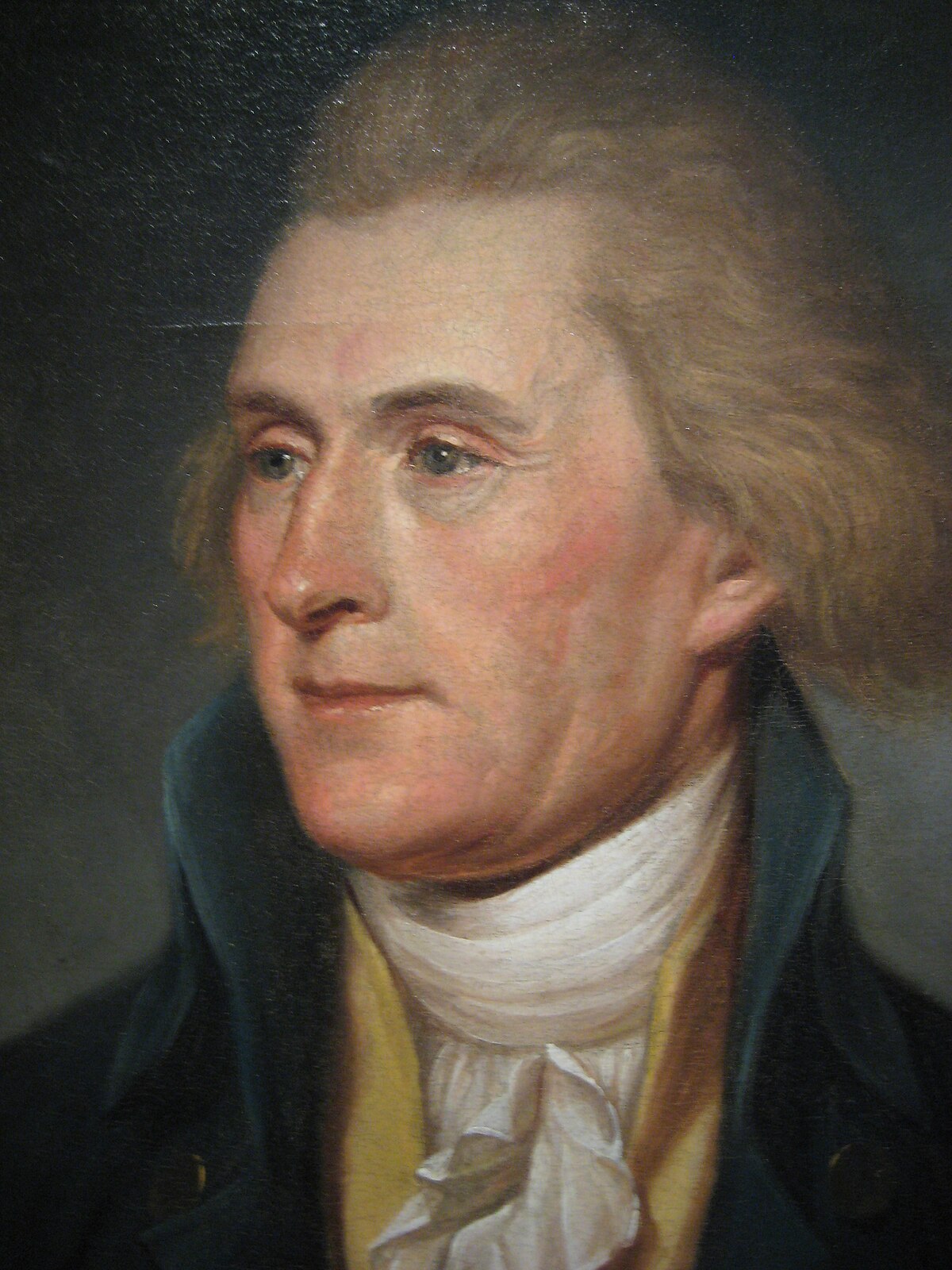
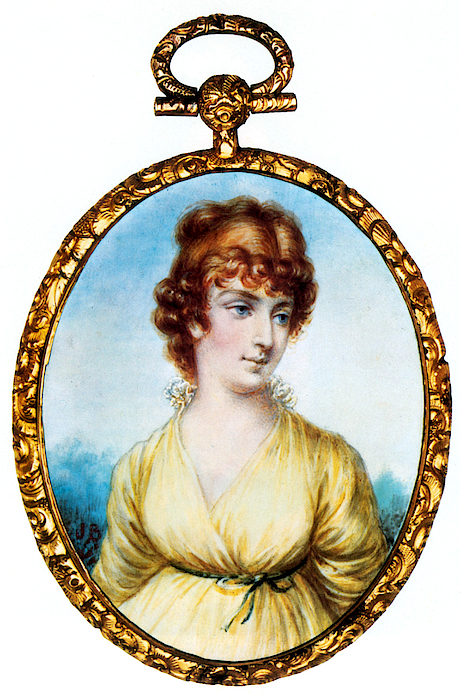
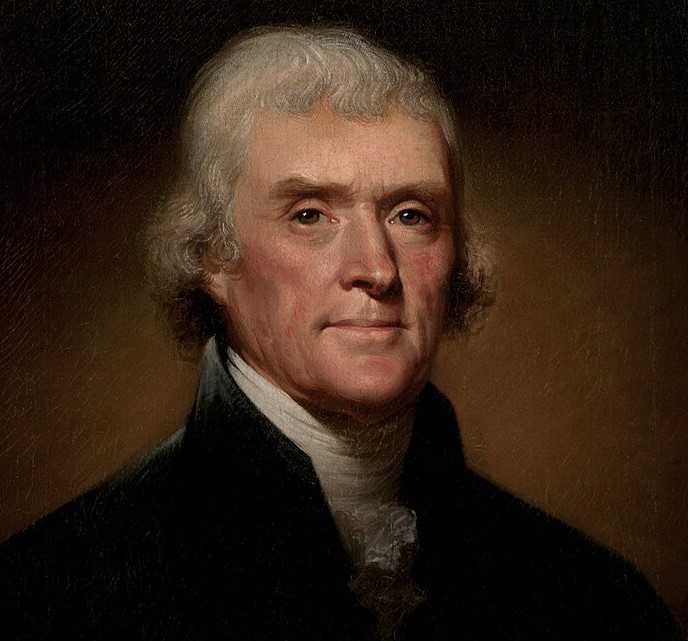
Portrait of Thomas Jefferson by Peale in 1791, (Image was taken from “Monticello: The Official Guide to Thomas Jefferson’s World”, Miller 2016). and the public domain “Portrait of Martha Wayles Skelton Jefferson”.
On January 1, 1772, Jefferson married Martha Wayles Skelton (1748-82), a young widow. The couple moved to Monticello and eventually had six children; only two of their daughters, {Martha (1772-1836) and Mary (1778-1804)}, survived into adulthood. In 1782, Jefferson’s wife Martha died at age 33 following complications from childbirth. Jefferson was distraught and never remarried. However, it is believed he fathered more children with one of his enslaved women, Sally Hemings (1773-1835), who was also his wife’s half-sister.
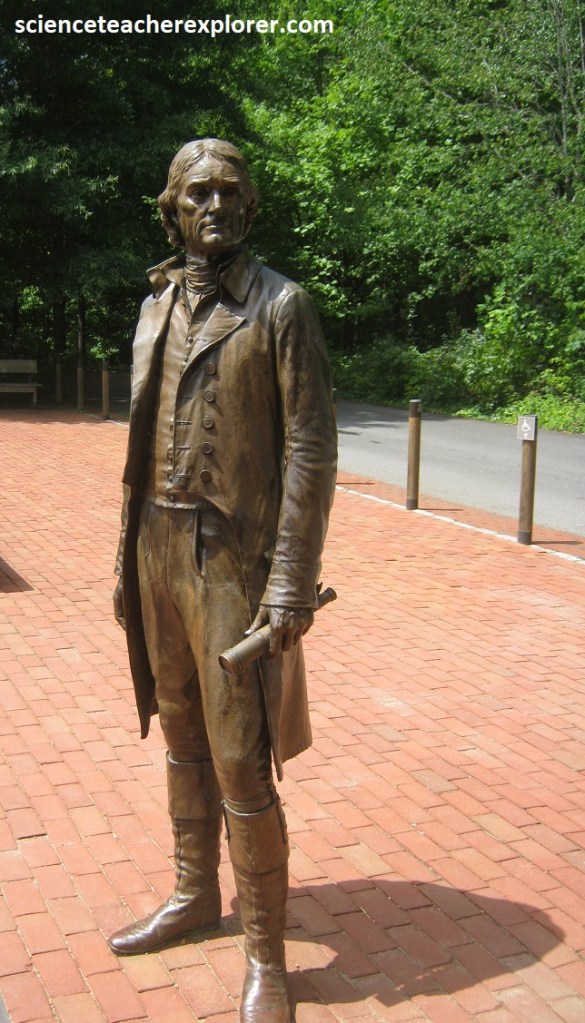
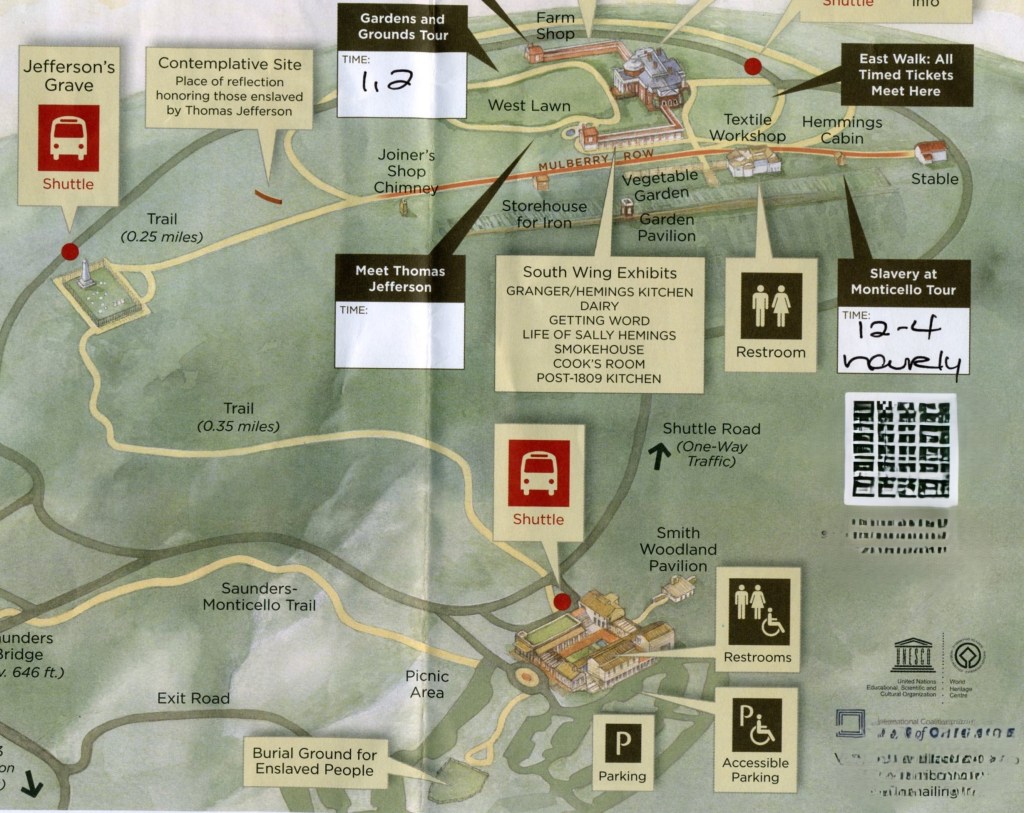
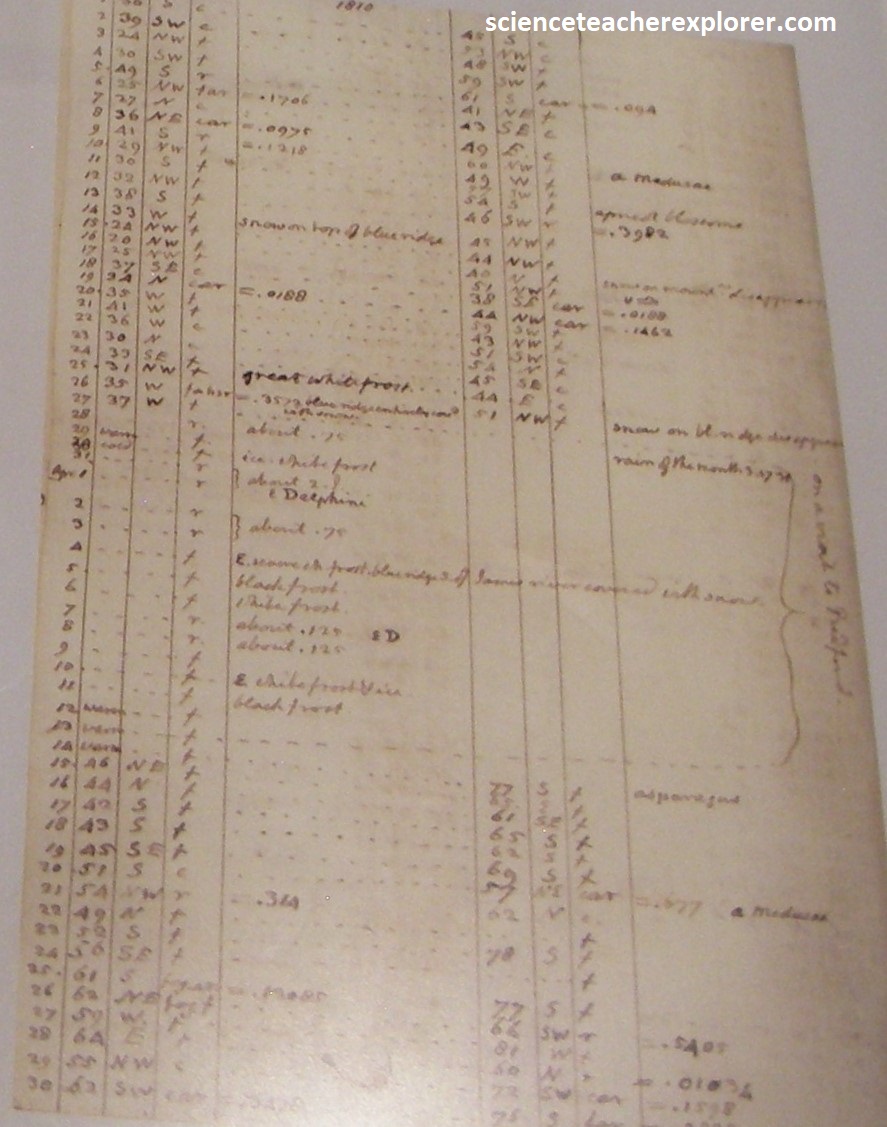
After his father died when Jefferson was a teen, Thomas Jefferson inherited the Shadwell property. In 1768, he began clearing a mountaintop on the land in preparation for the elegant brick mansion he would construct there called Monticello (“little mountain” in Italian). Jefferson, who had a keen interest in architecture and gardening, designed the home and its elaborate gardens himself. Over the course of his life, he remodeled and expanded the Monticello and filled it with art, fine furnishings, interesting scientific gadgets and architectural details that I plan to explore. He kept records of everything that happened at the 5,000-acre plantation, including daily weather reports, a gardening journal and notes about his slaves and animals. Becky and I took the shuttle up to the present brick mansion from the bronze statue seen above.
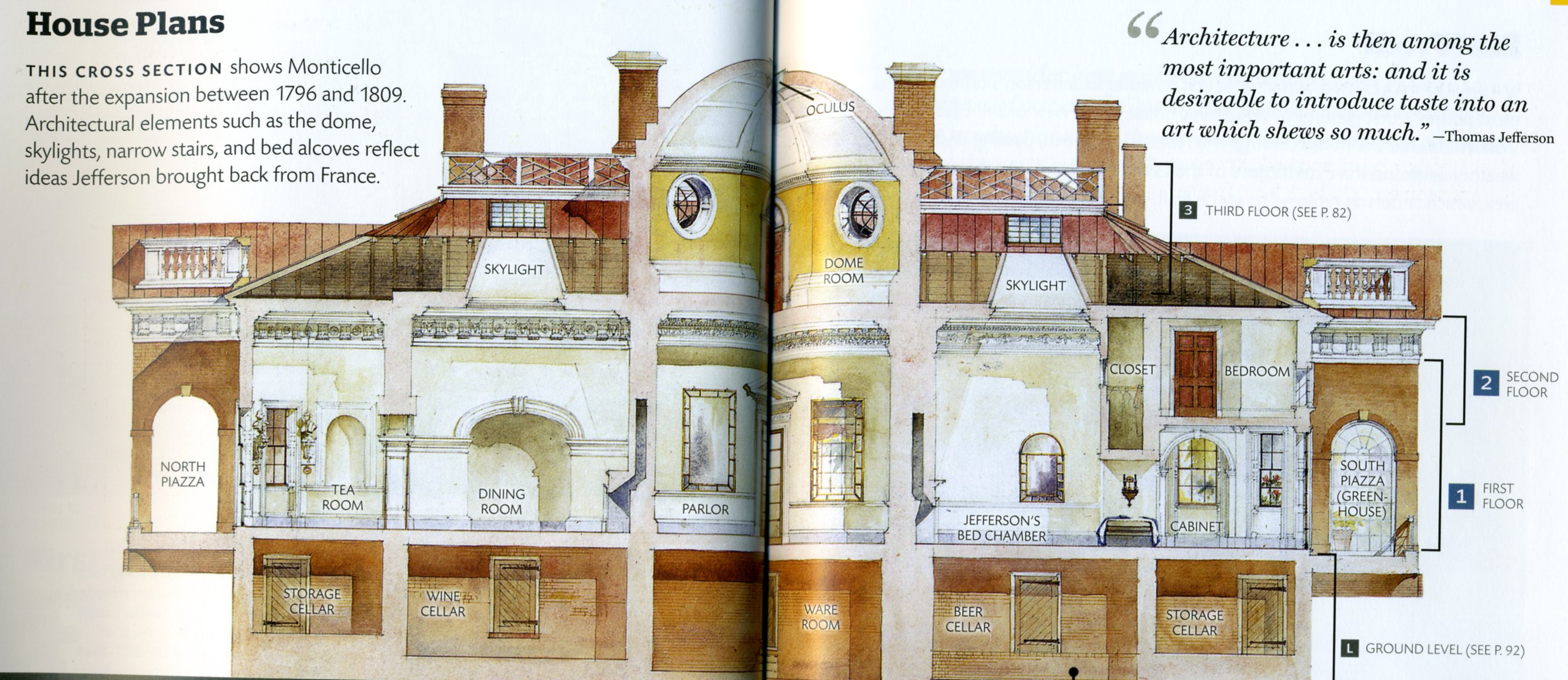
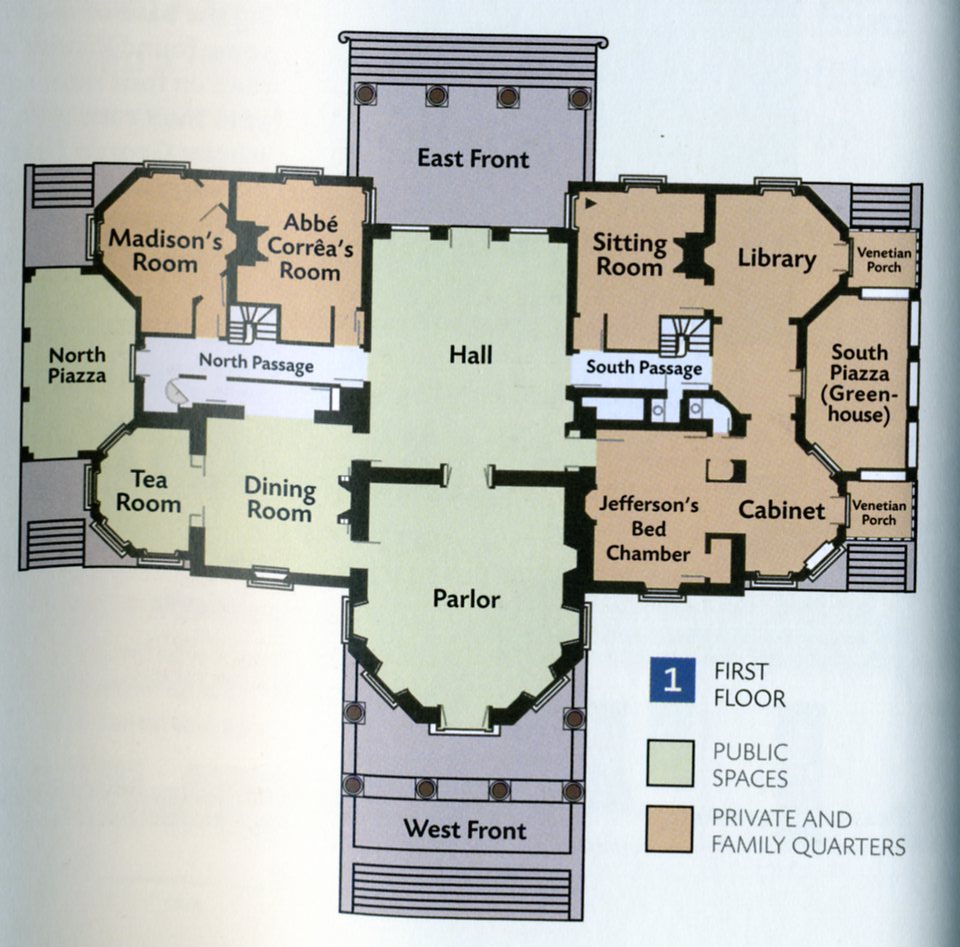
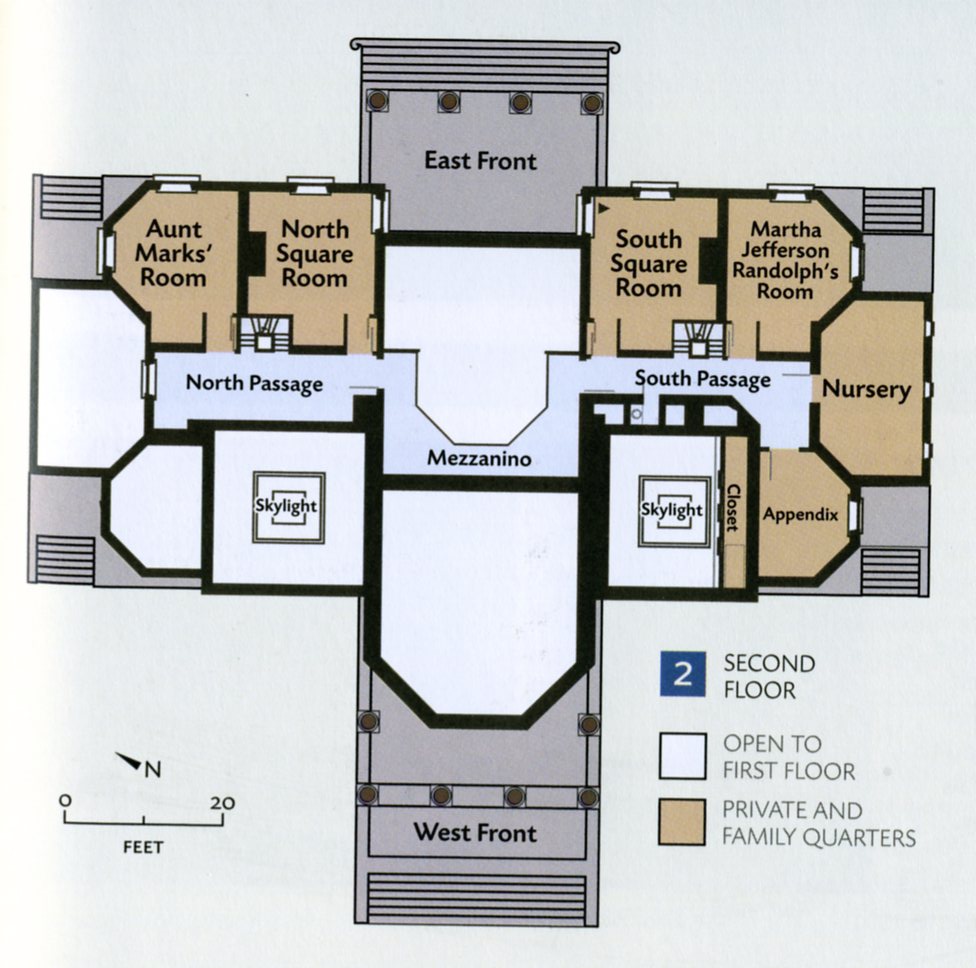
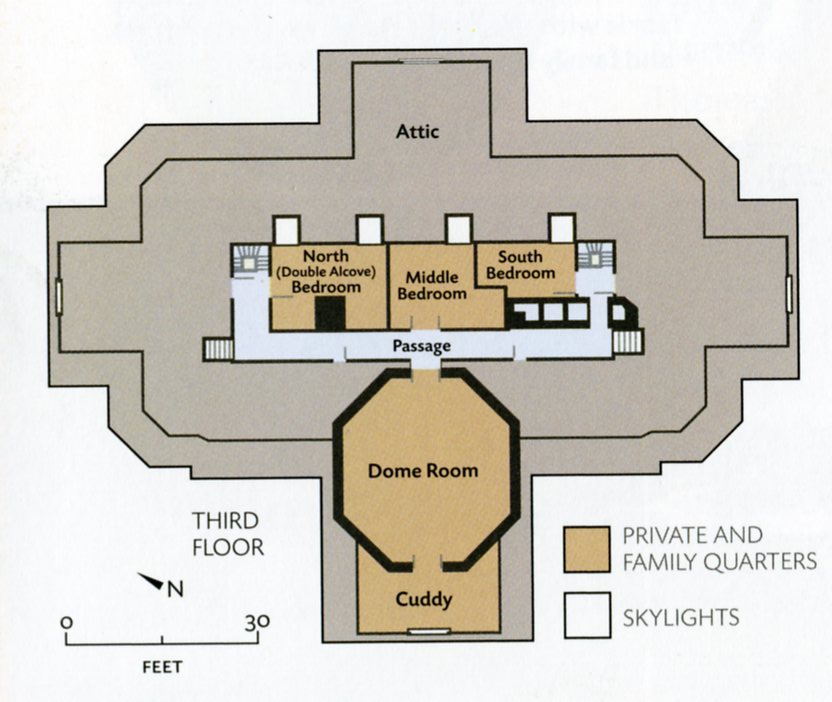
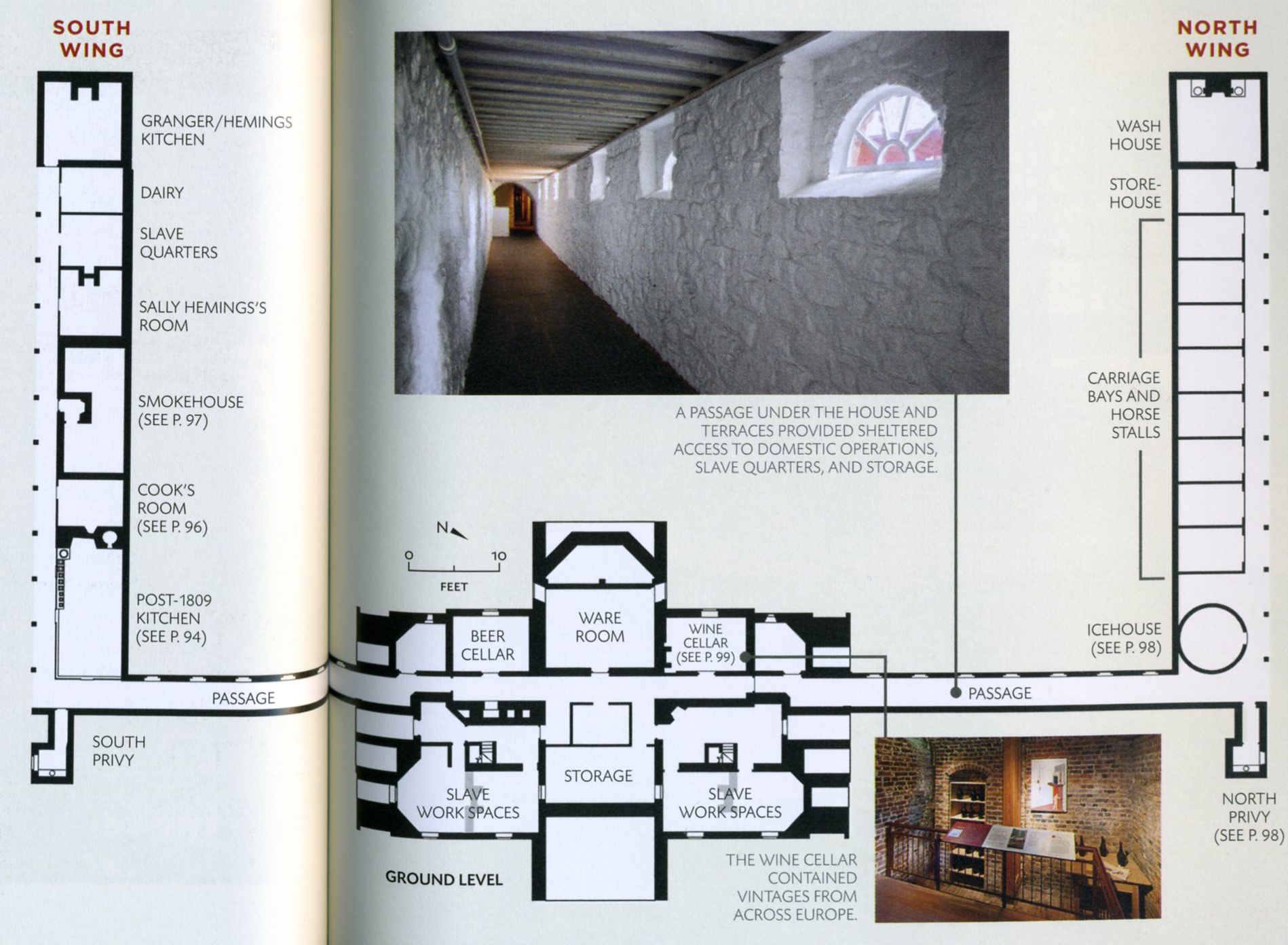
The overall house design of the Monticello Mansion; (House plans were taken from “Monticello: The Official Guide to Thomas Jefferson’s World”, Miller 2016).
Imaged above, our day-tour only took us through the first floor and the ground-level. Unfortunately, I was unable to get any photos from the second and third level. That might require an additional tour for another day.
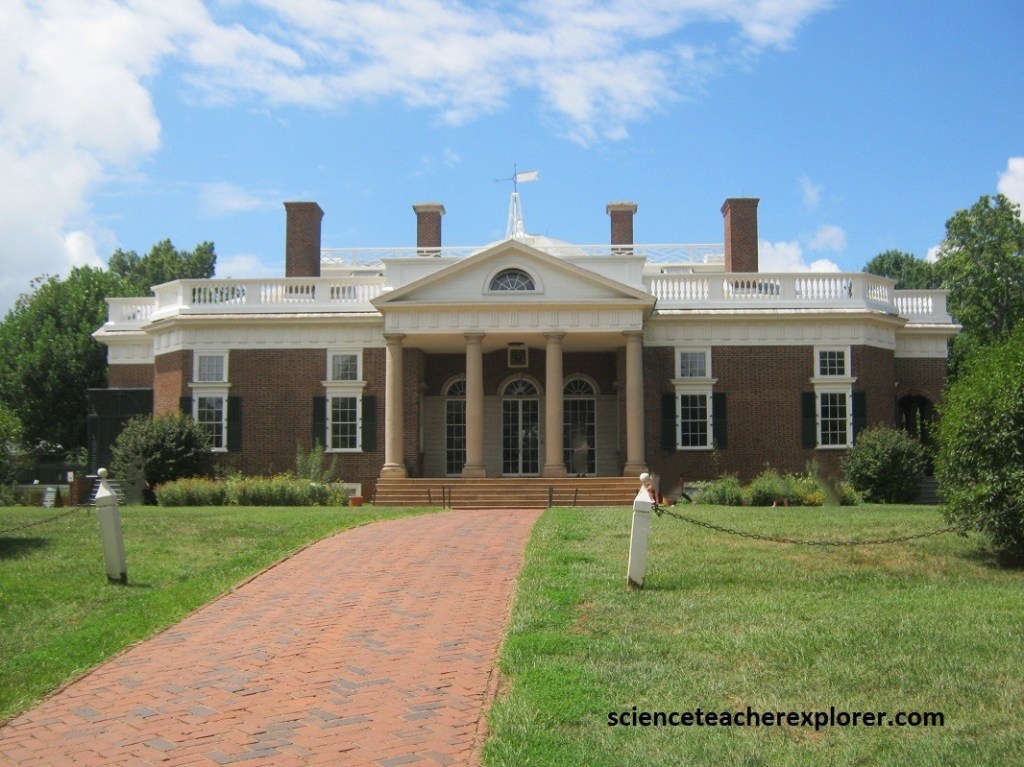
Becky & I started our tour by walking through the East Front Entrance. I noticed right away that the front entrance was a Doric architectural style with the column types. To my understanding, Thomas Jefferson started the whole new neoclassical movement in our new nation. His approach to architecture was largely influenced by Andrea Palladio. Jefferson’s architectural knowledge expanded fully during his years in France, where he marveled at the Hotel de Salm in Paris and the Maison Carree at Nimes.
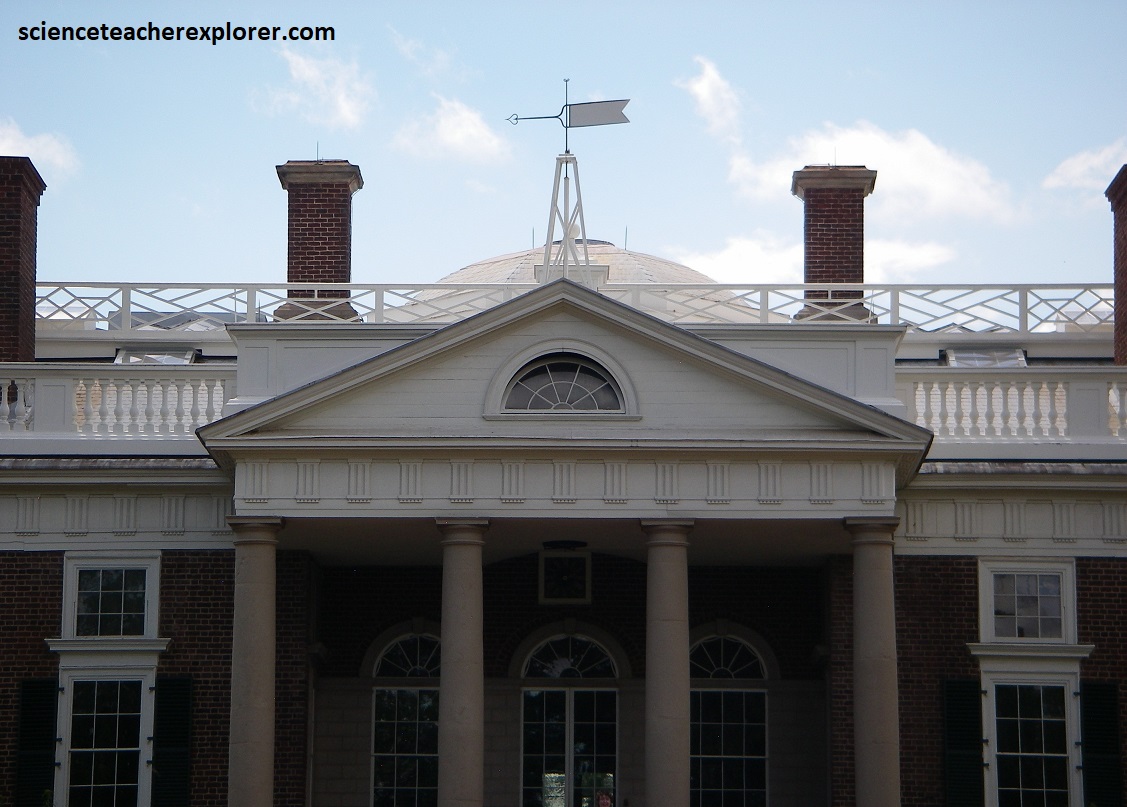
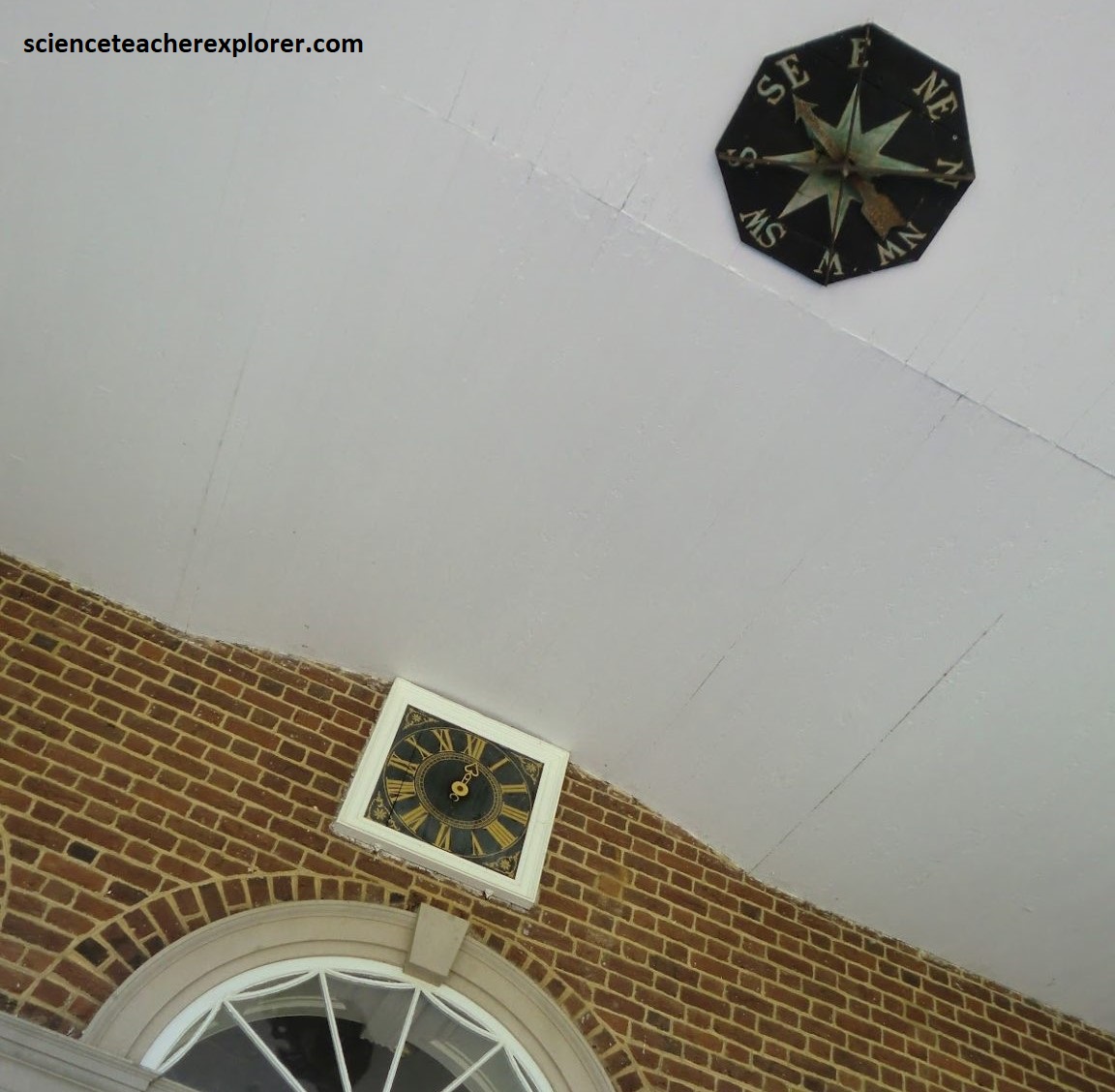
We entered the house through the Northeast Portico, passing under the weather vane and the exterior face of the Great Clock, (pictured above), and into the entrance area, which Jefferson referred to as the Hall. Pictured above, the arrow on this compass on the Northeast Portico’s ceiling is connected to the weather vane on the roof directly above. For Jefferson, weather was a lifelong passion. He recorded detailed observations of temperature and precipitation and despite inadequate measuring devices, attempted to collect data on humidity and wind speed. Jefferson has been claimed by the national Weather Service as the “father of weather observers”. {Note: to signal each hour on the Great Clock, Jefferson’s workmen installed a 22 inch diameter Chinese-made gong on the roof, (next to the weather vane), so it could be heard all over the farm}.
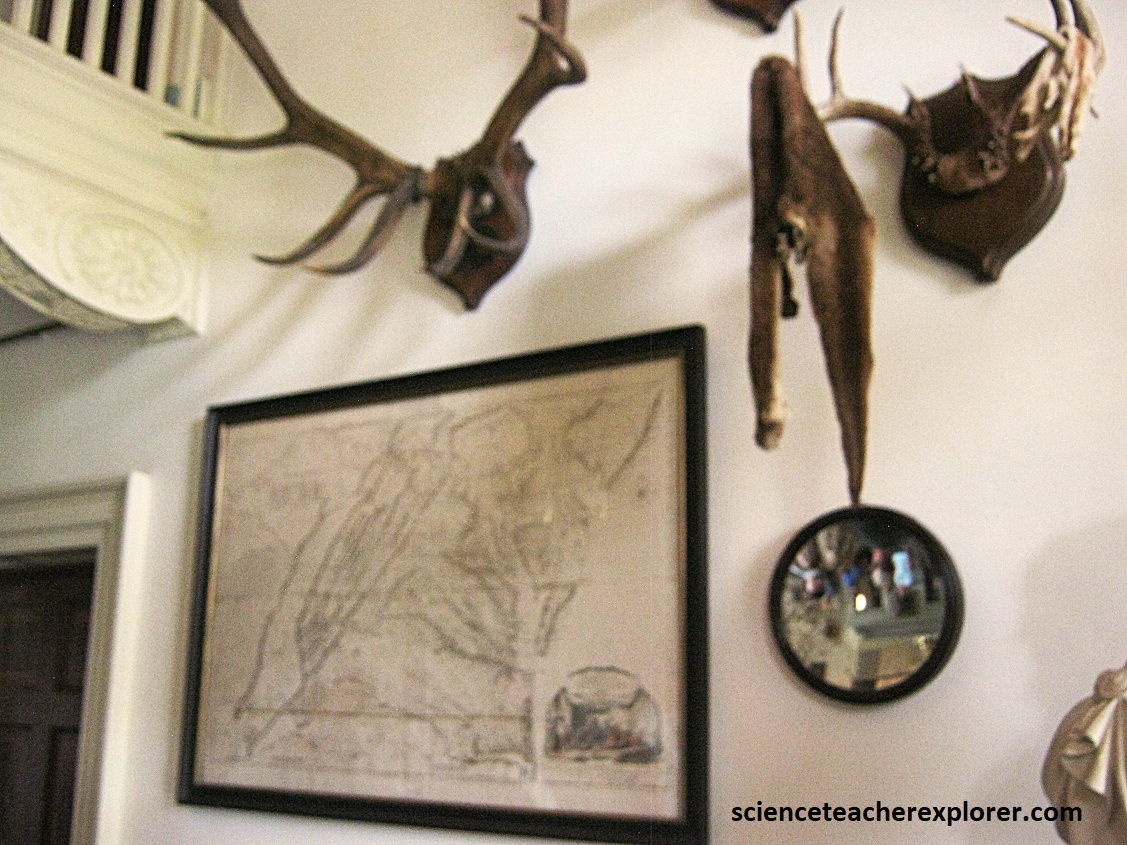
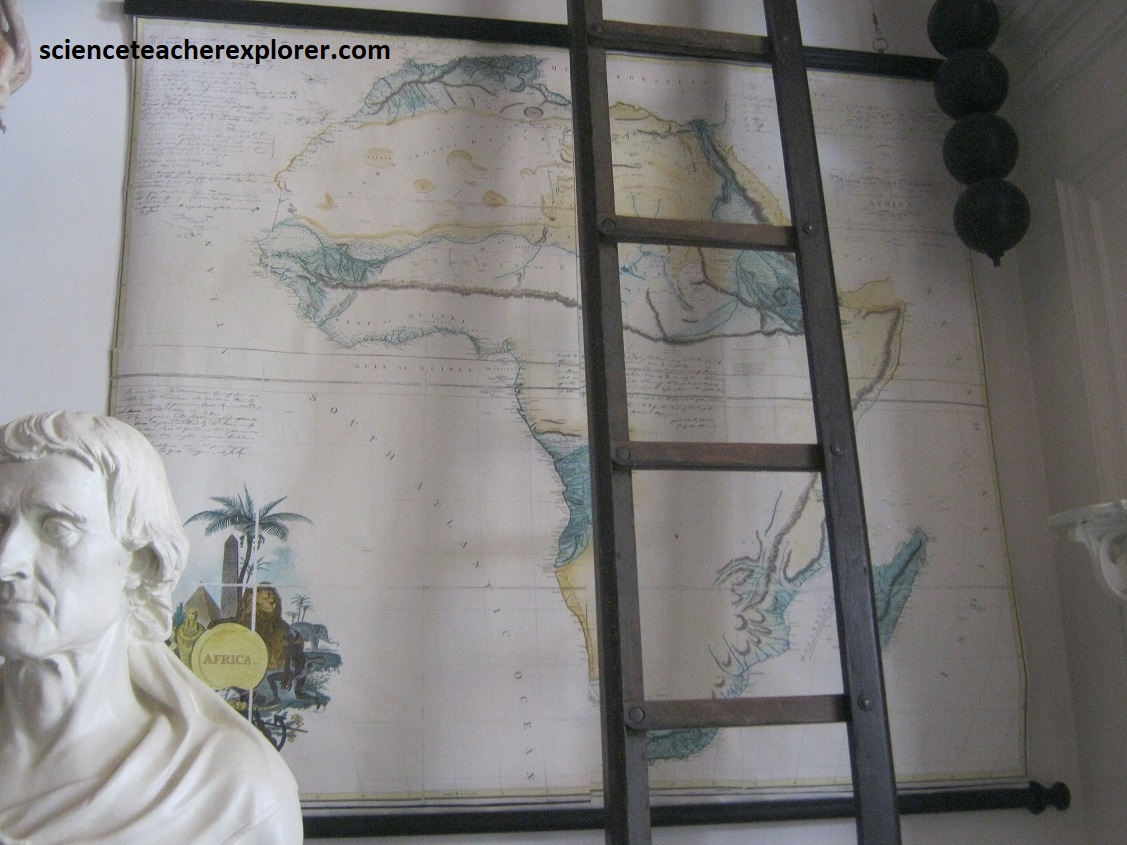
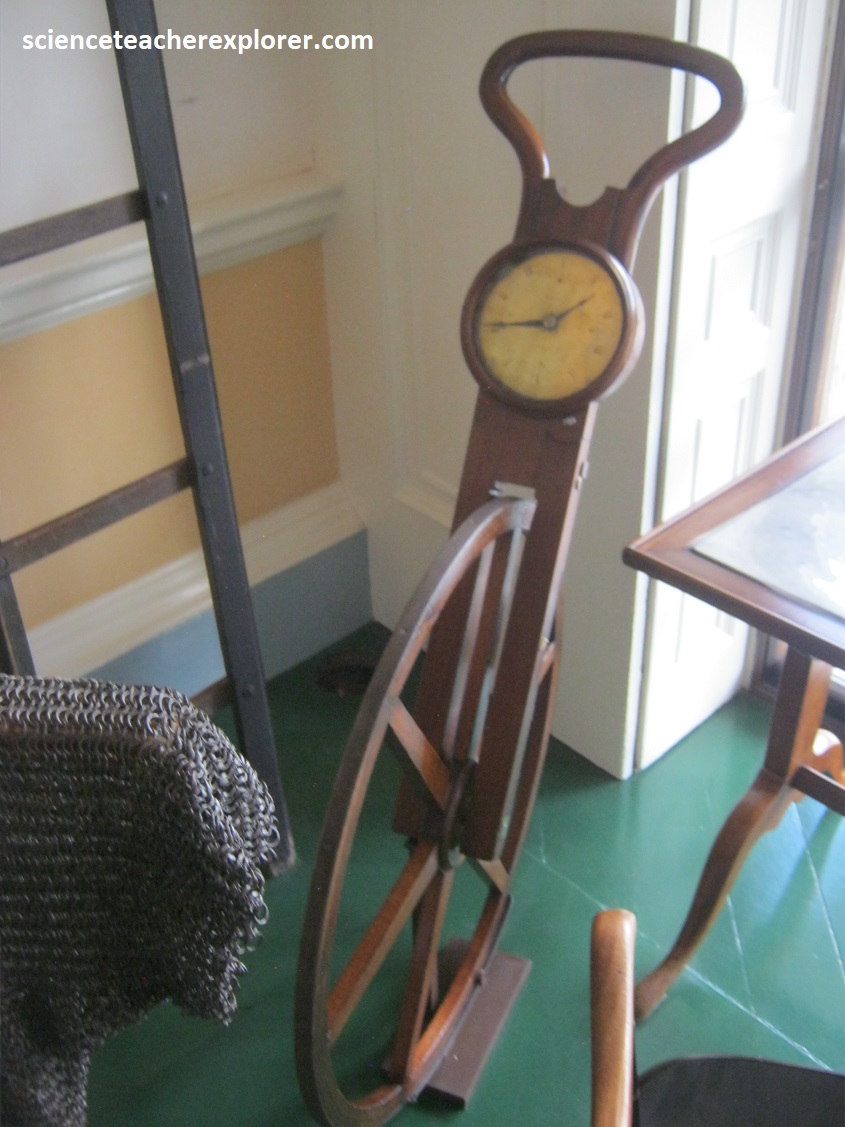
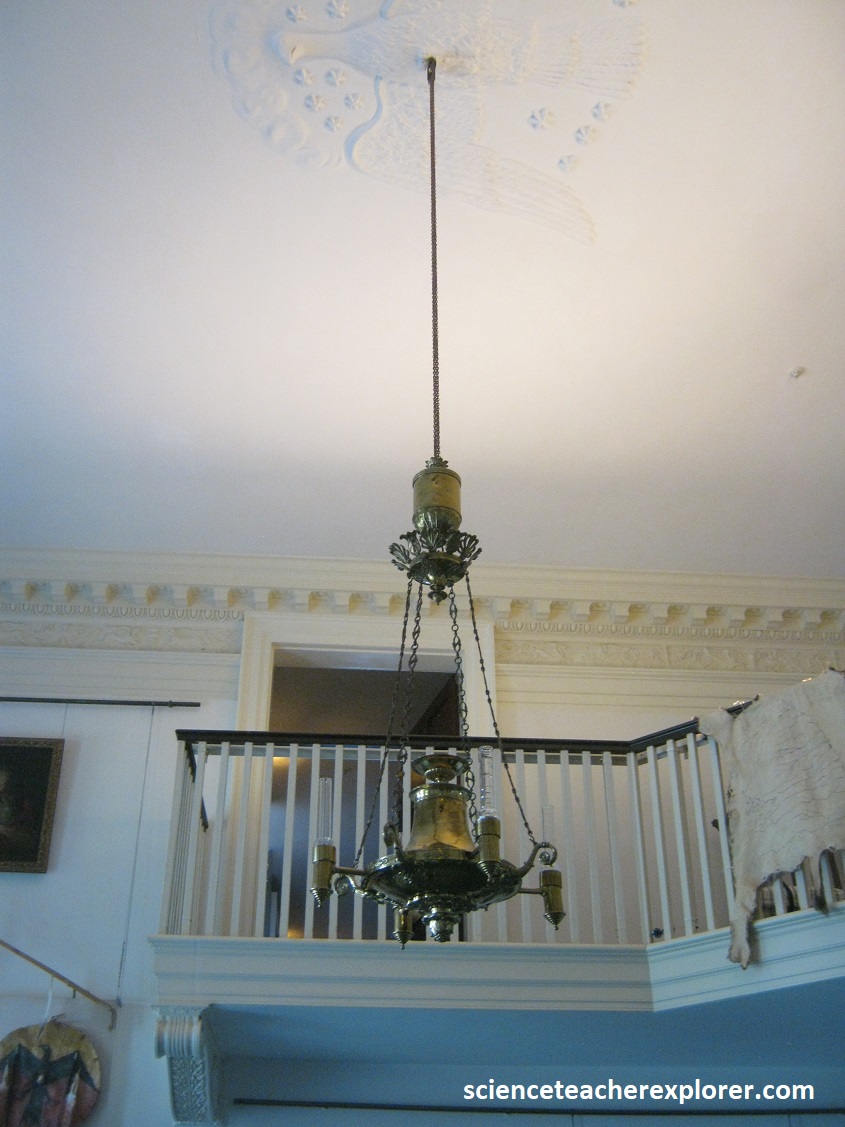
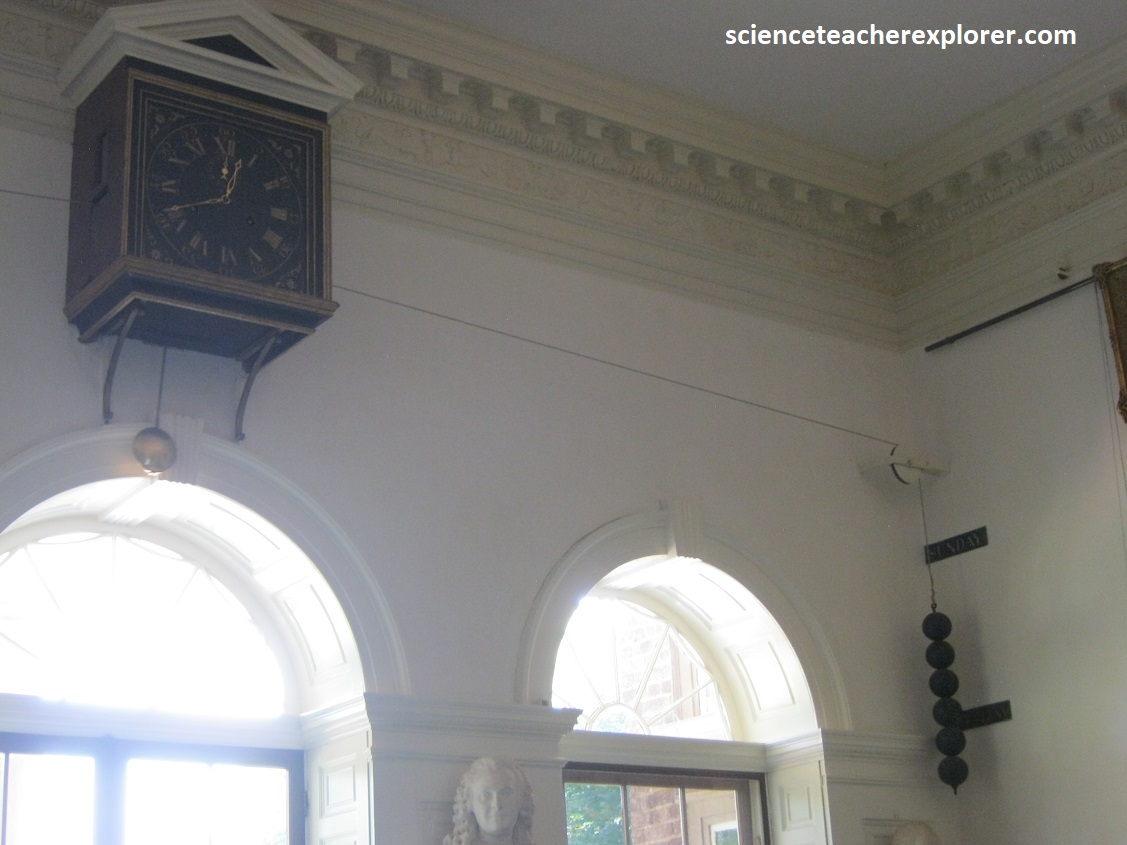
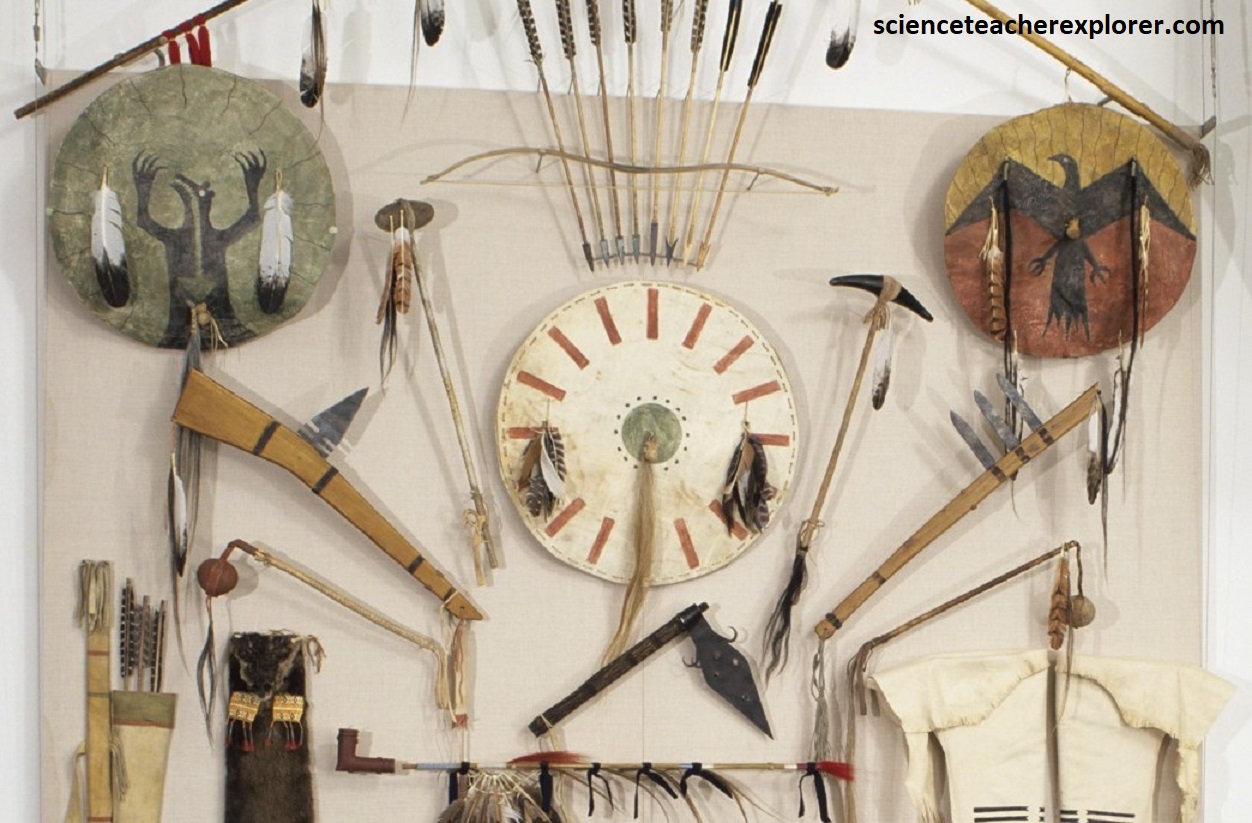
As Becky and I entered the “Hall” for the Monticello Mansion, we discovered that Jefferson created a two-story museum with a distinctly American focus. This was Jefferson’s waiting room before being received by their host. Pictured above, maps, paintings, busts of French philosophers & Alexander Hamilton, and natural historical specimens conveyed his interest. Antlers, including those of deer, elk and American bighorn sheep, as well as mastodon fossils found in Kentucky, were displayed as examples of the New World’s indigenous wildlife, (note that the elk antlers were sent to Jefferson by Lewis and Clark in 1805). Native American “tokens of friendship”, were sent back from the Lewis and Clark expedition to the Northwest. Above the door was the inside version of the Great Clock displaying the time of day. However, Jefferson’s ingenious clock also indicated the day of the week as its weights descended on ropes past markers on the wall. When Jefferson discovered that Monticello’s ceiling was not tall enough for the clock, (18.5 feet), rather than recalibrate it, his workmen cut a hole in the floor to allow the weights to descend all the way to the Saturday marker in the basement. {Also note the “Waywiser”, pictured above on the right, which was used for marking off acreage in the day}.
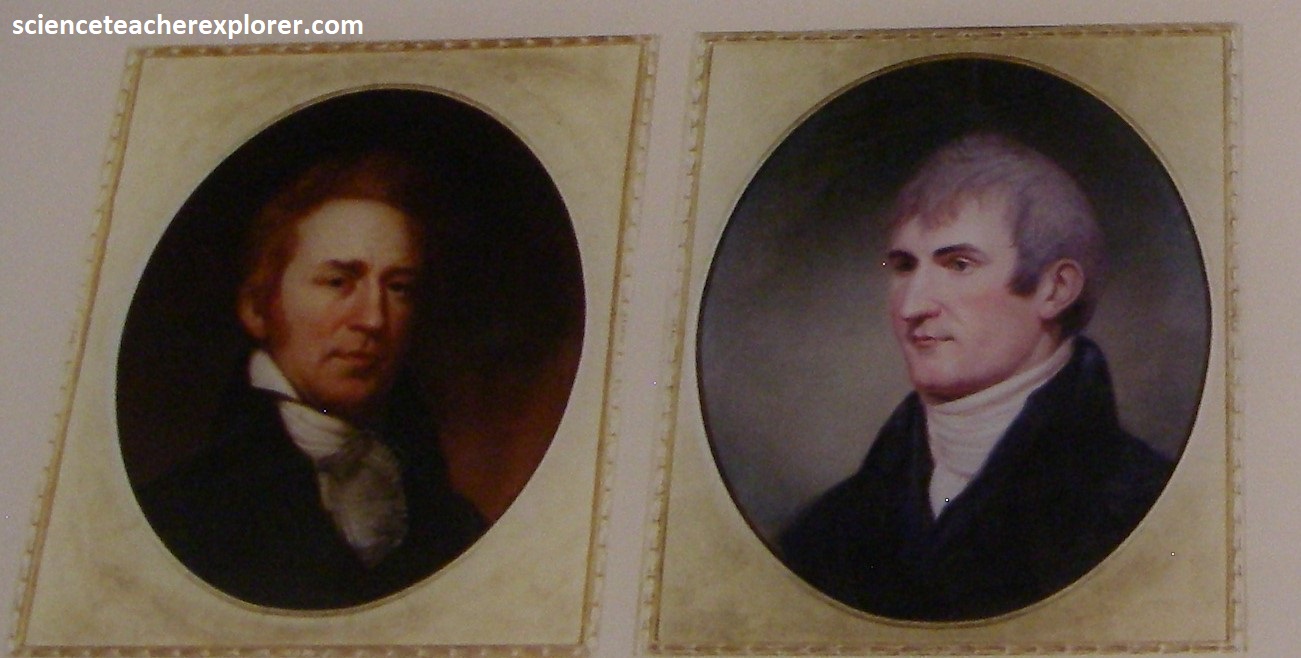
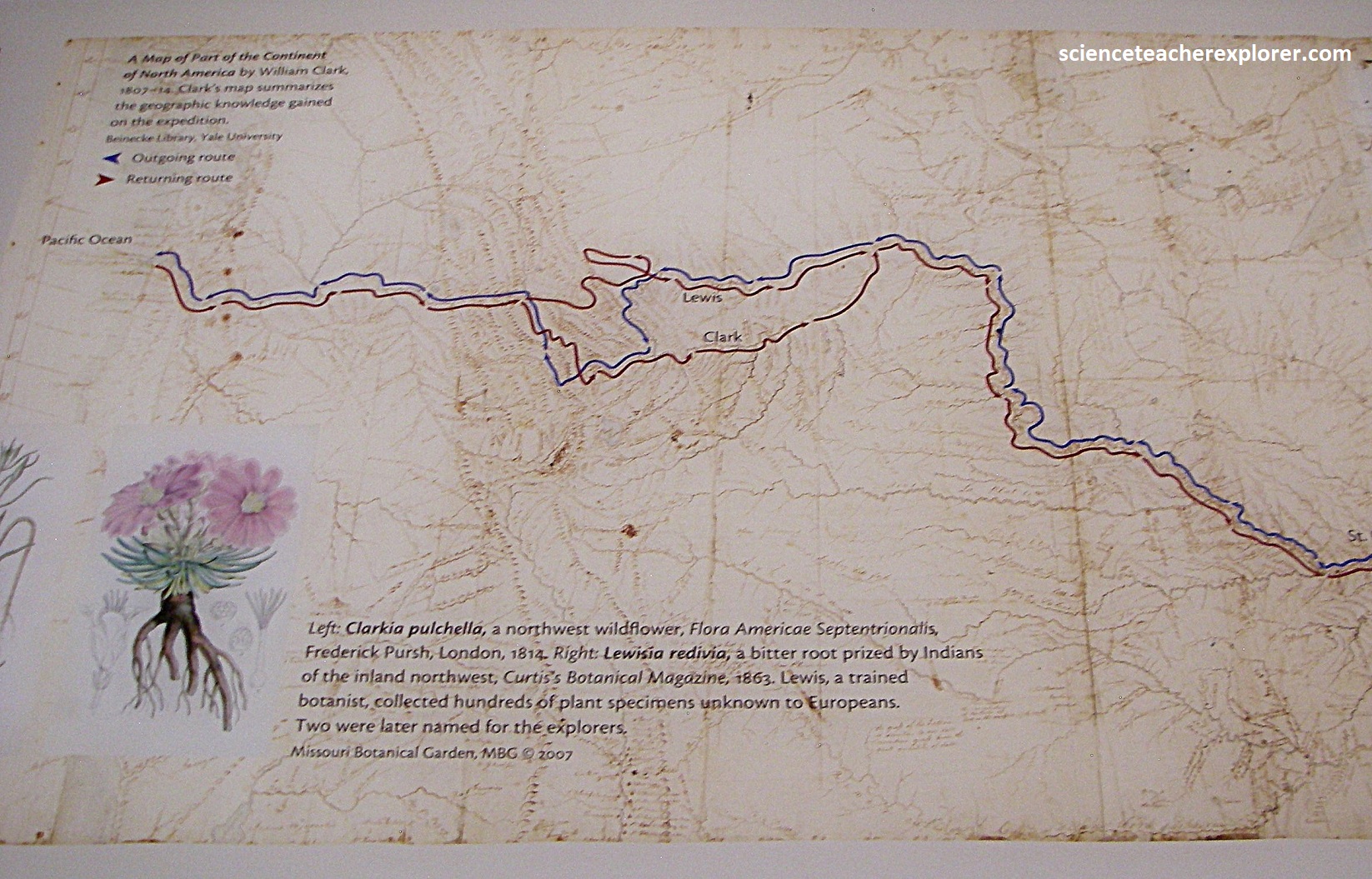
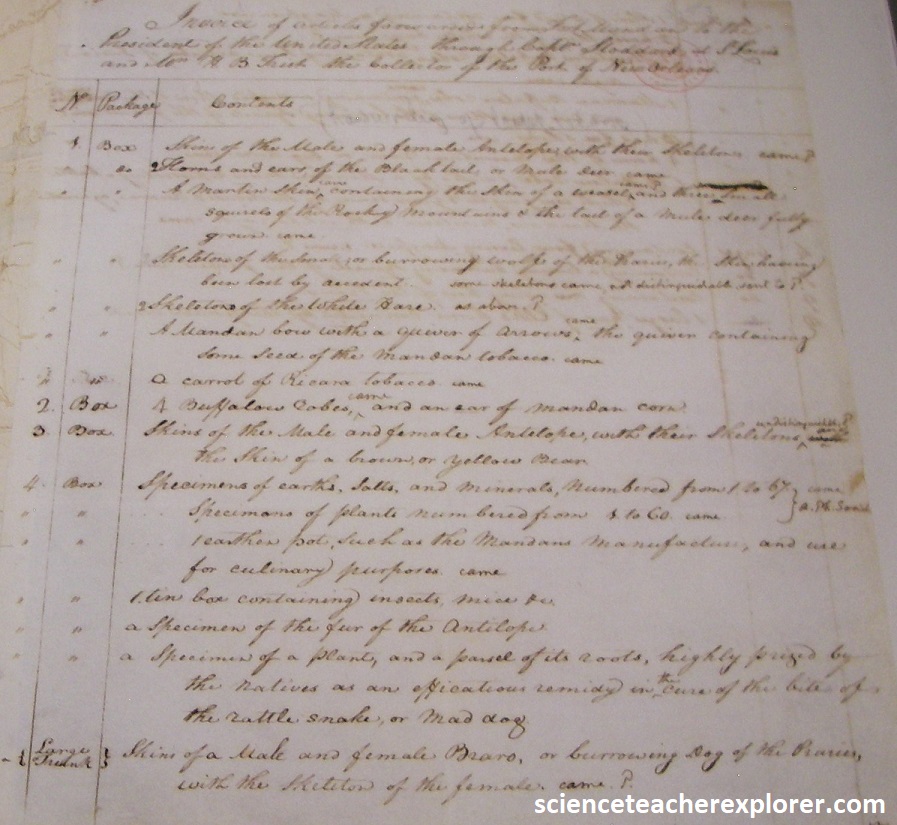
In 1790, Jefferson joined Washington’s Cabinet as secretary of state, an appointment marked by his opposition to the pro-British policies of Alexander Hamilton, who was secretary of the treasury. Six years later, he lost his first bid for the presidency to John Adams, falling short by 3 electoral votes. He served instead as vice president. Four years later, he defeated Adams to become the nation’s 3rd president. Jefferson’s most notable achievements in office were the launching of the Lewis and Clark expedition to explore the American West and the purchase of the Louisiana Territory in 1803, which doubled the territory of the United States. Pictured above, William Clark on the left and Meriwether Lewis were trained to record the geography, the lives and cultures of native people, and details of soil, plants, animals, minerals, fossils, and climate of the continent. Their findings took 8 years to be published, which Jefferson regretted. Pictured above is Clark’s map that summarizes the geographic knowledge gained on the expedition from 1807-14. Also pictured above are Jefferson notes of items sent & received from the expedition. {Note: these photos were taken from an interpretive sign on-site}.
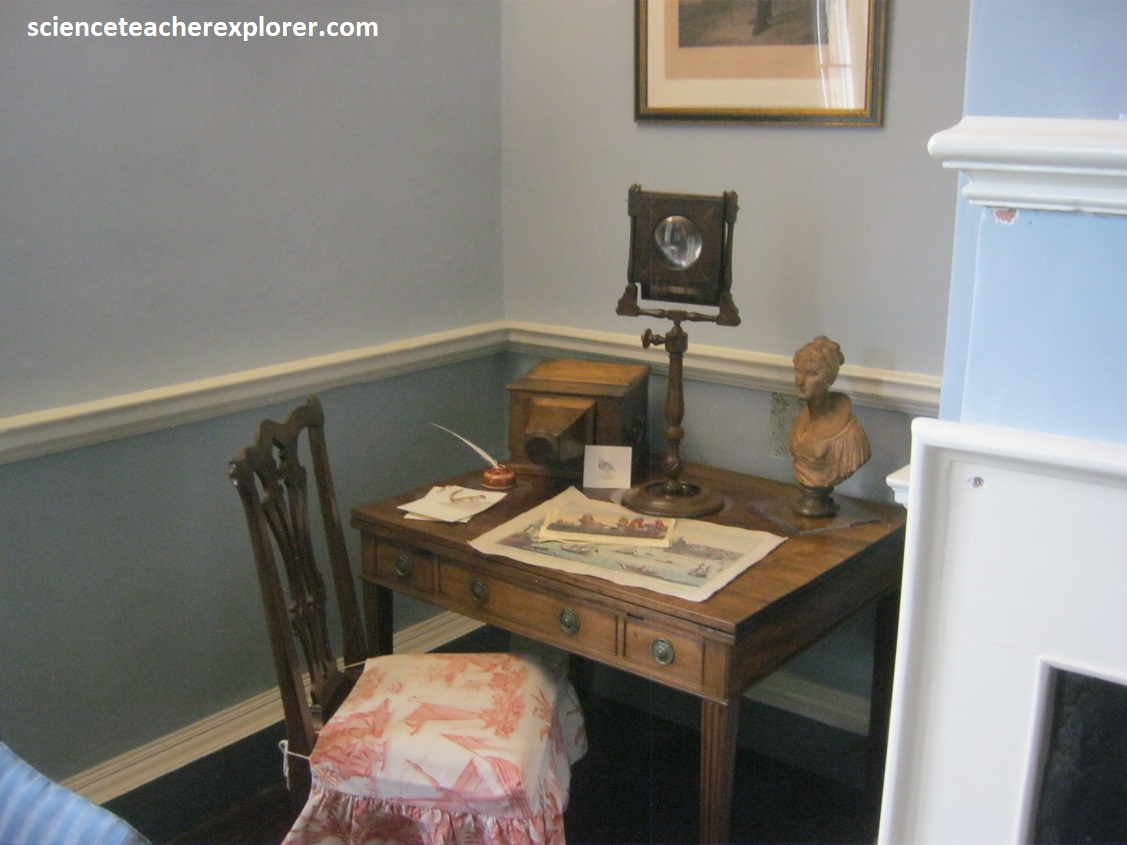
Our next room to explore was the “Family Sitting Room”. Originally part of Jefferson’s private suite and called the Book Room, it became a family sitting room only after the sale of his books to Congress. Marth Jefferson Randolph, Jefferson’s oldest daughter, regularly used it as a classroom when teaching her children. Jefferson modified the room’s fireplace to radiate heat from burning wood rather than coal, making it one of the easiest rooms in the house to keep warm.
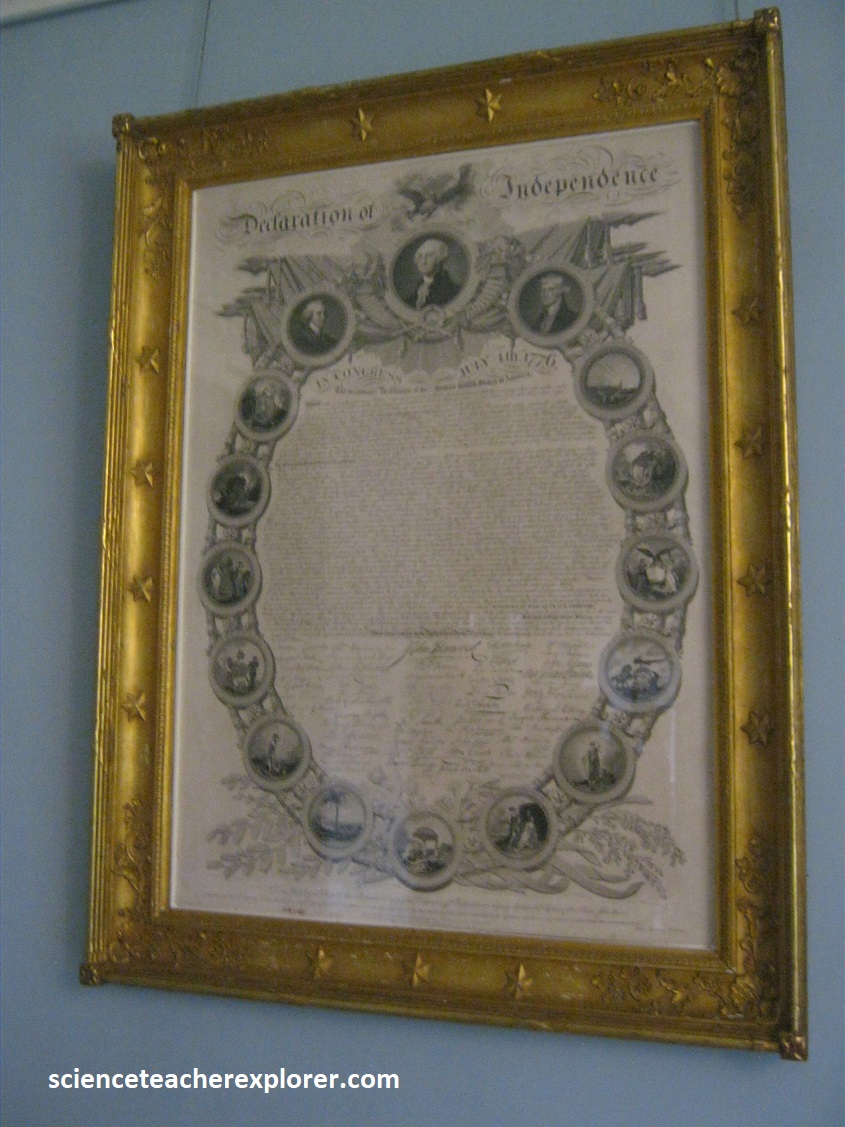
Hostilities between Great Britain and the American colonies ad begun in 1775, when Jefferson was elected as a delegate from Virginia to the Second Continental Congress in Philadelphia. Impressed by the eloquence of his previous writings, the Congress asked Jefferson in 1776 to draft the Declaration of Independence, in which he proclaimed that all men have equal rights, regardless of birth, wealth, or status, and that the government is the servant, not the master, of the people, (pictured above on right as a wall-hanging). Pictured on the upper left is the mahogany lap desk, (reproduction), on which he wrote the declaration was of Jefferson’s own design, built by Philadelphia cabinetmaker Benjamin Randolph.
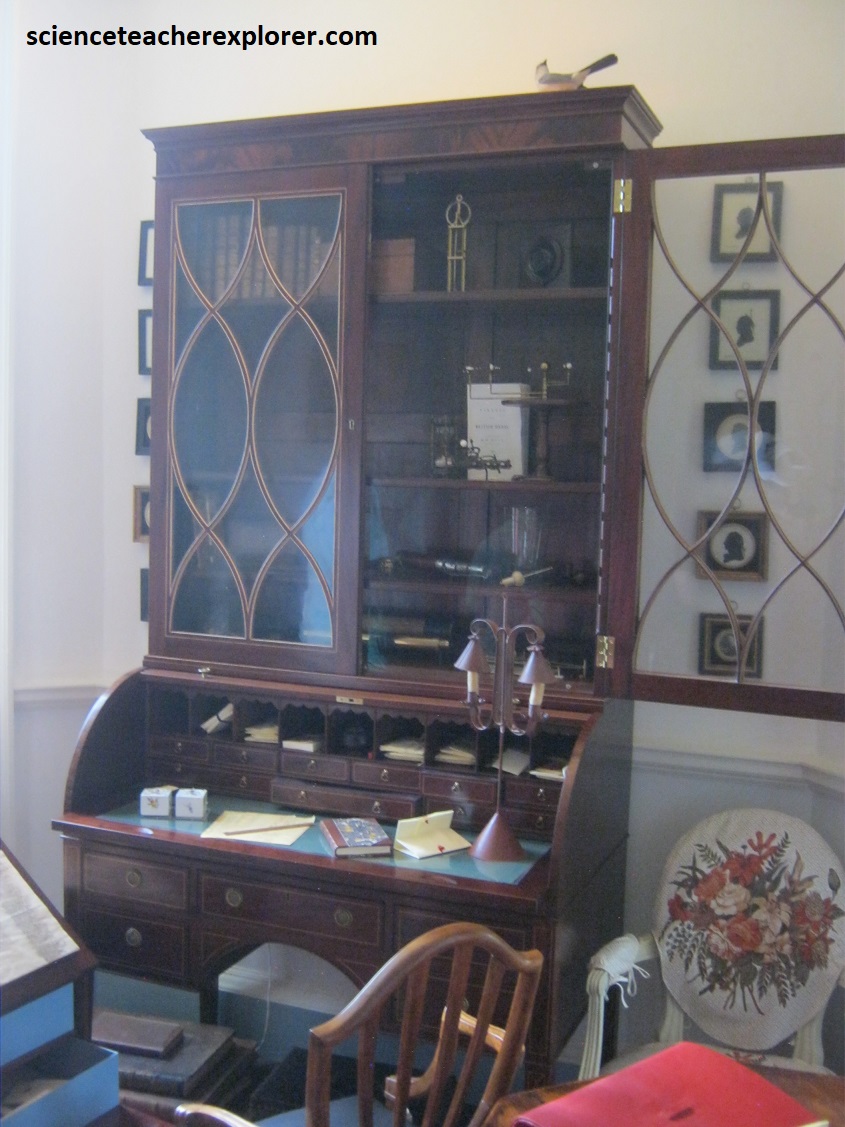
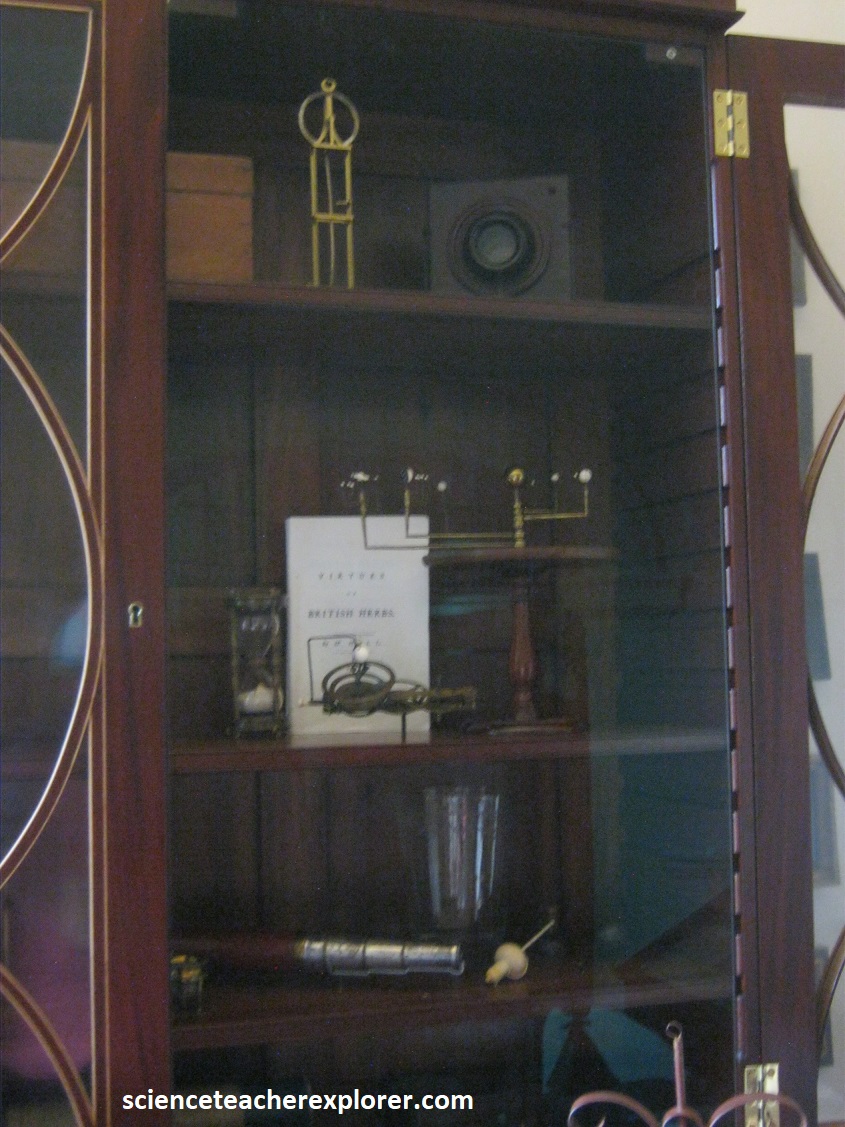
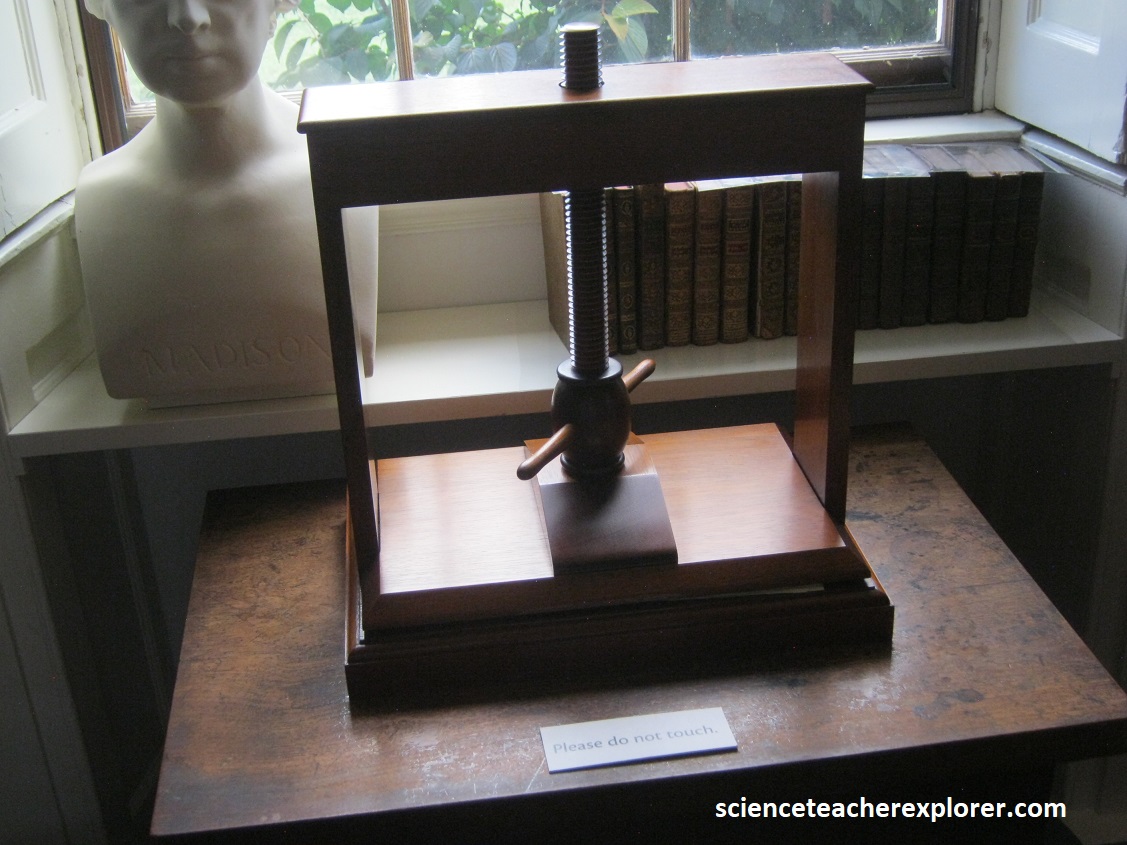
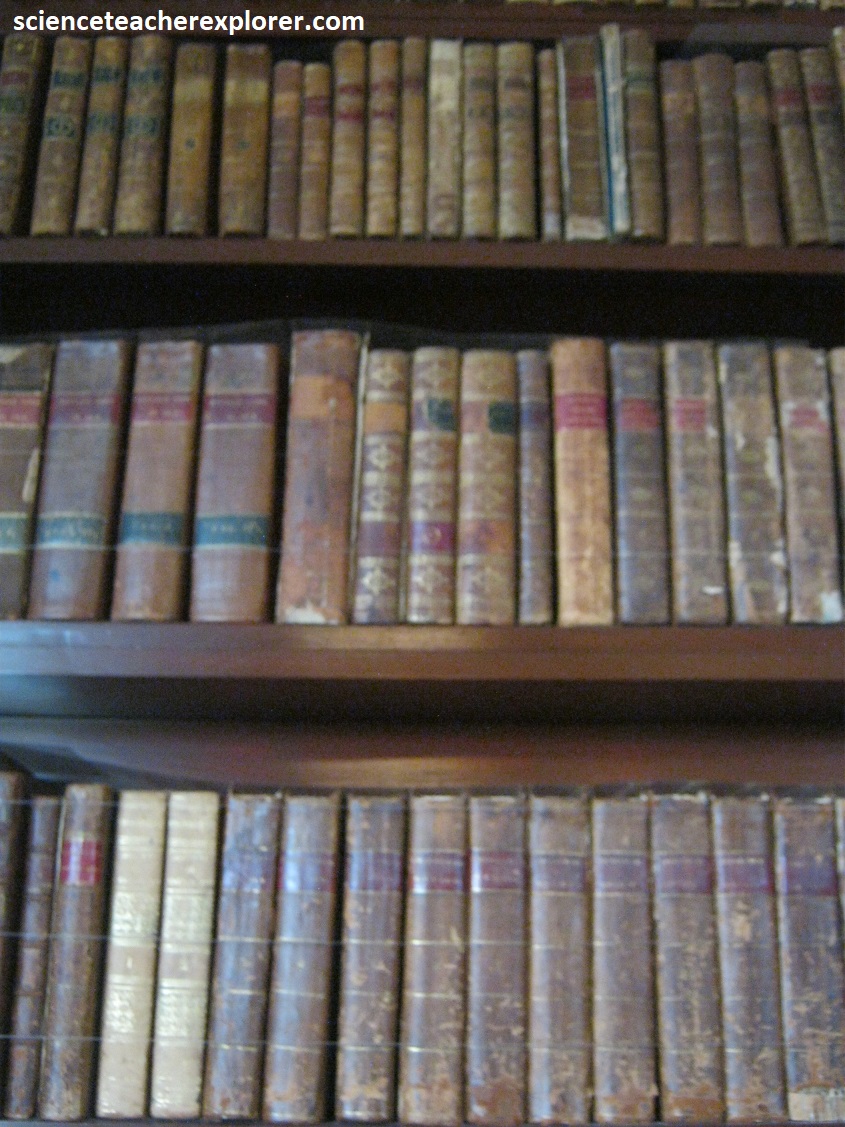
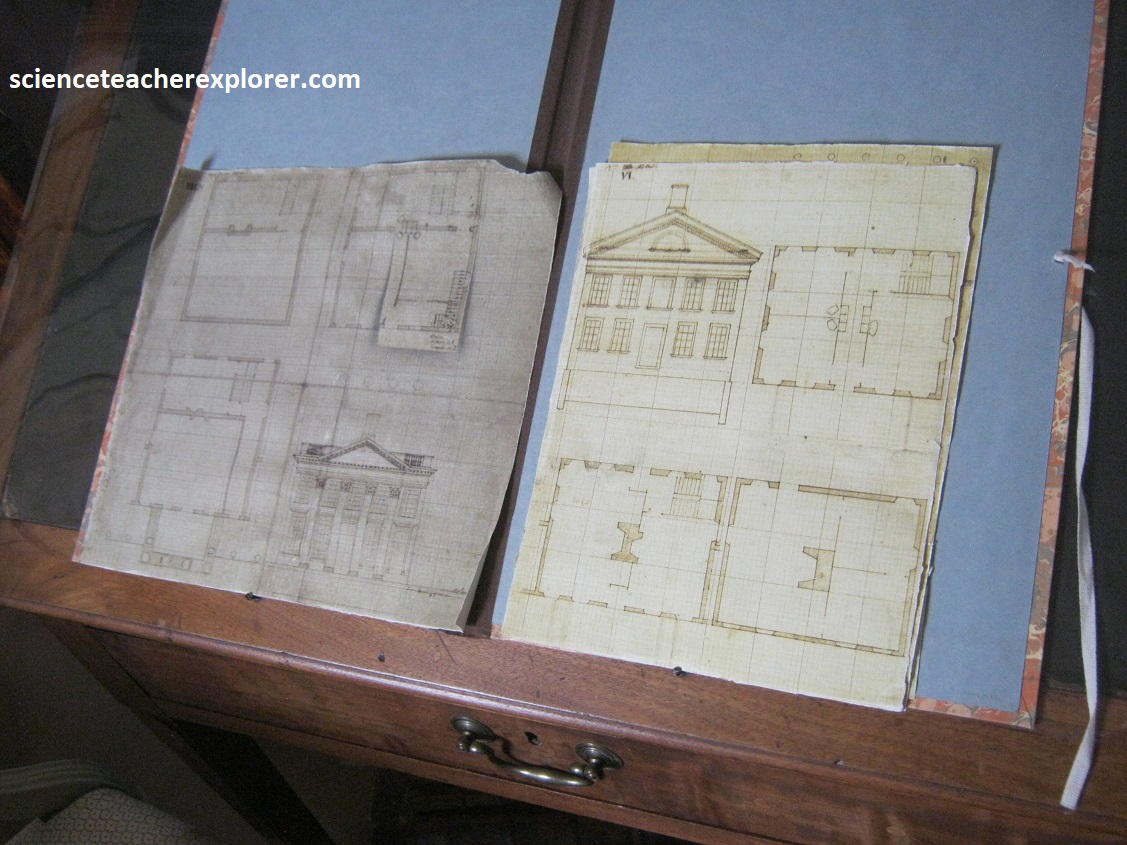
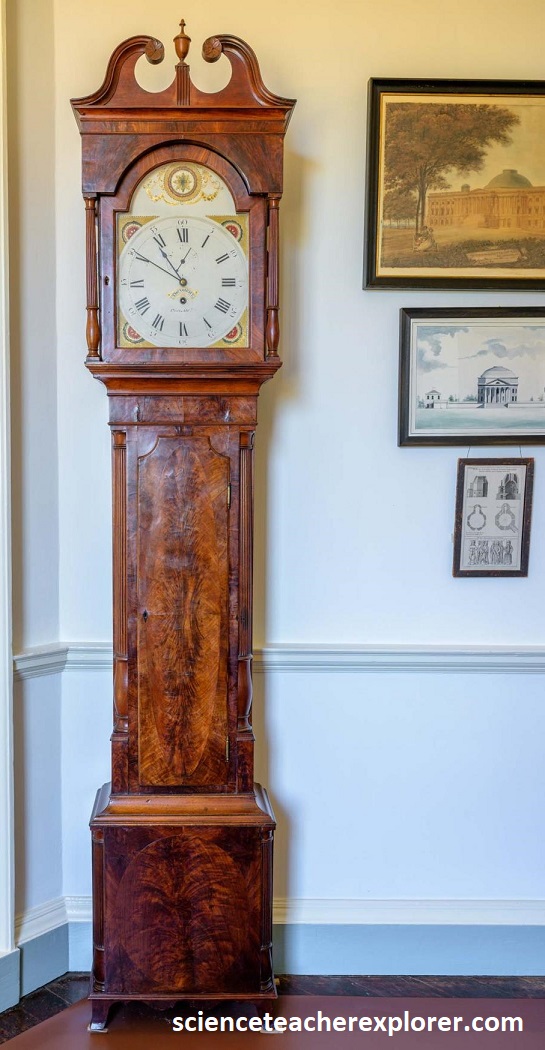
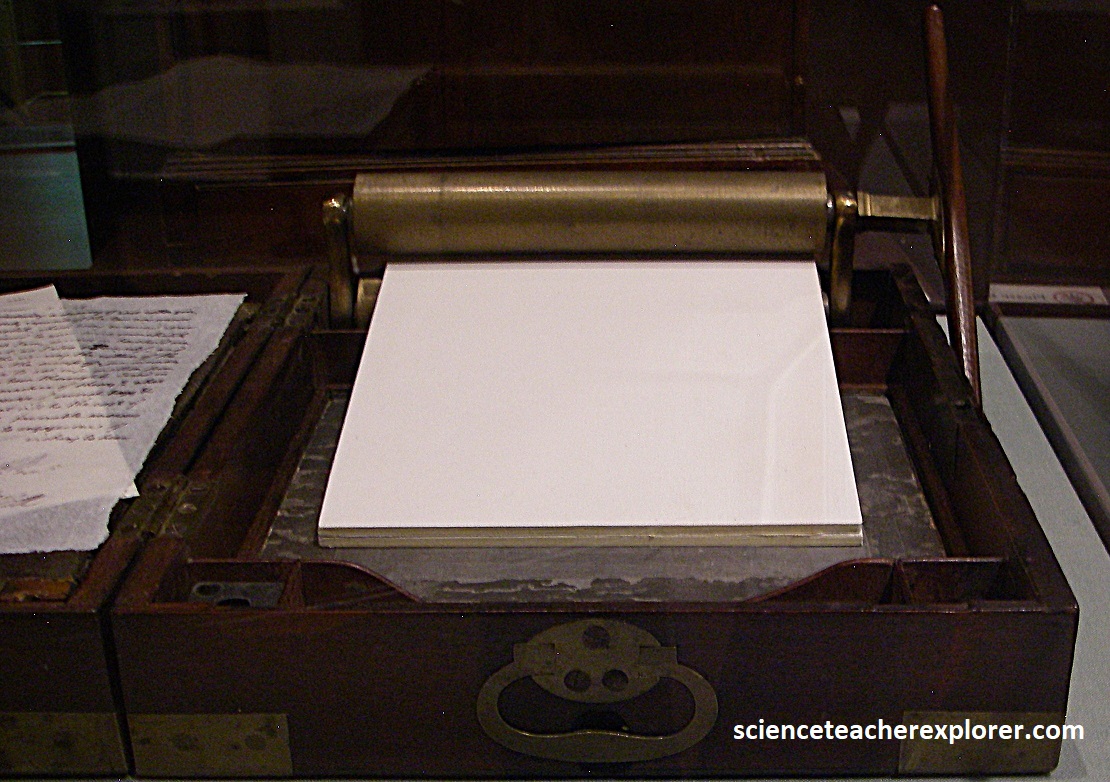
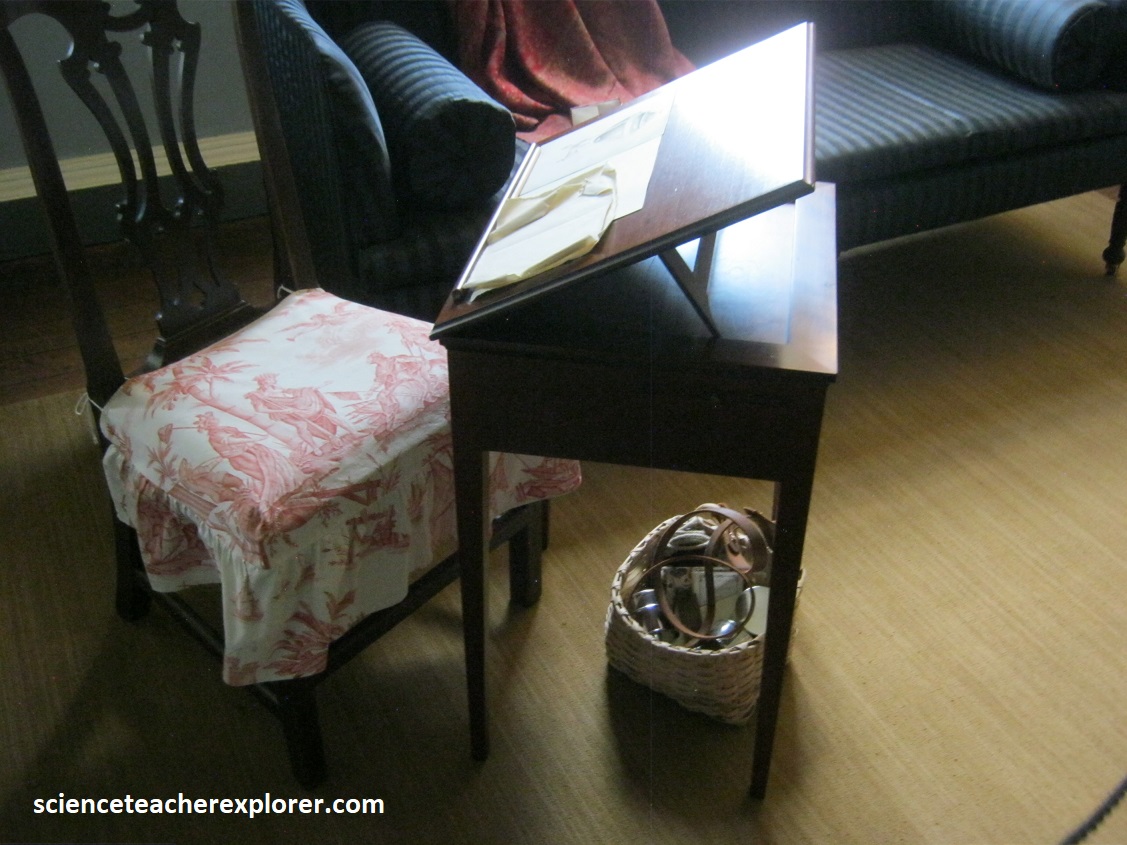
Next door was the “Library”. In 1814, just after the British burned the U.S. Capitol and the nation’s fledgling library, Jefferson “ceded” his collection to Congress as a replacement. Covering a wide variety of subjects, his books became the nucleus of the Library of Congress. Jefferson began a new library to enjoy during retirement, amassing some 2,000 favorite books. Pictured above on the middle-right, the library was also where Jefferson drew his plans for the University of Virginia on the adjustable table, (ideally suited for drafting). Pictured above, in the lower left, is the Astronomical Clock that the 1811 solar eclipse inspired Jefferson to hire the renown clock-maker and engineer, Thomas Voight, to make for astronomical observations. It has no striking mechanism and operates with a single weight with day marking labels affixed in Jefferson’s handwriting on the inside of the clock case corresponding to the position of the descending weight. Additionally, a Screw Press was in the room for flattening tightly folded letters, (pictured above in the center left). Pictured on the lower right, is a filing press made of cherry, walnut, and pine. Jefferson’s dedication to preserving information extended to his own papers.
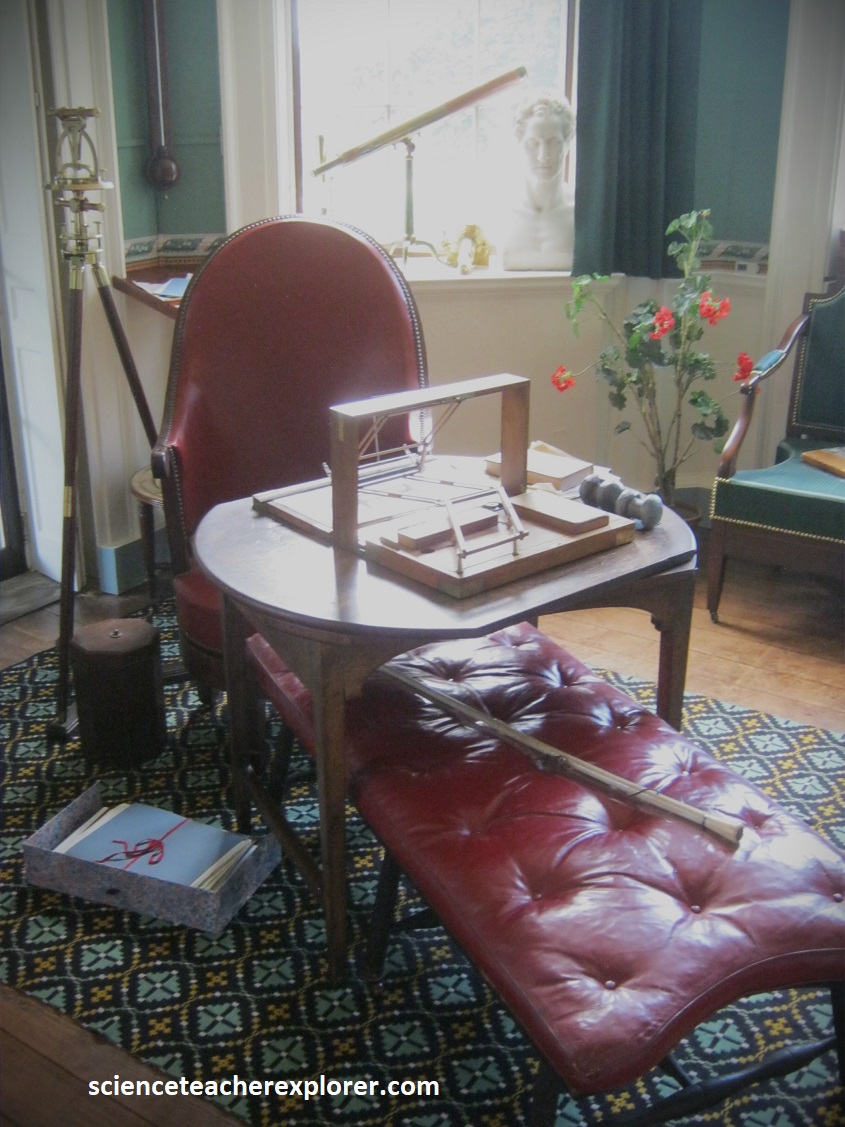
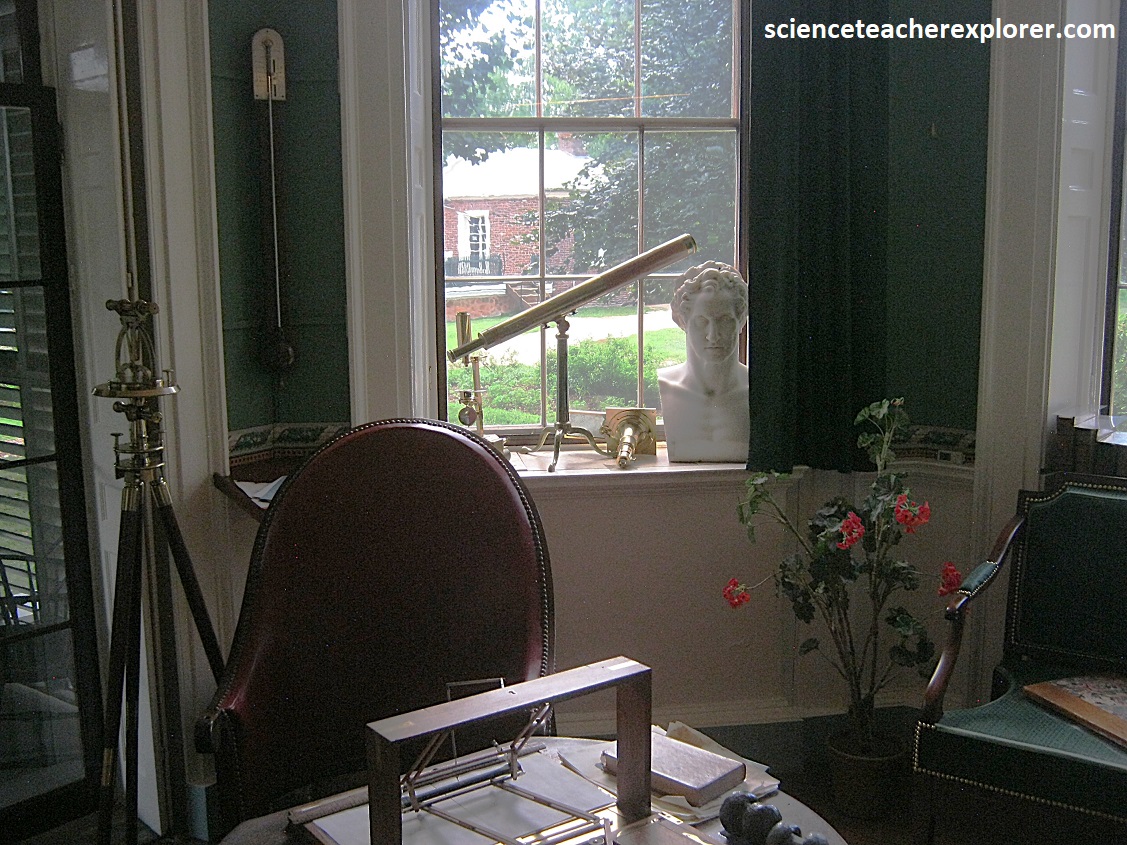
The next room to explore was the “Cabinet”, Jefferson’s office space. It was the nucleus of his intellectual and scientific world. Nestled in the heart of his “sanctum sanctorum”, between the “Library” and his “Bed Chamber”, the “Cabinet” is where he kept up with his extensive correspondence and made detailed notes about the plantation in his “Farm Book” and “Garden Book”. Pictured above, I immediately noticed that Jefferson’s “Cabinet” is full of devices and contraptions of all kinds. Jefferson was a gadget lover. His “Cabinet” was filled with telescopes, Terrestrial & Celestial Globes, Mercury Barometer, drafting and surveying equipment (theodolite), and custom-made furniture such as his revolving stand and desk with adjustable top, (pictured above on the left). On the table, the polygraph is a two-pen copying machine that create duplicates of some of the roughly 19,000 letters Jefferson wrote. Also on the table are two lead dumbbells that Jefferson used to rehabilitate his wrists. The revolving table was created by John Hemmings in the Joinery. The upper cherry section revolves on a wrought iron bolt embedded on a stationary lower walnut section. The pictured red sofa was enjoyed daily by Jefferson during nap-time. Additionally, notice the John Adams Bust in the right photo below, while looking through the alcove into the “Cabinet”.
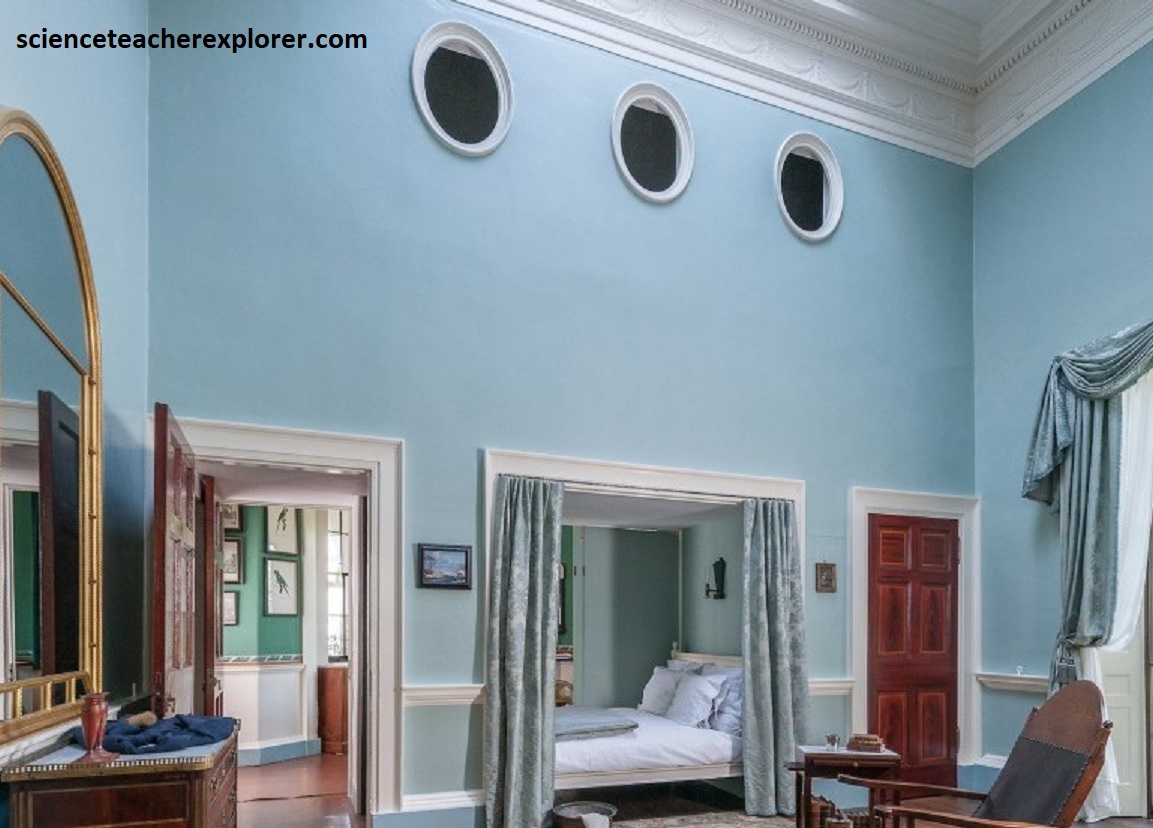
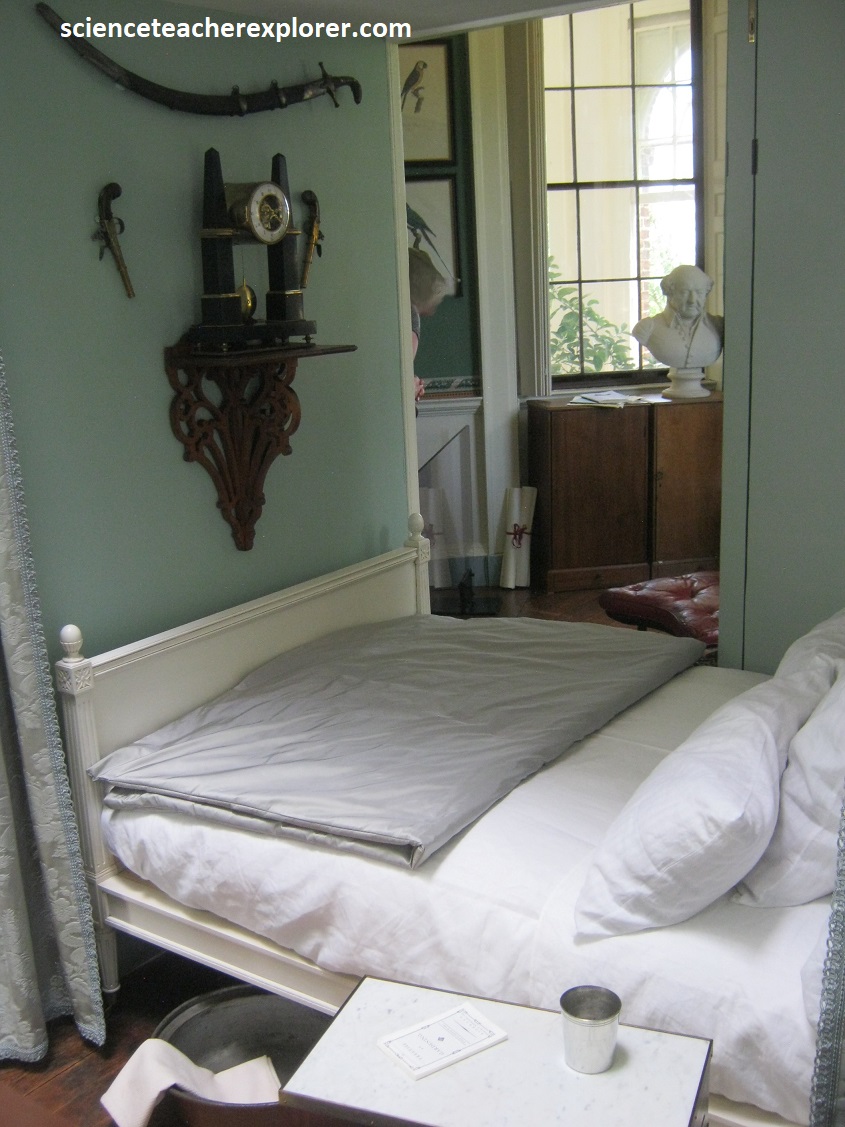
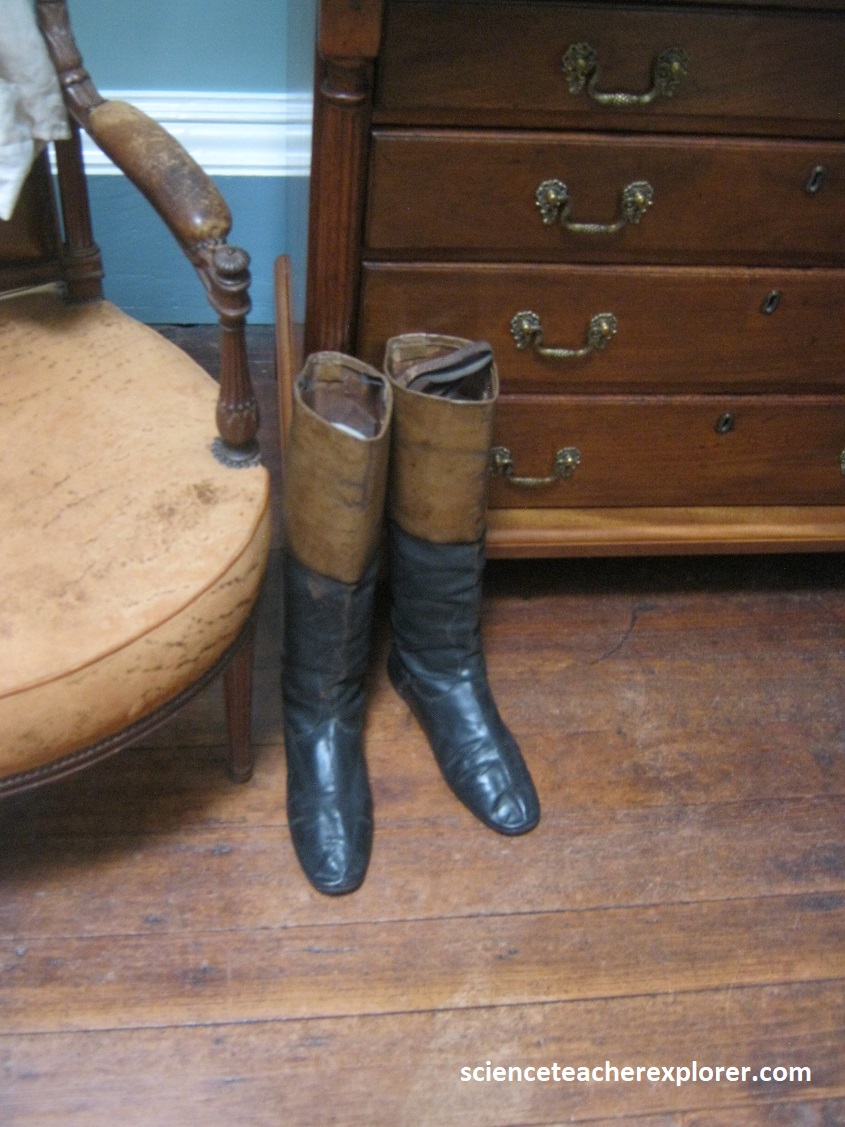
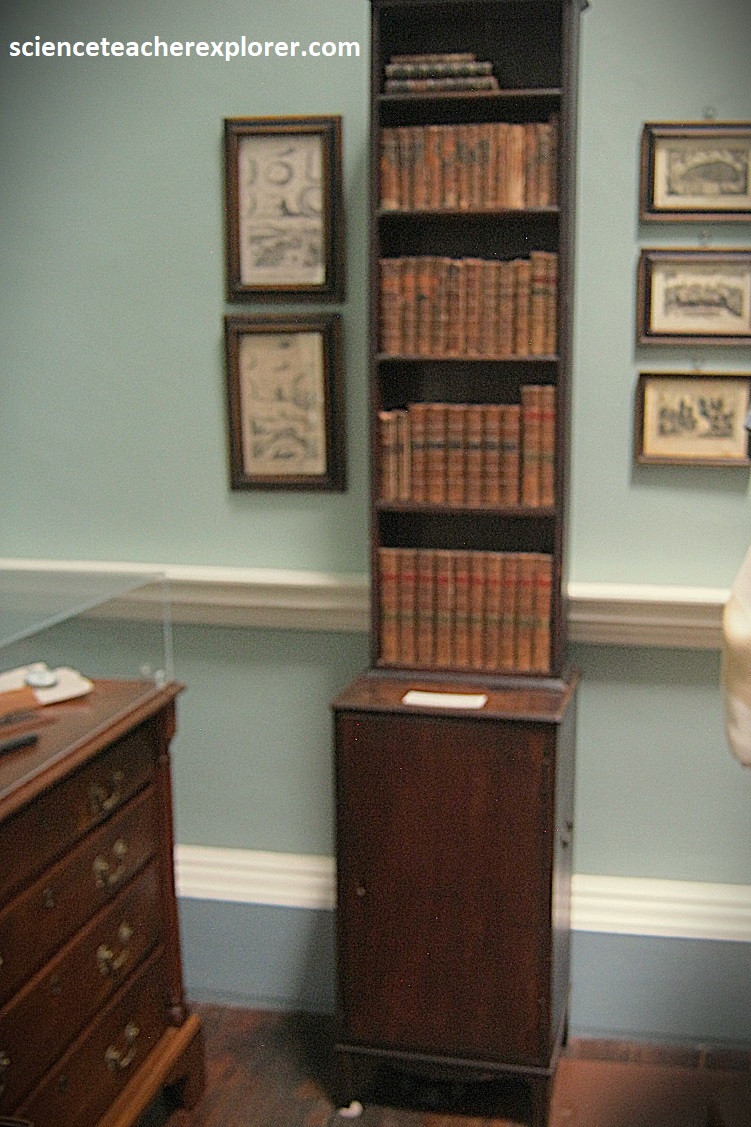
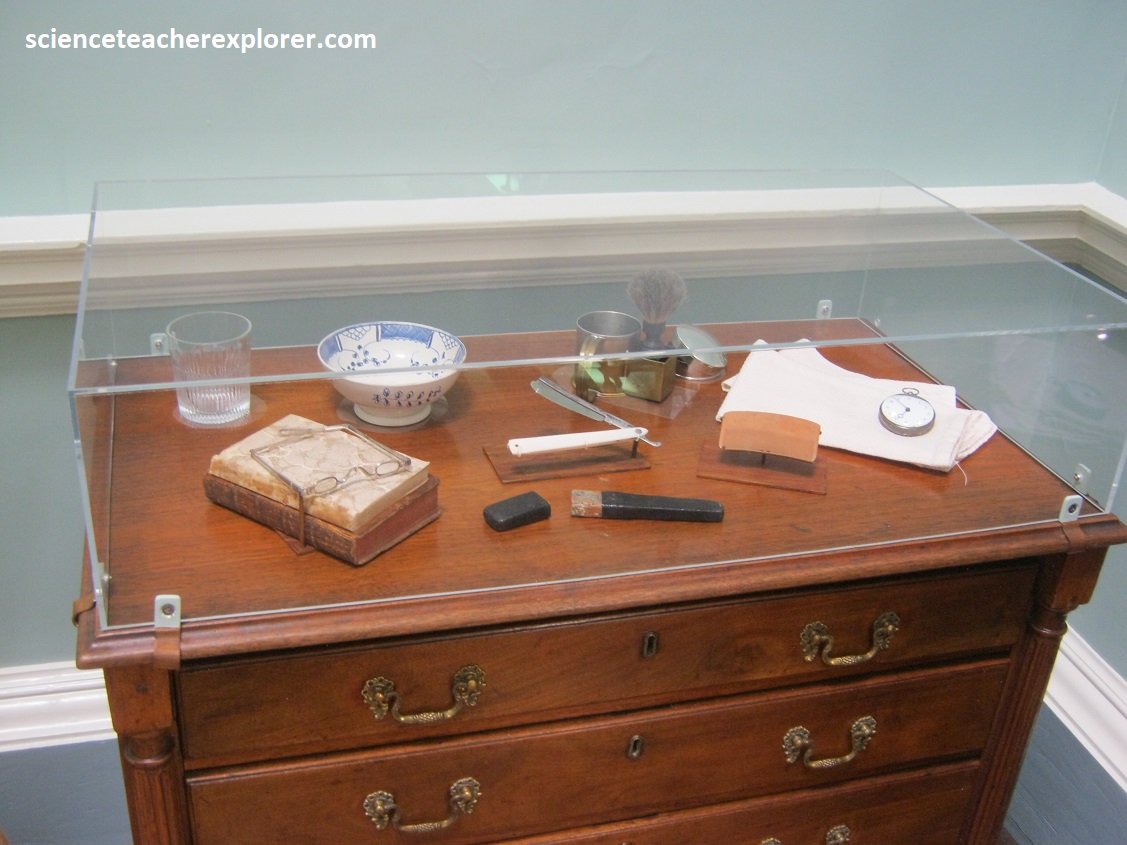
Jefferson’s bed chamber is joined with the “Cabinet” by an alcove bed with a hinged, double-door folding screen. This room featured a privy, an early example of indoor bathroom facilities in America, one of the house’s thirteen skylights, and a closet over the bed accessible via ladder in the privy. A Compeche Chair sits near the window with a French armchair offering comfortable sitting with his riding boots next to that. On the other side of the room is a chest of drawers owned by Martha Jefferson with personal affects on-top, (razor, reading-glasses, pocket-watch, etc.) and a humble bookcase made by himself. In the alcove is seen a candle-holder, sword, pistol and an obelisk clock that includes a pendulum, a second hand, and a chime to sound every hour and half-hour. Jefferson died in this alcove on July 4, 1826.
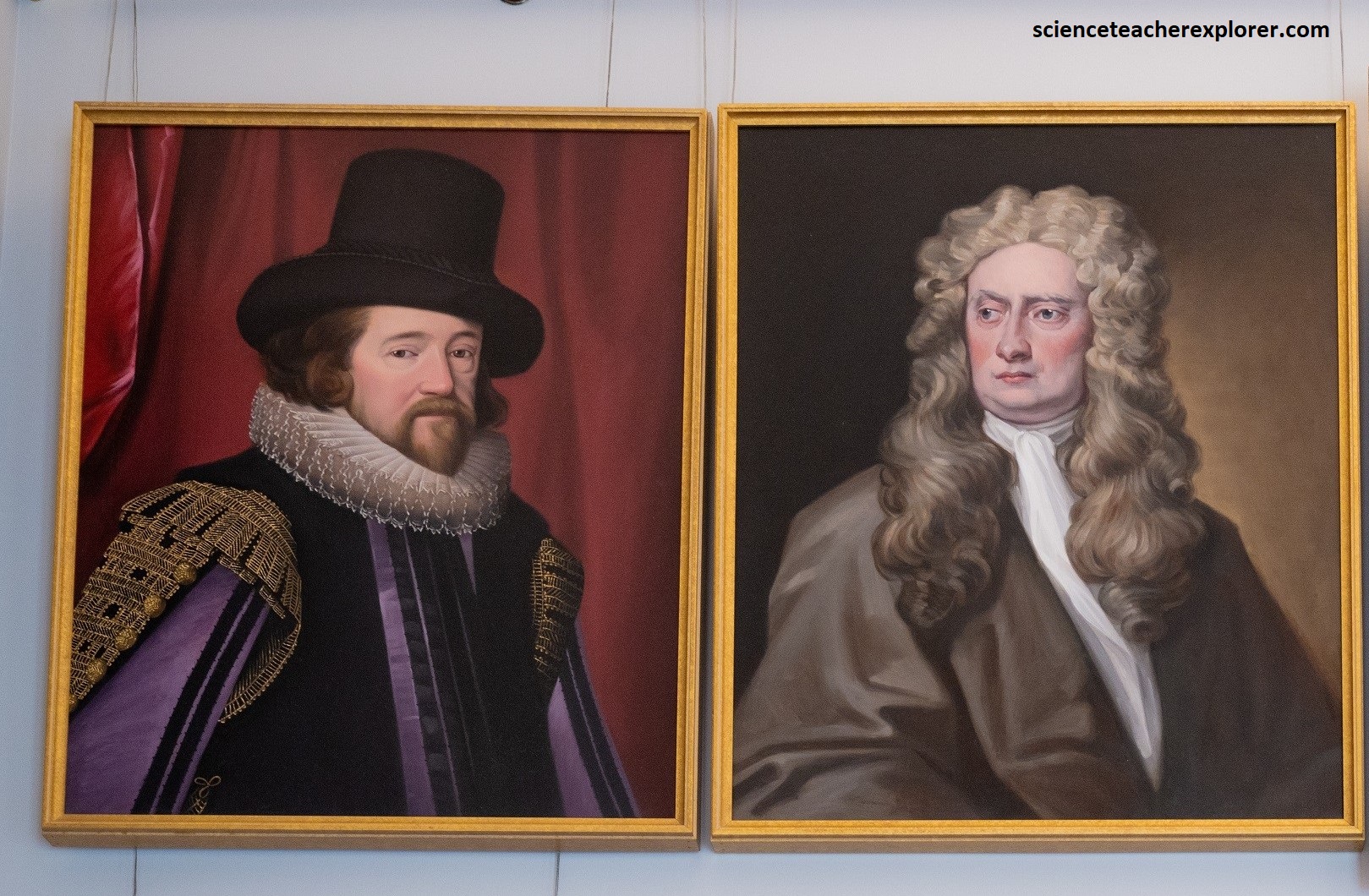
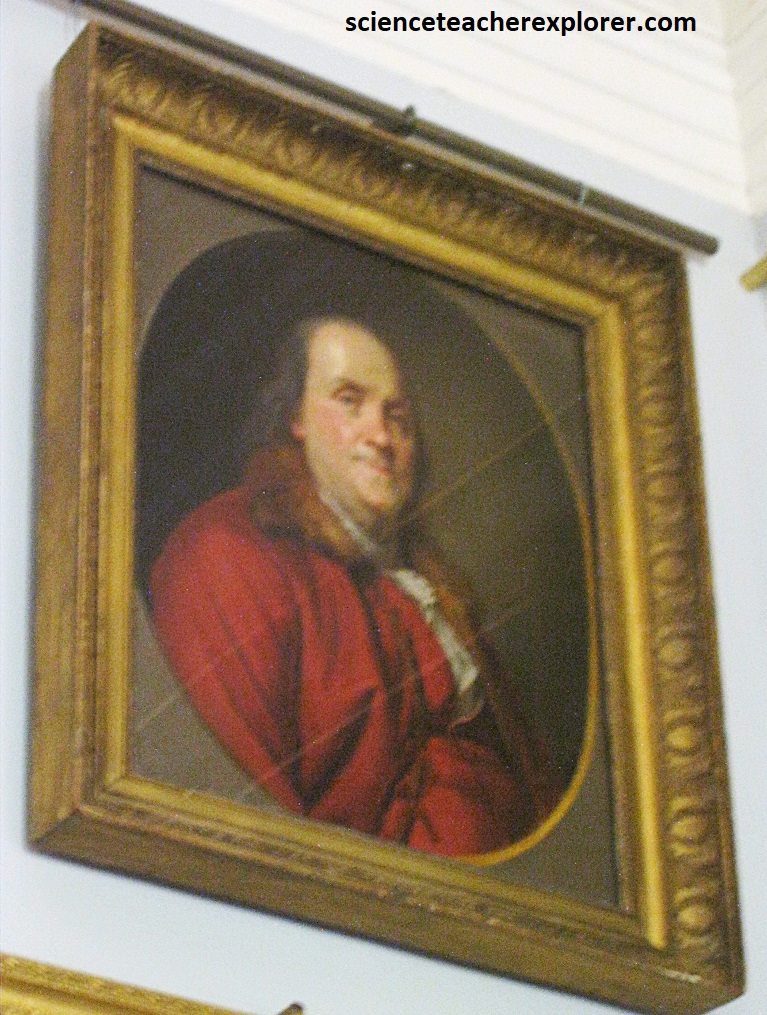
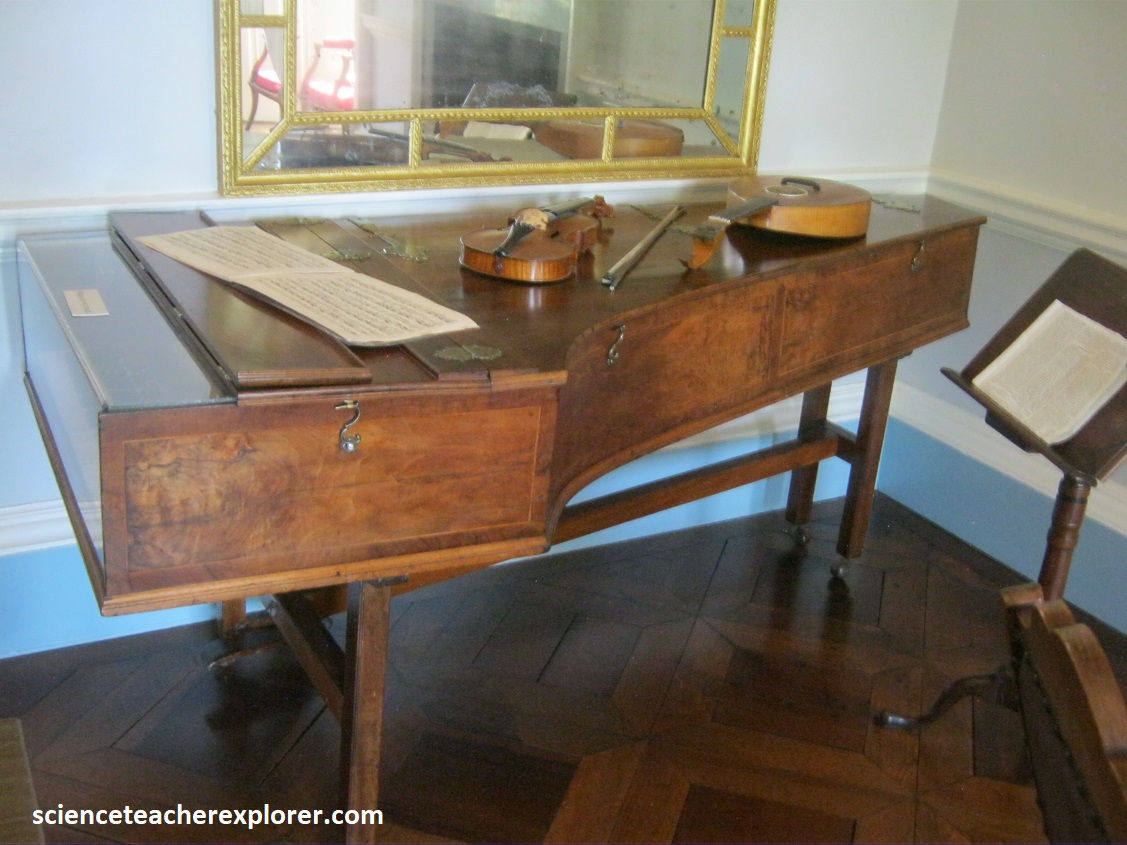
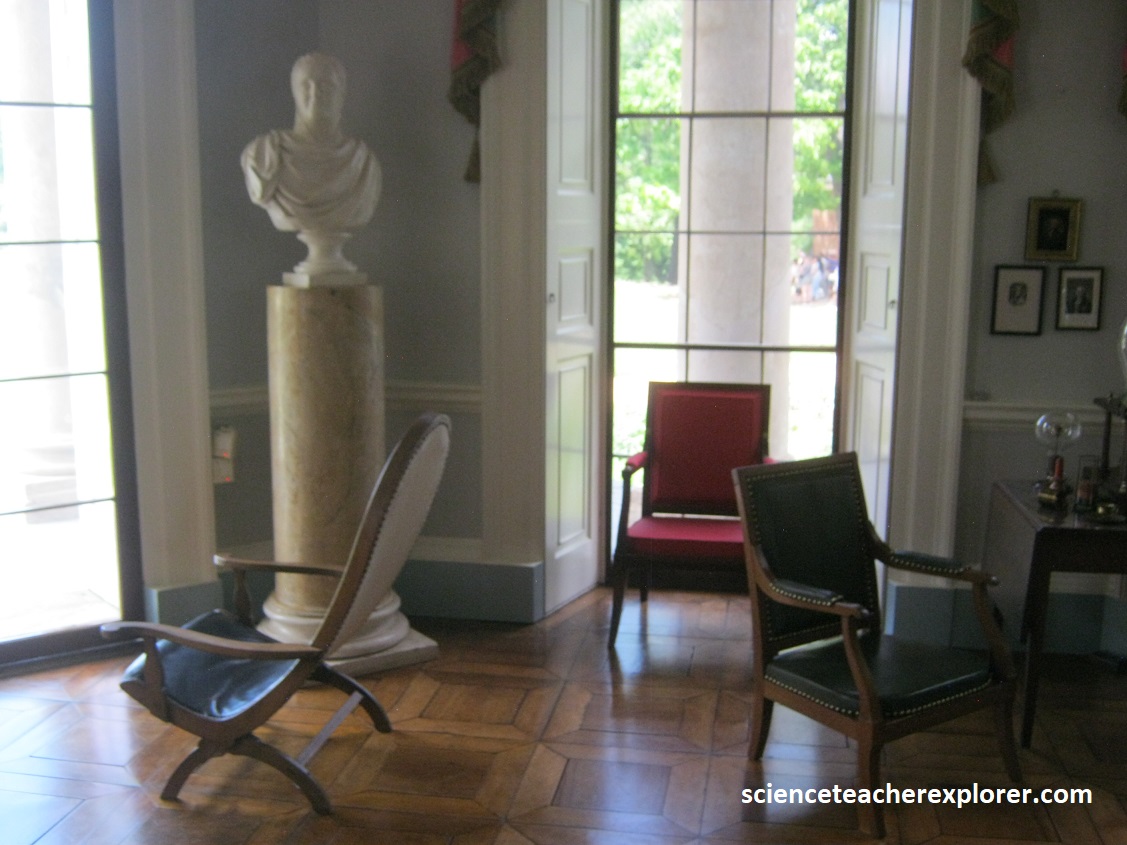
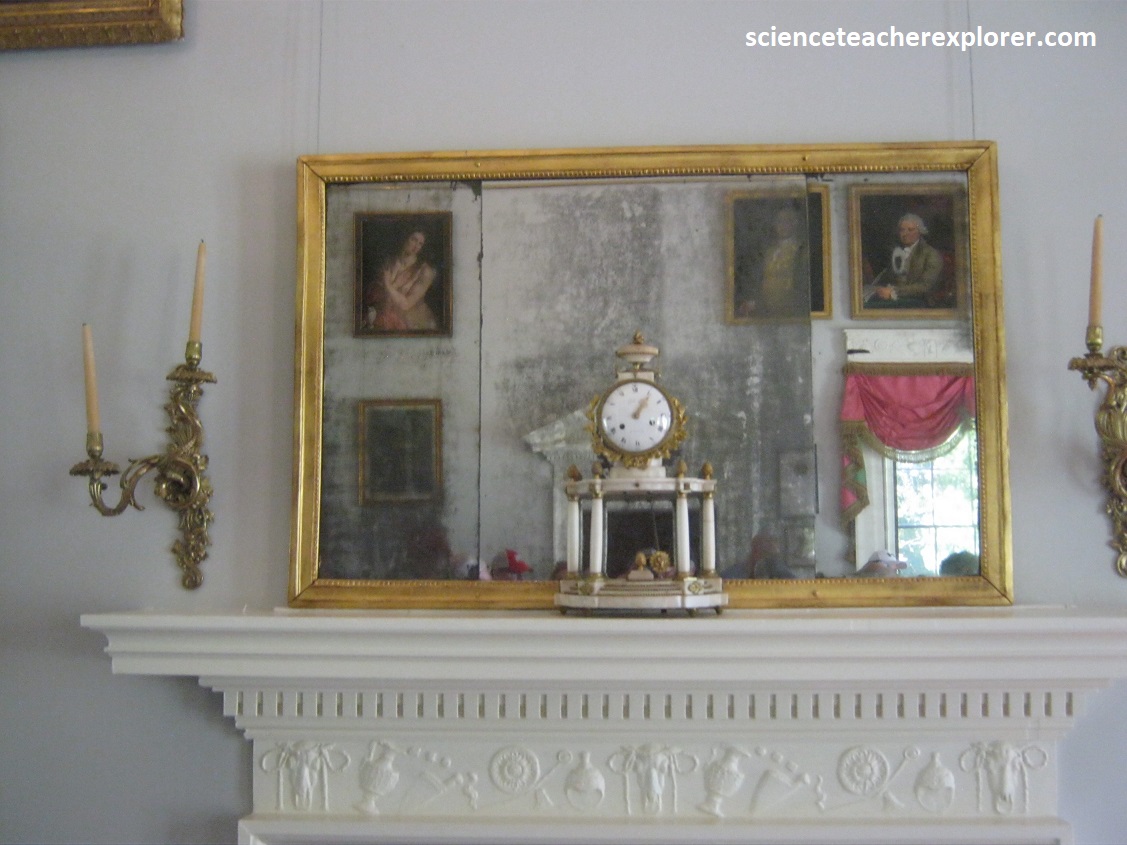
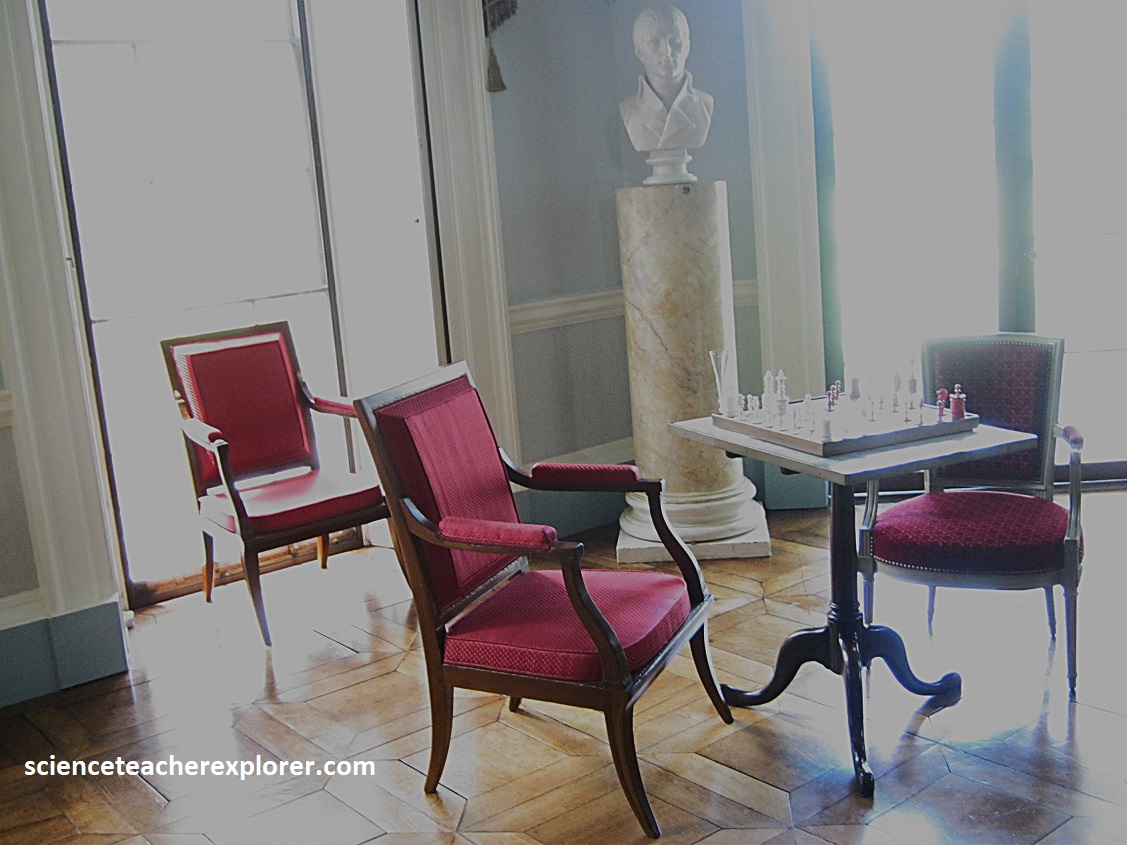
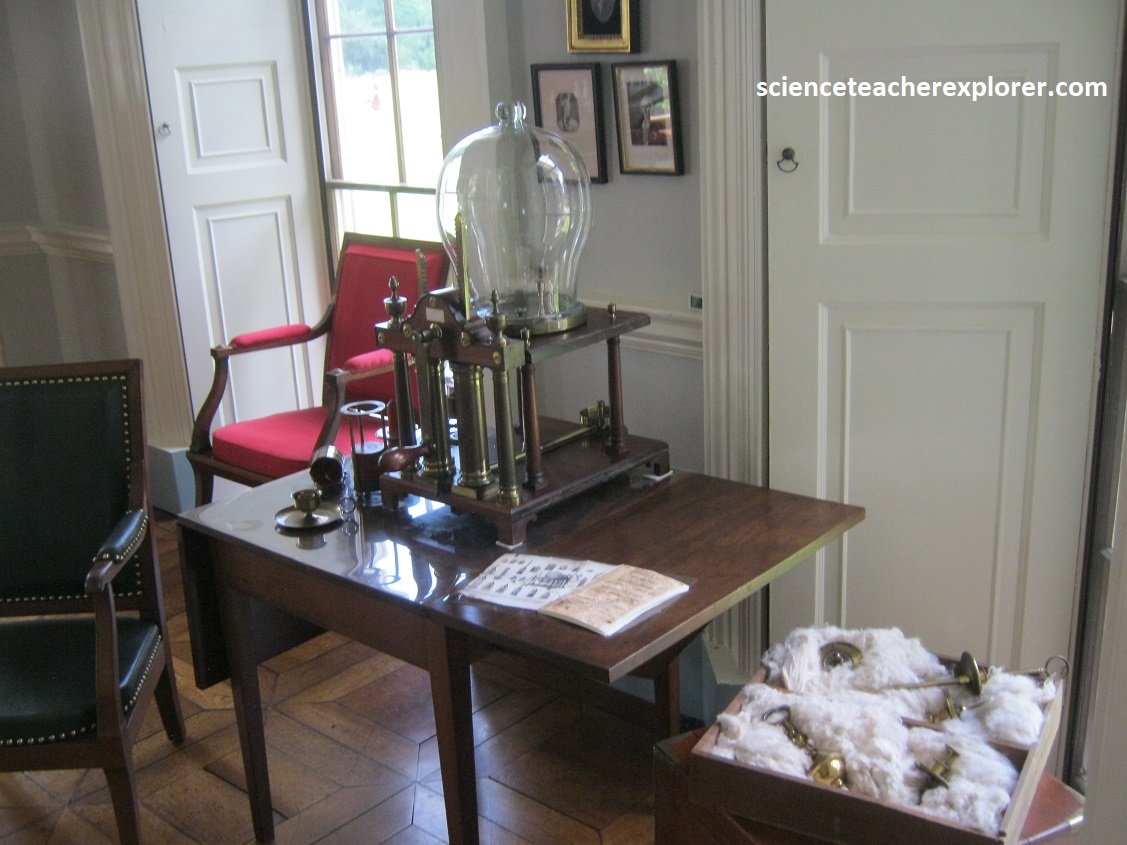
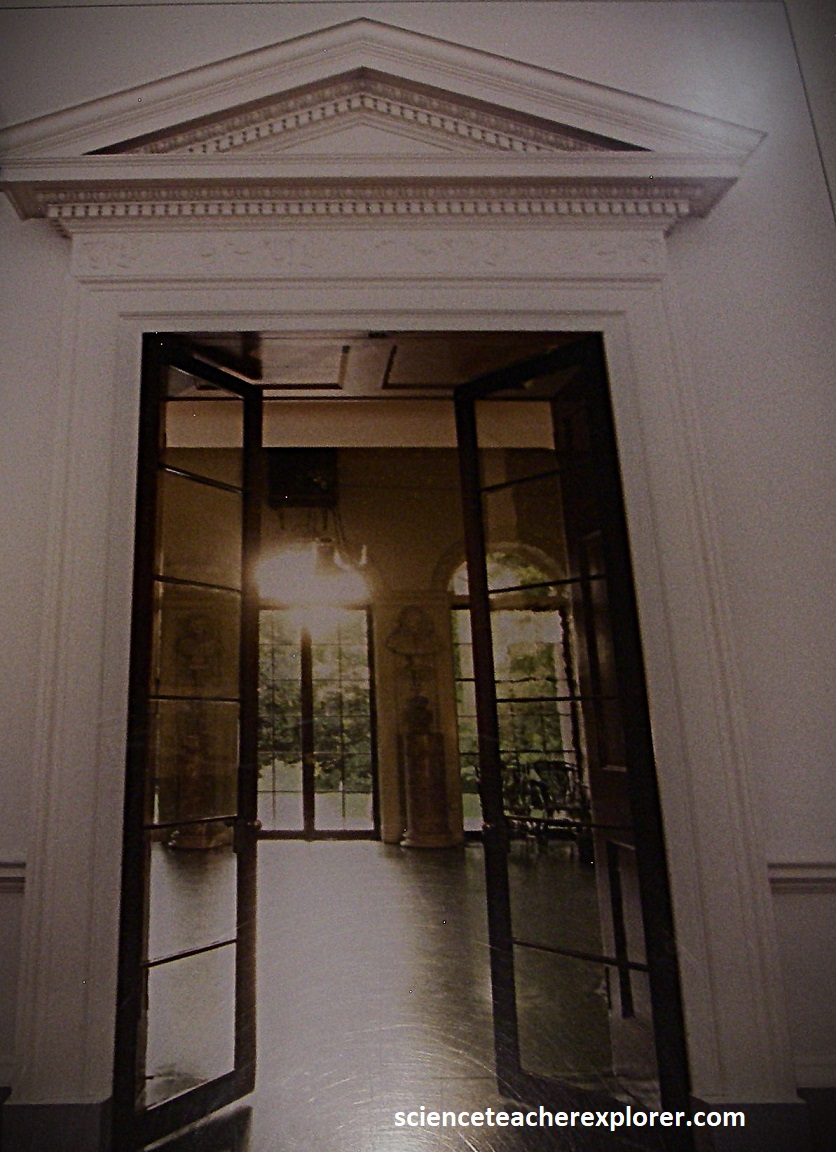
Becky and I explored the “Parlor” next. Evenings at Monticello were often spent here, where Jefferson and his family entertained guest with music, games, and conversation. When Jefferson returned from France in 1789, he brought 86 crates of goods purchased, and many of which are found in this room. More than 25 paintings line the walls, three of which are portraits of my scientific heroes, (Benjamin Franklin, Sir Francis Bacon & Sir Isaac Newton). Jefferson called music the “favorite passion of his soul”. By his own estimation,, he practiced playing the violin, (pictured above), for more than 13,000 hours during his lifetime. His daughters and granddaughters often filled the room with music, playing instruments such as the harpsichord and guitar, (pictured above). The harpsichord seen above was made by Jacob Kirckman in 1786. Jefferson’s favorite board game was chess. The set seen above was carved from ivory in the ‘barley corn’ style, so called for the carved leaf designs on the kings and queens. Jefferson designed the Parlor’s double door from the “Hall” to open together when either side was moved, (created in 1805). {Note the above photo was taken from an interpretive sign on-site}. Jefferson based the design of the parquet floor like something he saw in France. Irish head-joiner James Dinsmor completed the floor in 1806 with the colors of the deep red cherry center squares contrasting with the lighter beech borders. Additionally, on the northside of the “Parlor”, I noticed a ‘Vacuum Bell” with various equipment displayed on the table, (pictured above). Obviously, another gadget used for discussion, since a vacuum was claimed to be in non-existence at the time.
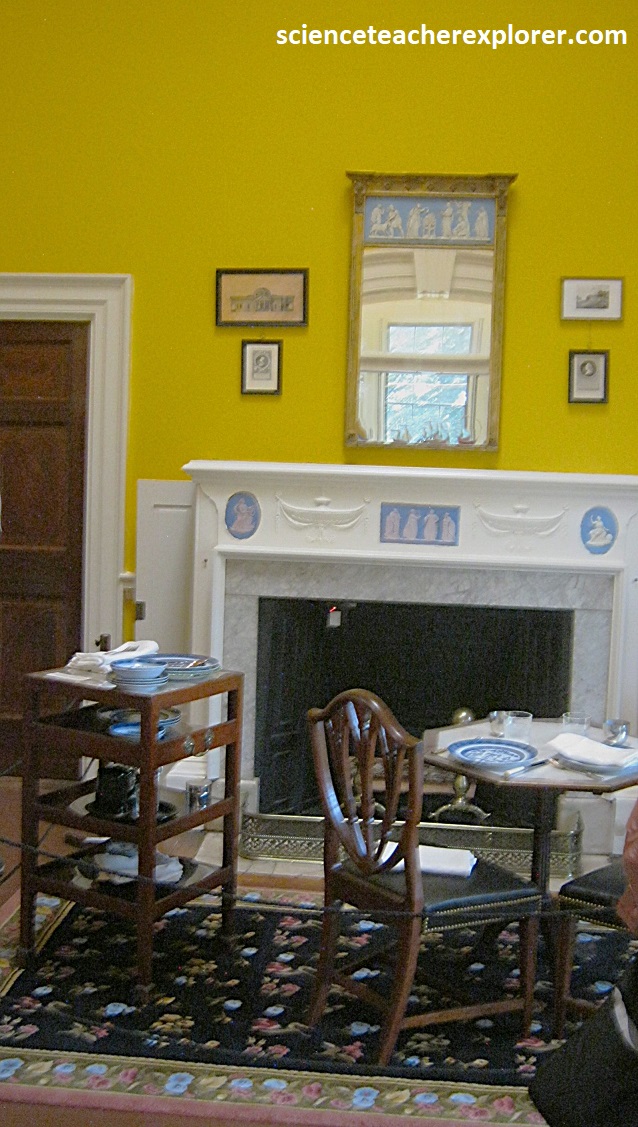
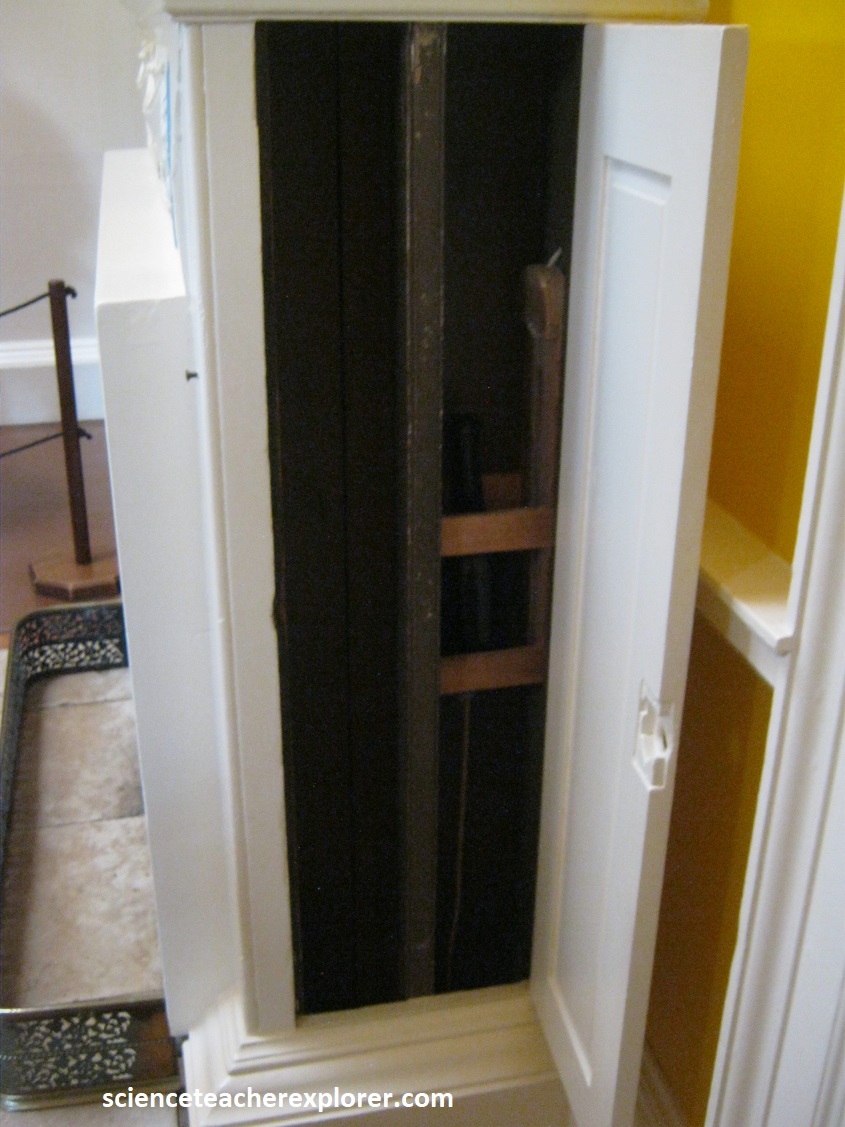
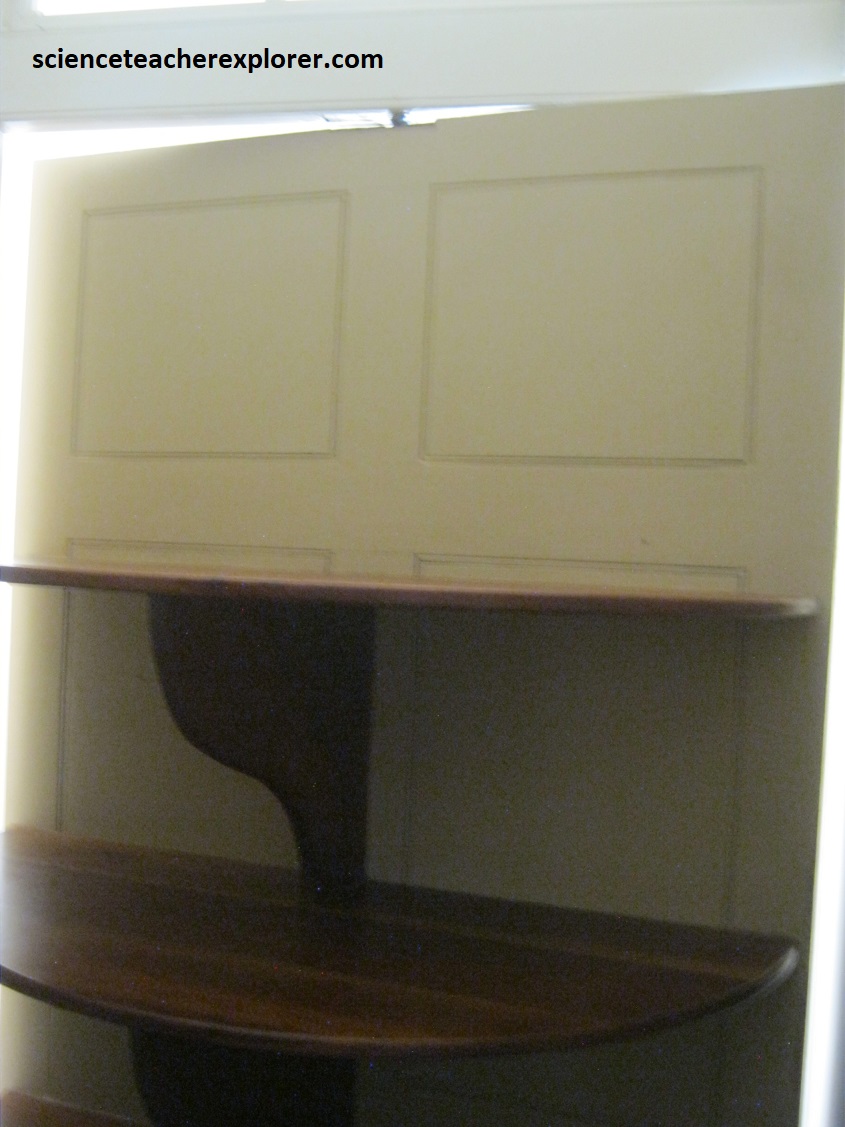
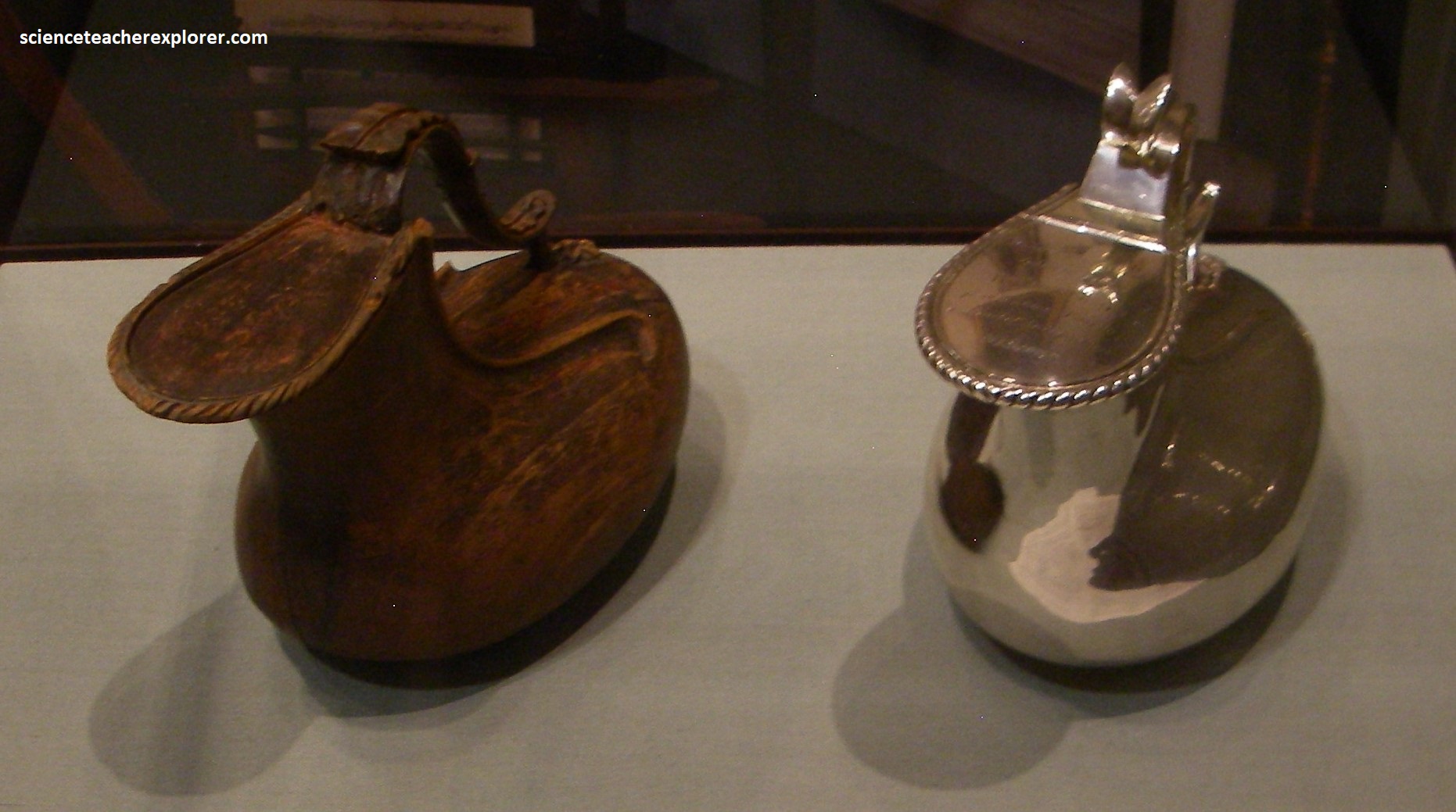
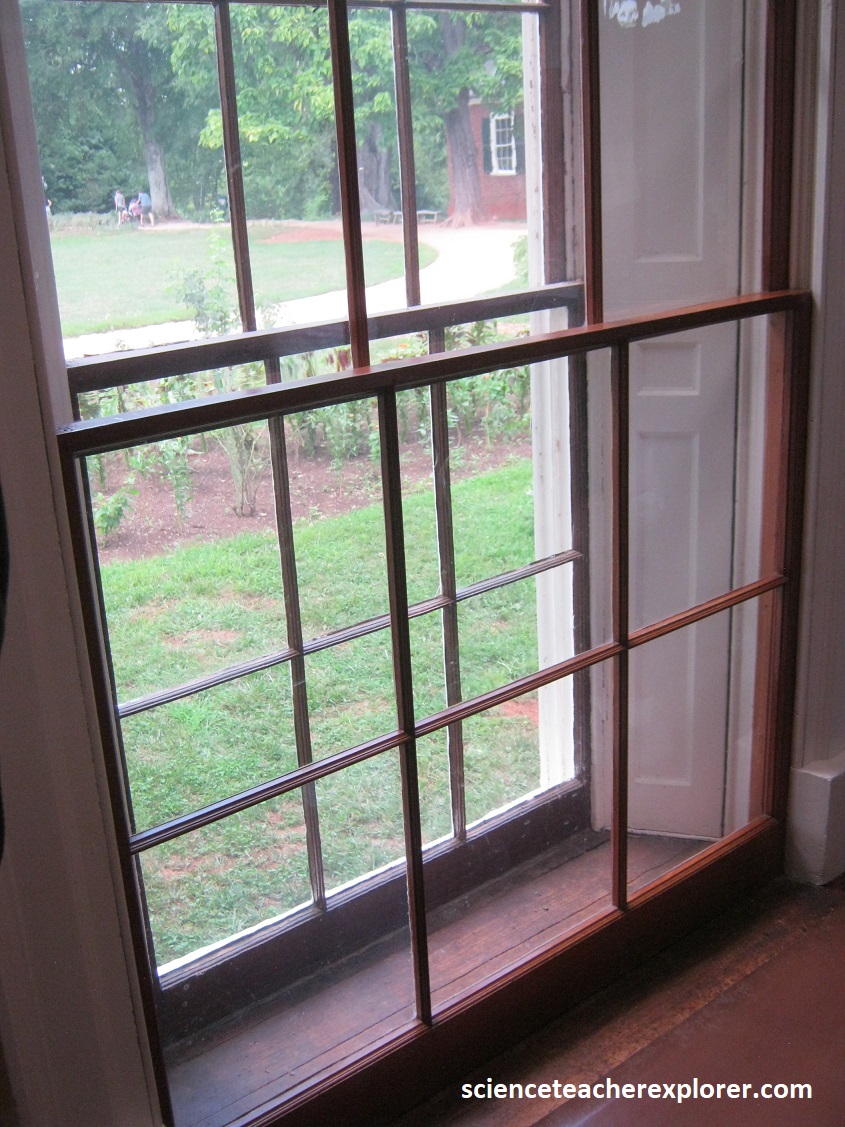
We next strolled into the “Dining Room”. In the Dining Room, Jefferson, his family, and many guests took meals twice a day. Enslaved workers served Jefferson’s family and guests, but he used gadgets built into the architecture to minimize the number of enslaved waitstaff present, including a dumbwaiter for wine and a revolving food service door (concealed in a niche along the wall). To facilitate wine service at the end of the meal, a two pulley-operated dumb-waiters hidden on either end of the fireplace bring 4 bottles at a time up from the wine cellar, (pictured above). In 1784, Thomas Jefferson brought two enslaved girls back from France to train with a French chef at the President’s House. Fruits, vegetables, and meats from the plantation were augmented by imported delicacies such as olive oil and Parmesan cheese. Pictured above, a silver & leather tumbler and askos was created by Jefferson to serve chocolate & wine that was modeled after a Roman bronze pouring vessel he had seen excavated in Nimes, France. Around 1815, Jefferson painted the room in the fashionable “chrome yellow” seen in the pictures above. Additionally, I noticed that the windows were double-paned to prevent heat transfer in the winter and summer times. This was quite revolutionary for the time.
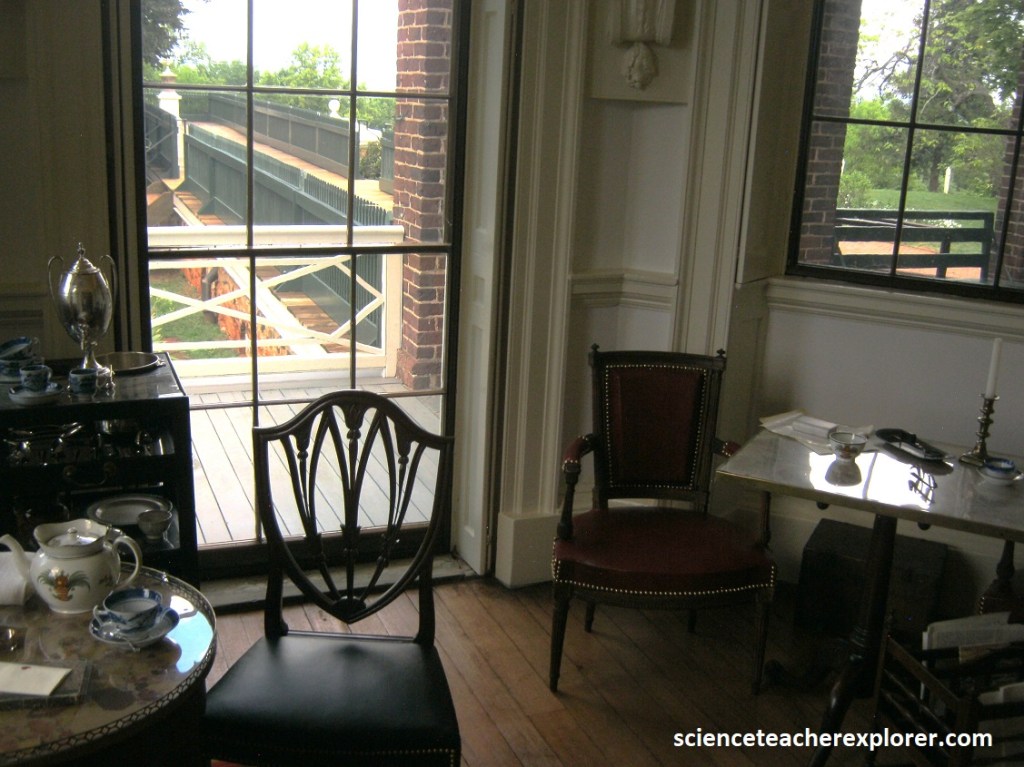
Wandering around in the “Parlor”, we slipped into the “Tea Room”. Tea was popular at Monticello. Jefferson’s letters and financial records indicate that he purchased “about 20lbs of good tea annually” and preferred a green variety called Young Hyson. But the Tea room served many more functions than the pouring of its namesake beverage. If guest out-numbered the Dining Room’s seating capacity, the pocket doors could be opened and overflow diners seated here.
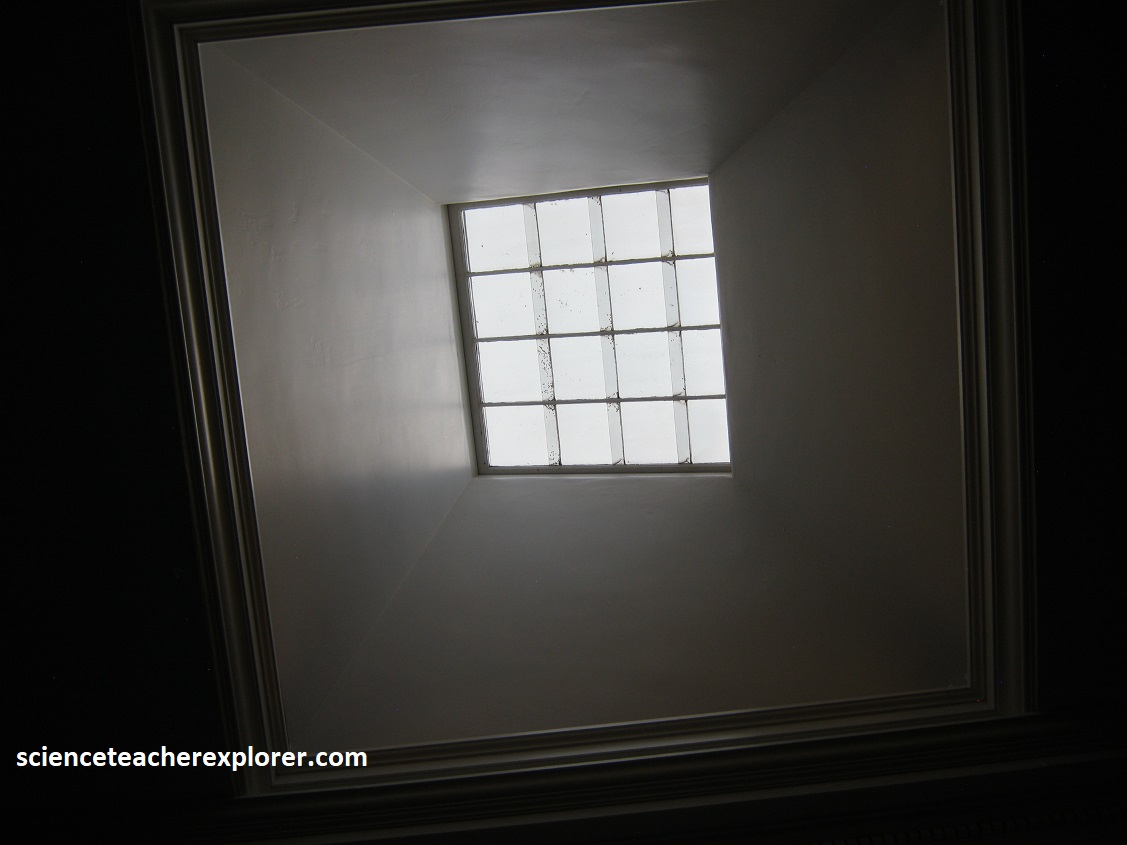
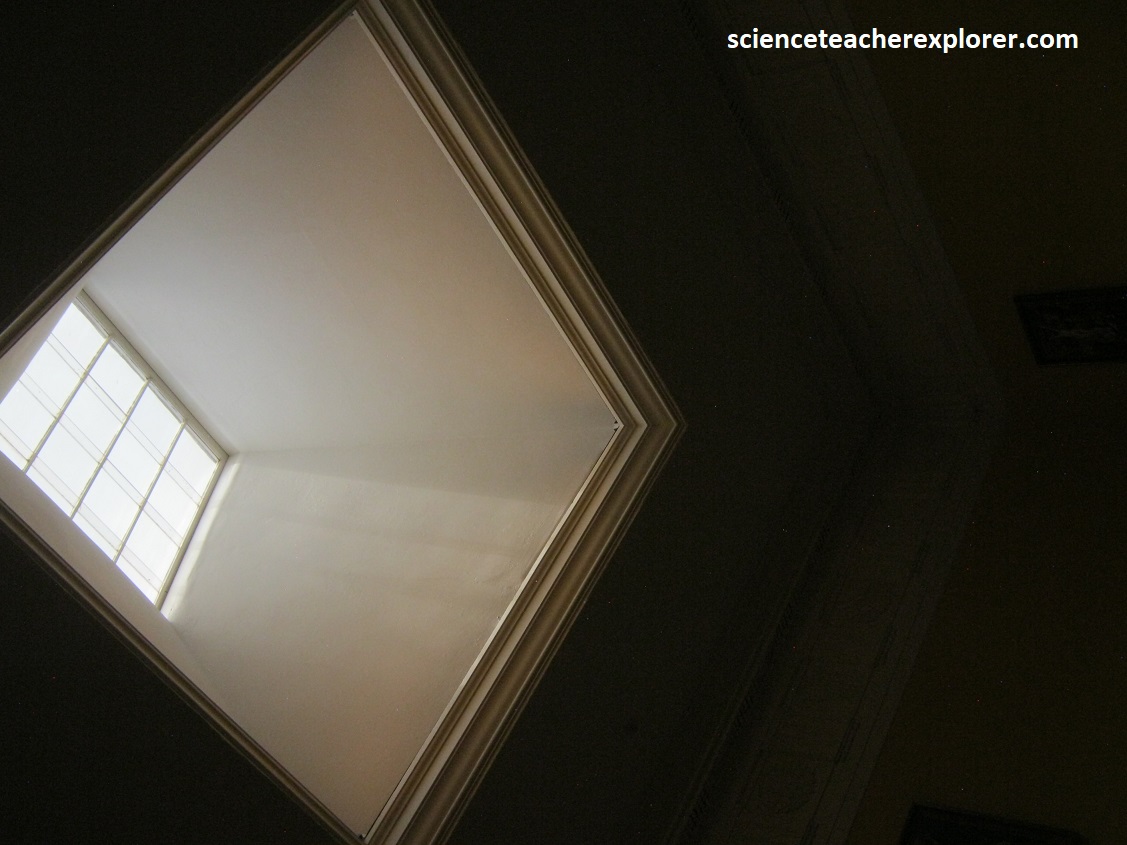
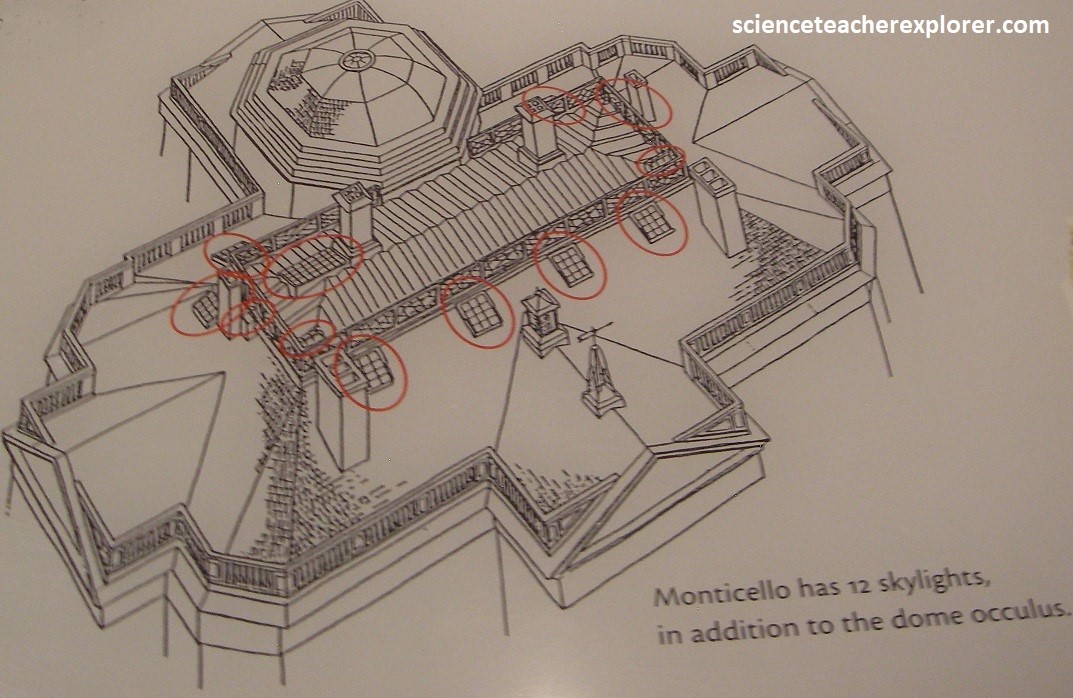
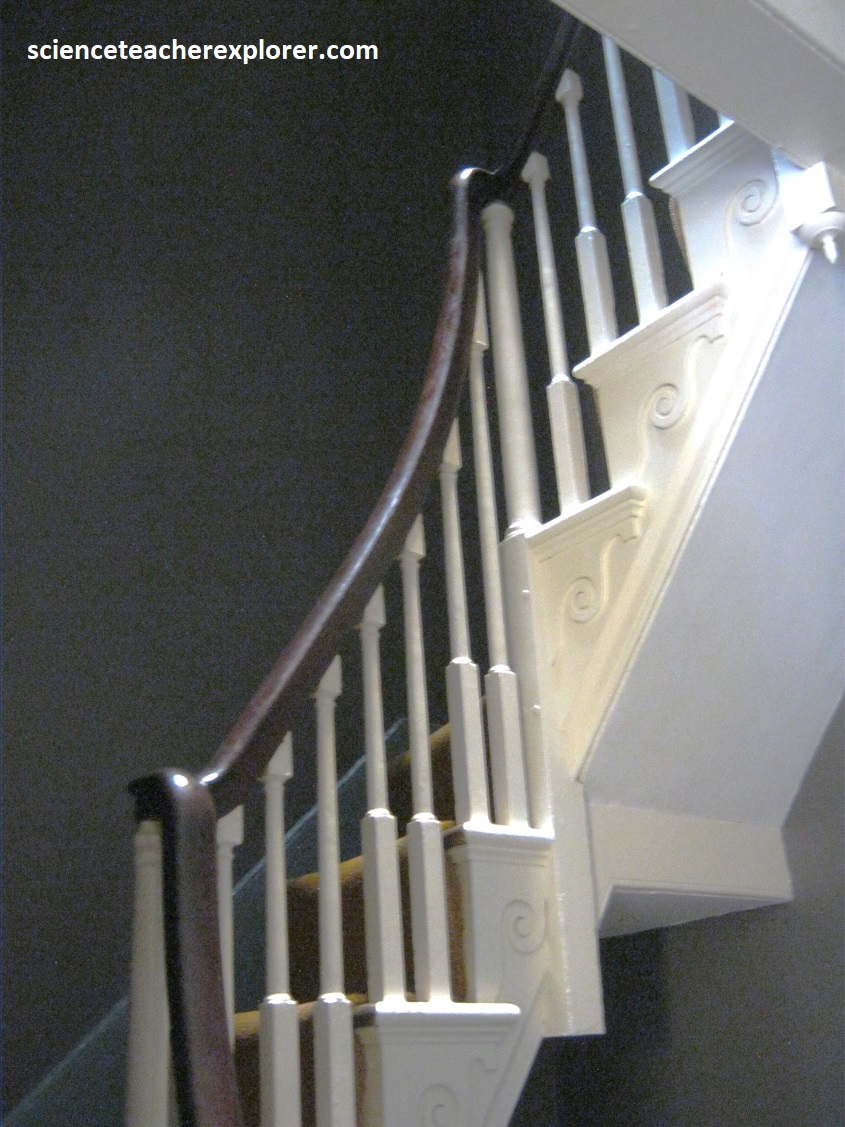
The Monticello house was exceptional for its abundant natural light admitted by skylights and large triple-sash windows. For heating, Jefferson used a highly-efficient fireplace design introduced in 1796, (a small, shallow firebox with widely-angle side walls to radiate as much heat as possible and a tall, narrow chimney to increase the updraft. Additionally, Jefferson installed a modest staircase in each wing. He designed them to be narrow and steep to save “space that would make a good room in every story.” He also built the hallways, called passages, to be flexible spaces. From this point, Becky and I was escorted out onto the north “Piazzas and Terraces”. Jefferson embraced the use of outdoor areas as living spaces, both around the perimeter of the house and across the terraces extending to the pavilions. (Note: we were unable to see the 1st story bedrooms, the 2nd, and the 3rd floors on this tour).
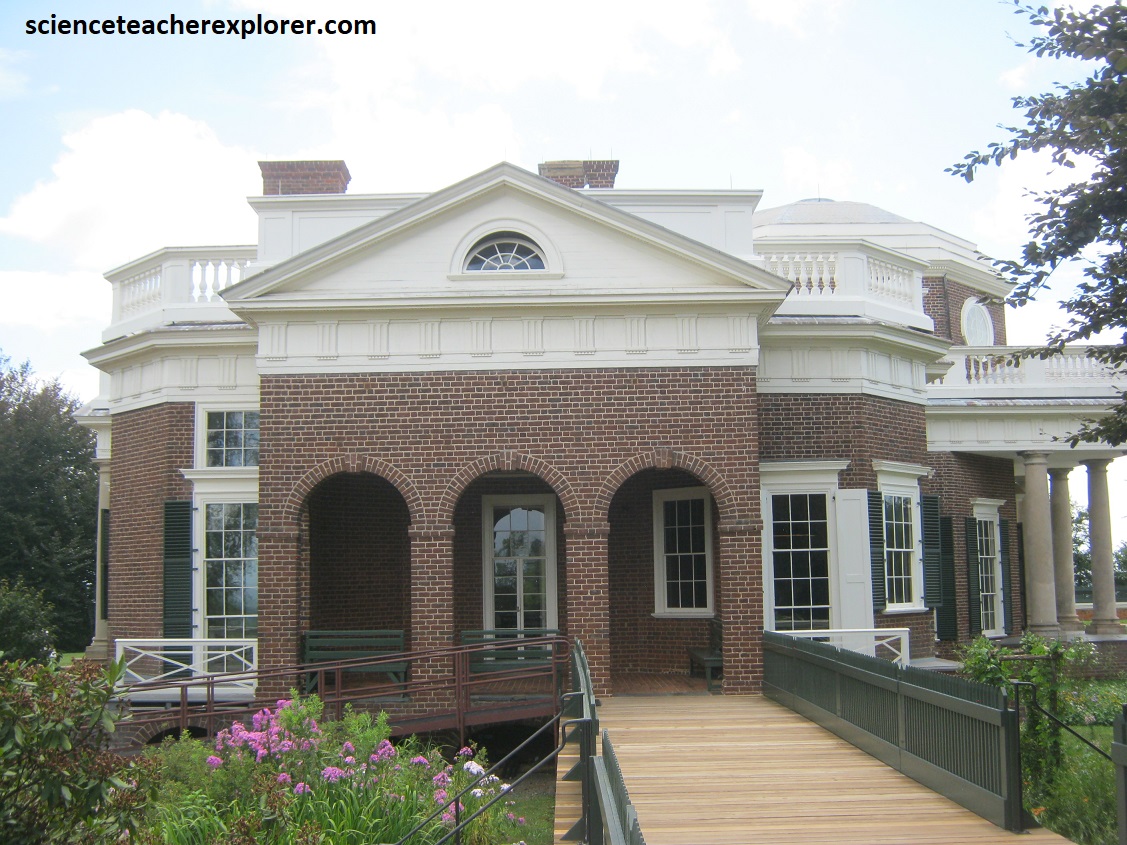
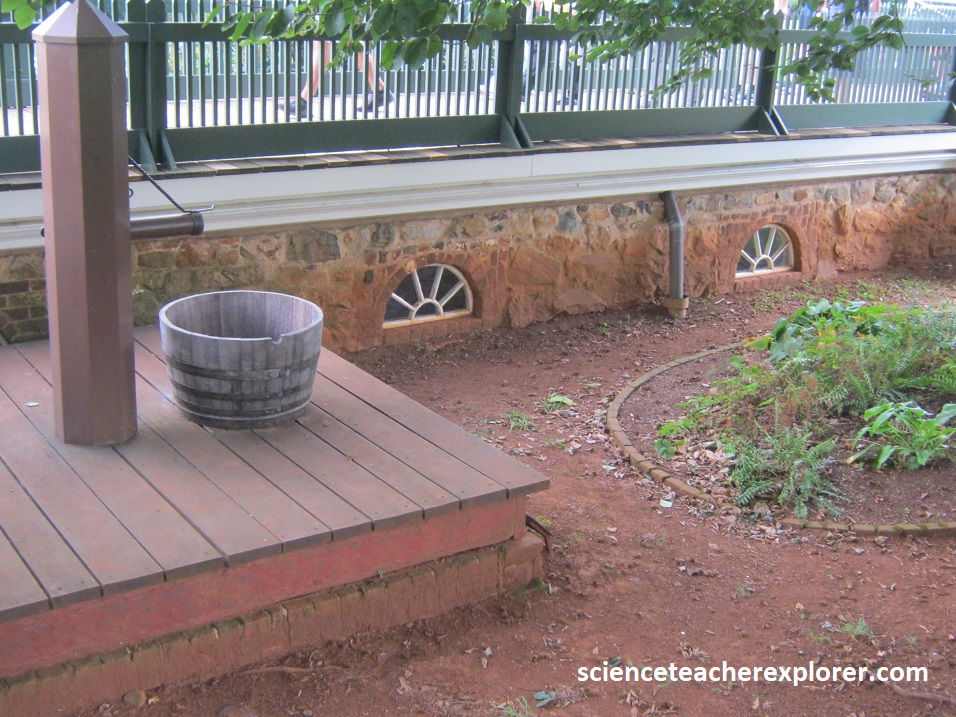
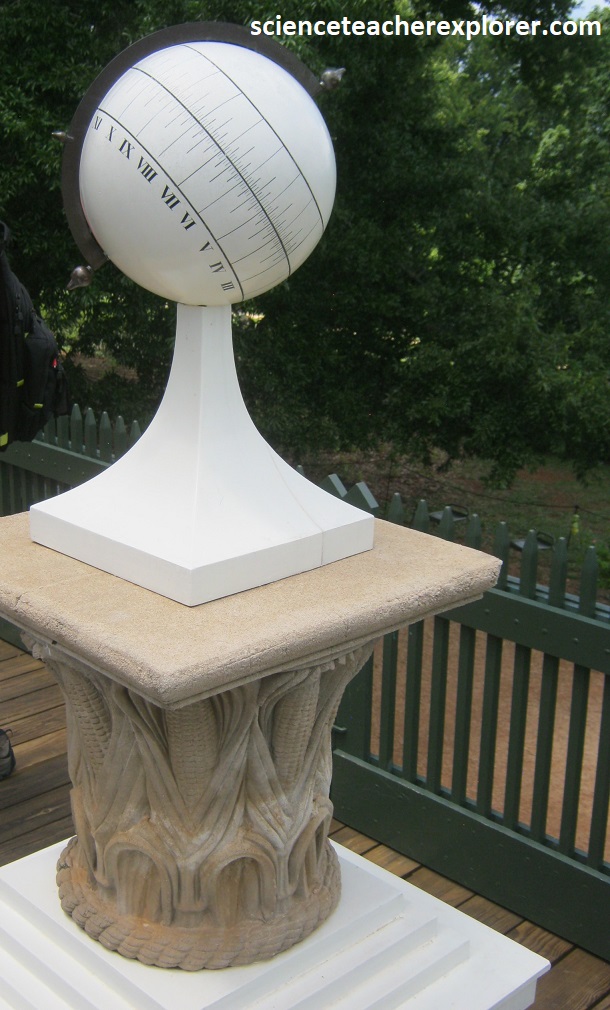
Thomas Jefferson’s goal was to make the “Piazzas and Terraces” as inviting and comfortable as possible by adding touches like louvers and shutters to provide shade and create private spaces, which Jefferson valued. These outdoor spaces were used for taking walks after dinner, reading, conversation, enjoying the garden and vistas, and as places for grandchildren to run and play. Picture above on the left is a Spherical Sundial that indicated time by the position of the iron bar’s shadow across the vertical lines on the sphere. Picture to the lower left is a water pump to the north spring.
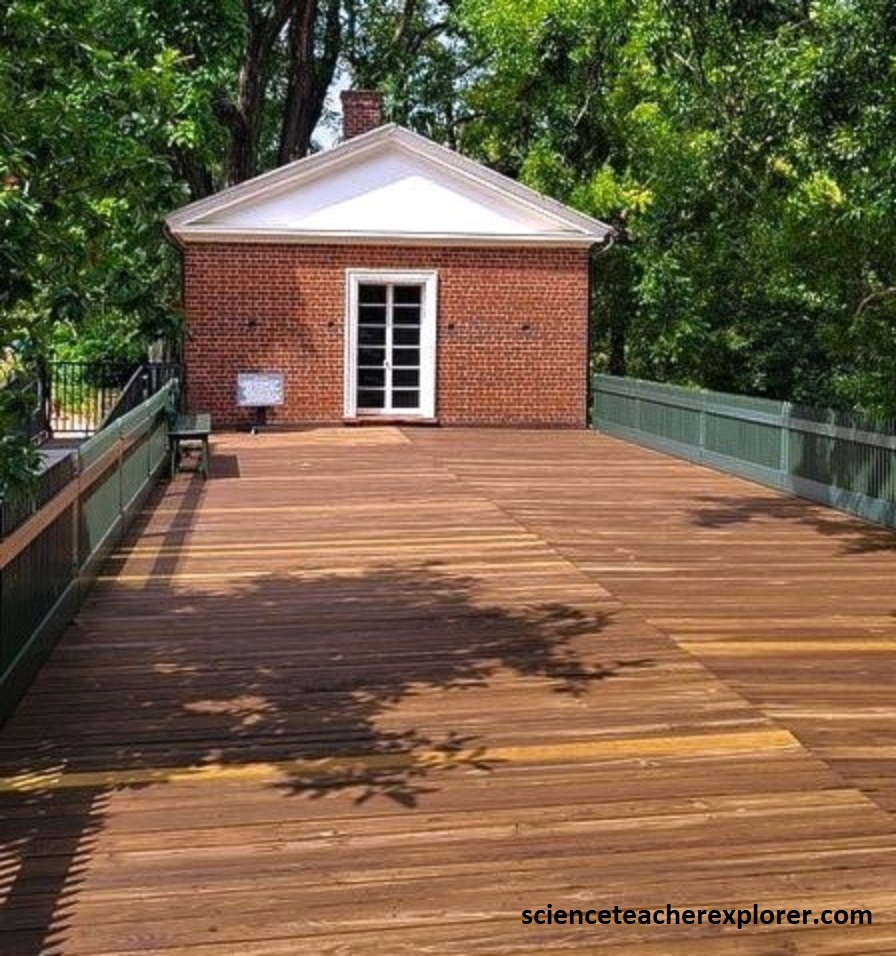
Although both the North and South Pavilions were elements in Jefferson’s designs of the 1770’s for Monticello, it was not until 1808 that his scheme was fully realized with the completion of this structure. After Jefferson’s daughter Martha and her family moved permanently to Monticello in 1809, this room was used as an office by her husband, Thomas Mann Randolph. In May 1819 the North Pavilion was partially destroyed by fire. Becky and I then, explored under the North Terrace. {Note: the image below were taken from an interpretive sign on-site}.
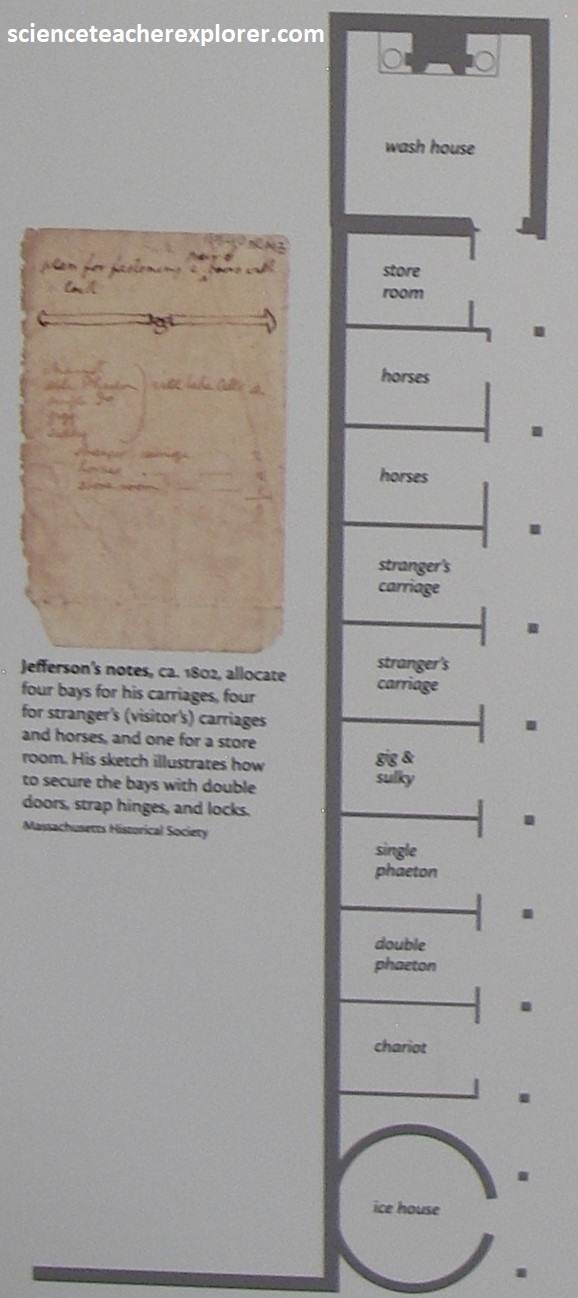
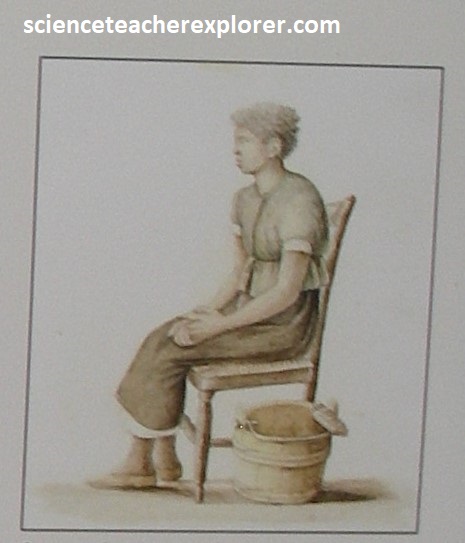
Spaces for working, living and storage were tucked under the main house and beneath the terraces and pavilions. Anchored by the Ice house and the Wash House at either end, the north wing served as Jefferson’s “garage”, (his valuable carriages and the carriages and horses of visitors were kept here. The North Pavilion cellar may have stored wood or supplies before becoming a bath house. After 1818, it was used as a wash house (laundry). The above left image is a depiction of an enslaved scrubwoman. They washed the clothing, bed sheets, table cloths, and napkins for the Jefferson household. {Note: the image below right, was taken from an interpretive sign on-site}.
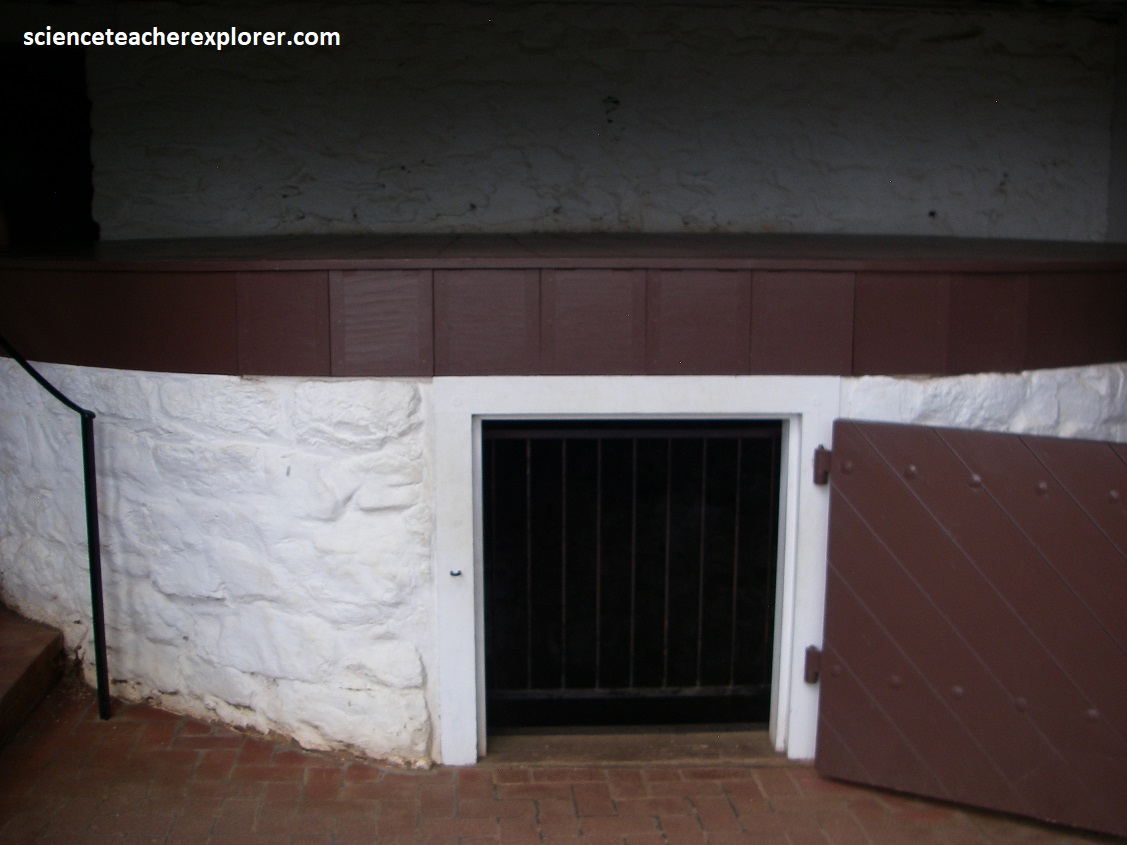
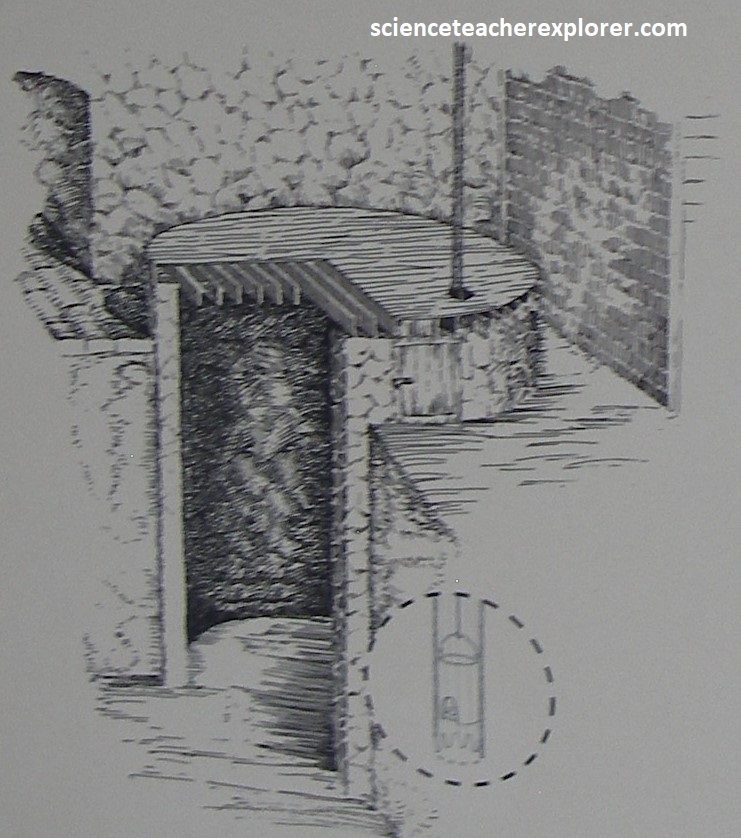
Pictured above is the Monticello Icehouse. During the winter of 1802/03, Jefferson instructed Gabriel Lilly to build a round structure 16 feet in diameter and 16 feet deep in the coldest location at Monticello, under the North Terrace. The icehouse was use primarily to store fresh meat and butter, and to chill wine. Packed tightly and insulated with wood chips or straw, the ice sometimes lasted through the summer. The first year it was used, 62 wagons-full of ice had to be hauled from the Rivanna River to the top of Monticello Mountain. {Note: the image below-right, was taken from an interpretive sign on-site}.
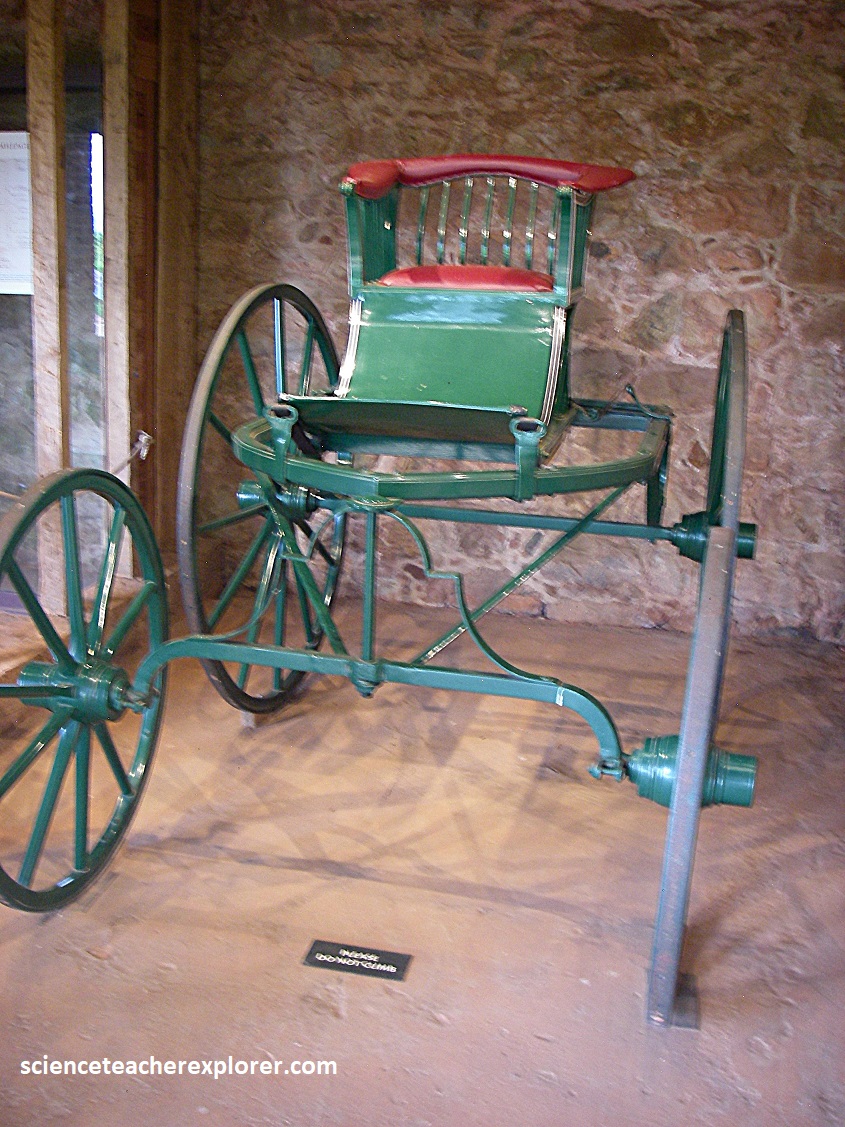
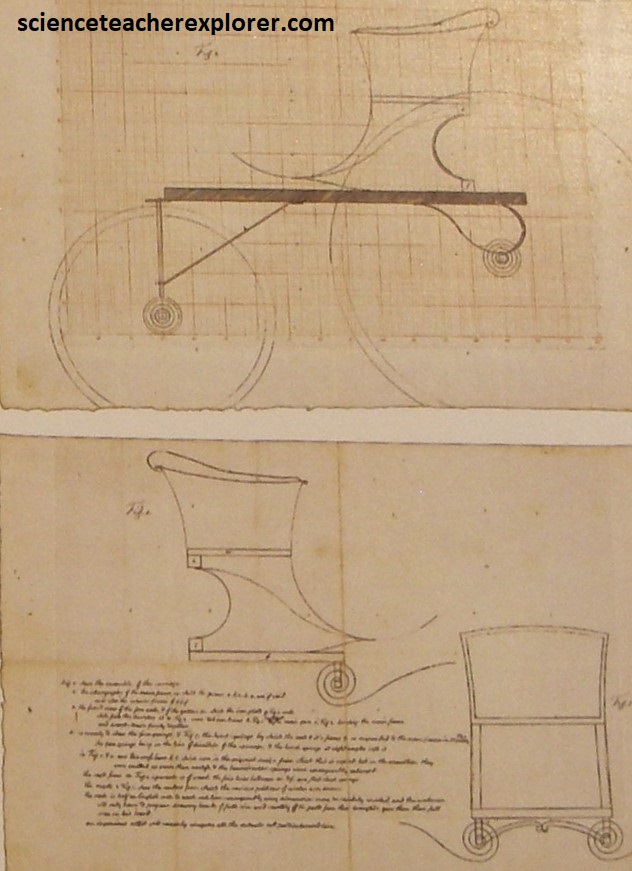
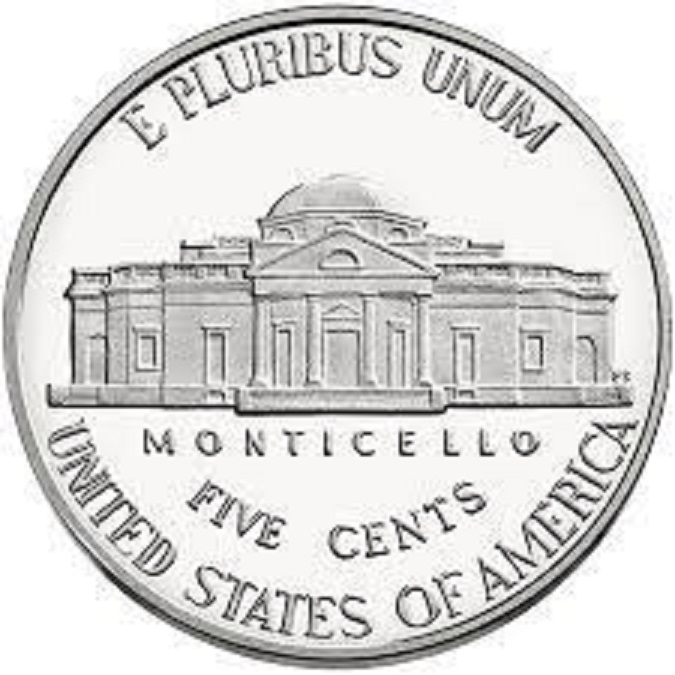
Pictured above, Jefferson kept his carriages and those of his guests in spaces like this one. He was among the few wealthy Americans who owned horse-drawn carriages. He bought, commissioned, and designed at least 12. In his time two-wheeled gigs were the most common carriage. Jefferson designed two Phaetons that were two-passenger, open-bodied carriages known for lightness, speed, and stability. The one pictured above was his 1802 single-horse phaeton with a model of Jefferson’s 1807 odometer attached. Later, Jefferson designed a landau, (4-6 passenger carriage), for his use that lasted the rest of his life. {Note the image below-right, is a Wikipedia-image of the backside of a nickel}
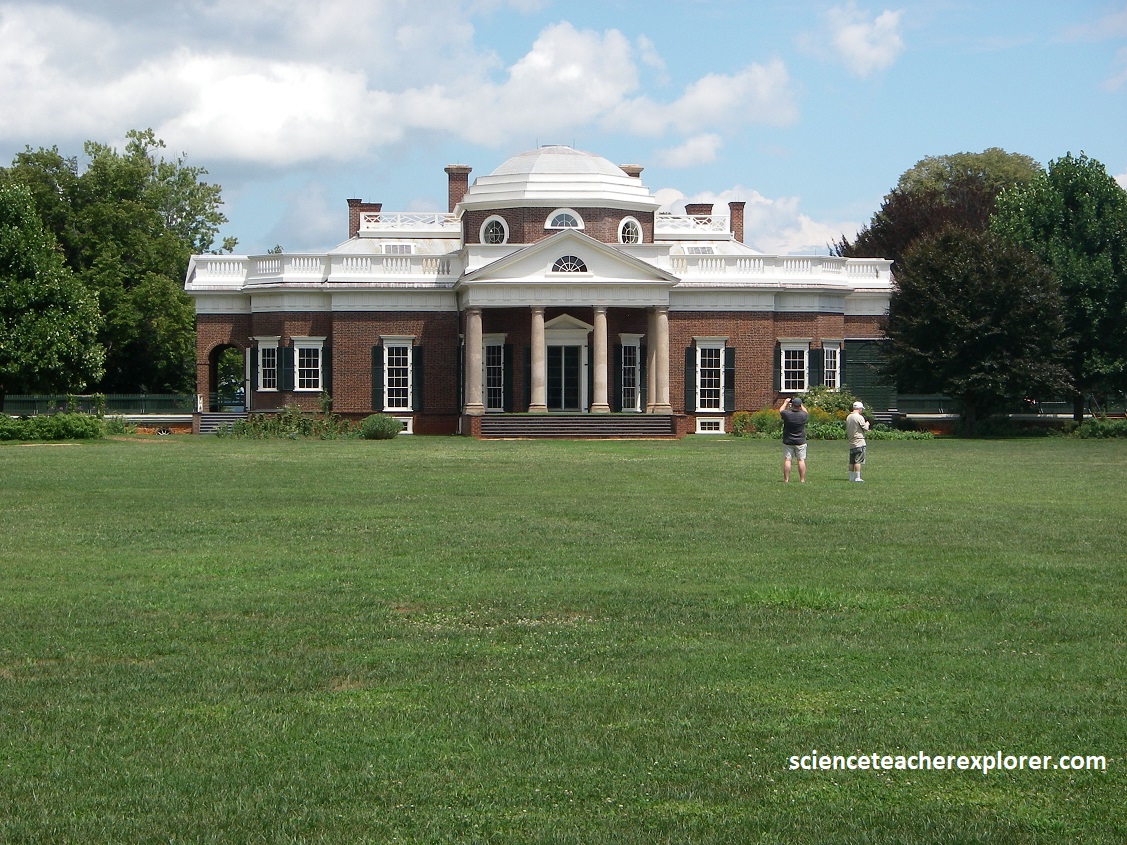
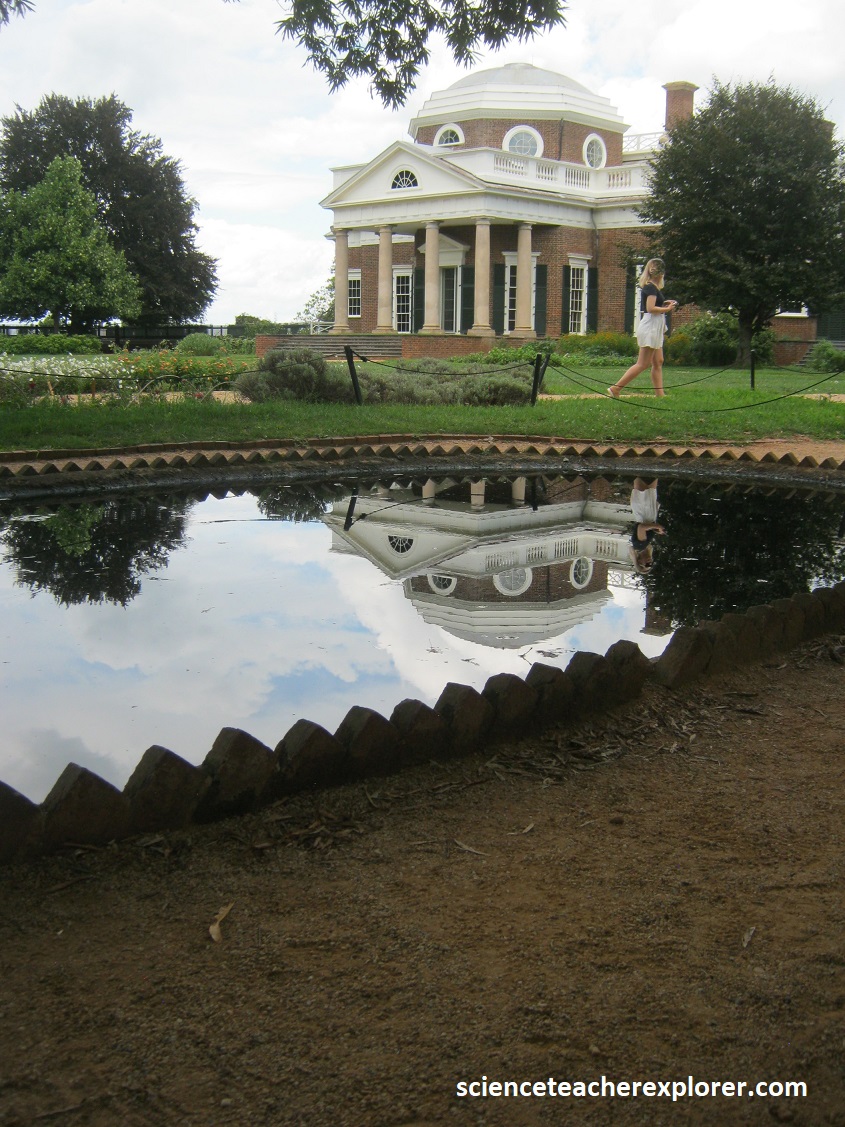
Picture above, the southwest portico, topped by Monticello’s iconic dome, is at the center of the symmetrical “West Front”. Designed as an extension of the Parlor’s living space, the portico offered cooling shade during the summer months and views of the elaborate garden to the south. Jefferson’s design for Monticello’s dome was influenced by the temple of Vesta in Rome and the spectacular skylighted Halle au Ble, the new Paris grain market by architects Legrand and Molinos. Jefferson was intrigued by the dome’s visible supporting ribs. They divided the dome into sections small enough to hold glass panes that illuminated the market. Jefferson engineered the Monticello’s dome to fit onto the existing irregular octagon room. {Note that the right photo below is the view from the “South Pavilion”.
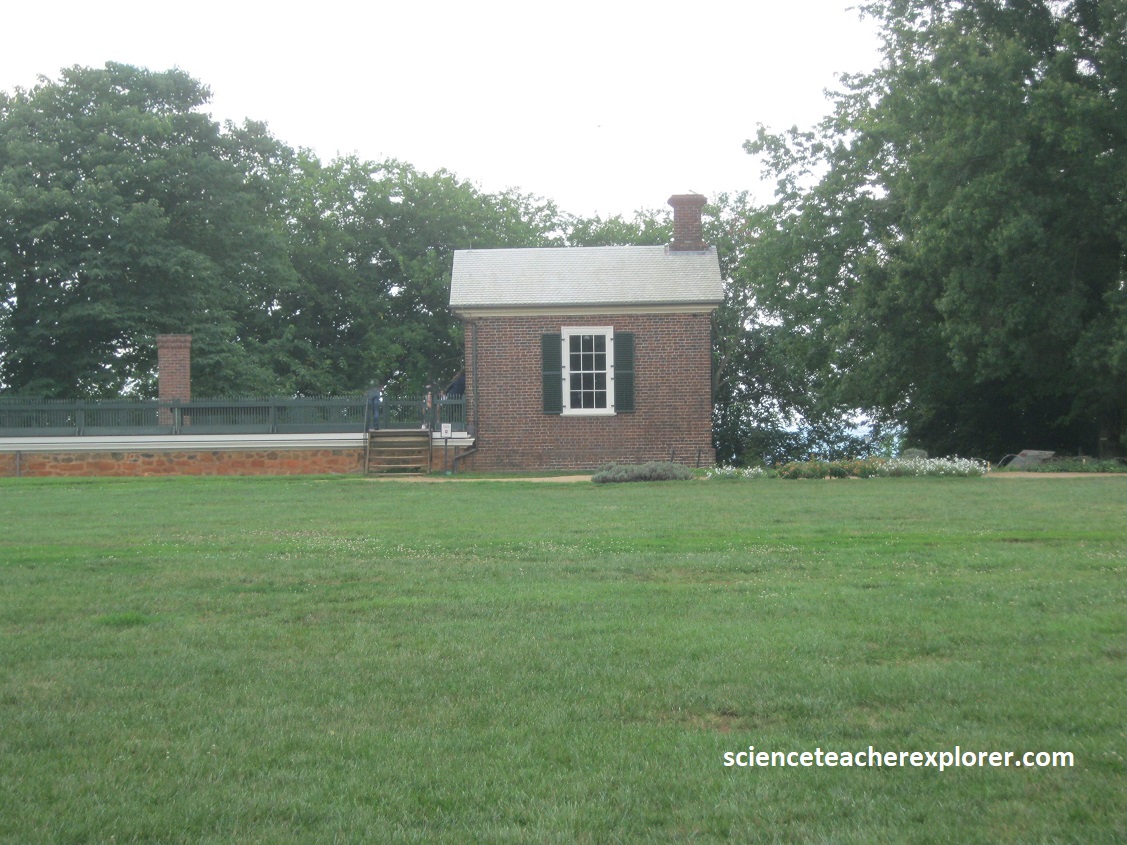
Construction of Monticello began in 1770 with a 2-story brick structure that Jefferson called the out-chamber, now known as the “South Pavilion”, (the oldest brick structure on the landscape and Jefferson’s first home at Monticello). A simple living space on the upper floor with a kitchen below, each measuring just 18ft x 18ft, it became a family residence after Jefferson’s marriage to Martha Wayles Skelton in 1772. Later he built Monticello I & II. Today there is a bottom level to the “South Pavilion” called the “South Wing”. Of course Jefferson designed the “wings” under the L-shaped terraces to hold the facilities required for domestic operation. Pictured below, the “South Wing” connects the “South Pavilion” to the all-weather passage that runs under the main house and contained the post-1809 kitchen, cook’s room (where the head cook lived), smokehouse, two living quarters for enslaved workers (Sally Hemings & family), and the dairy. Each side of the long passage under the main house had and indoor, non-flushable toilet called a privy, (pictured below).
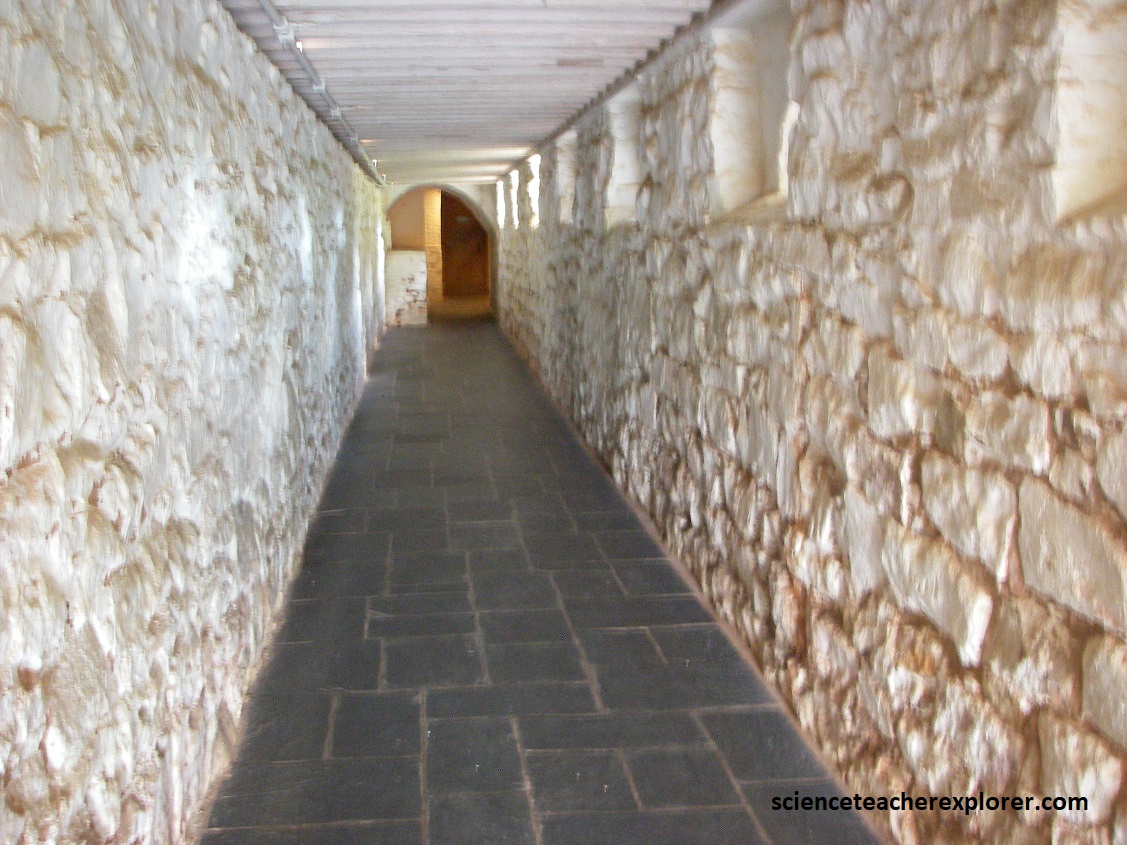
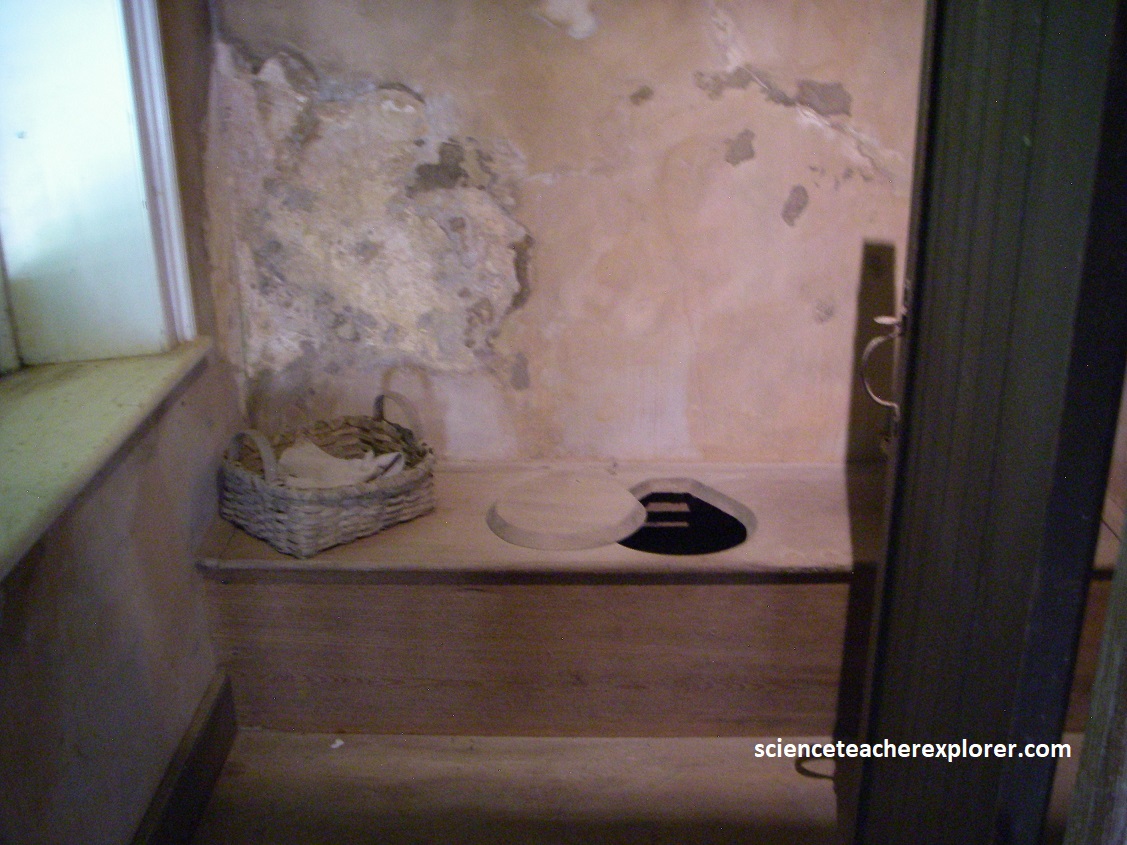
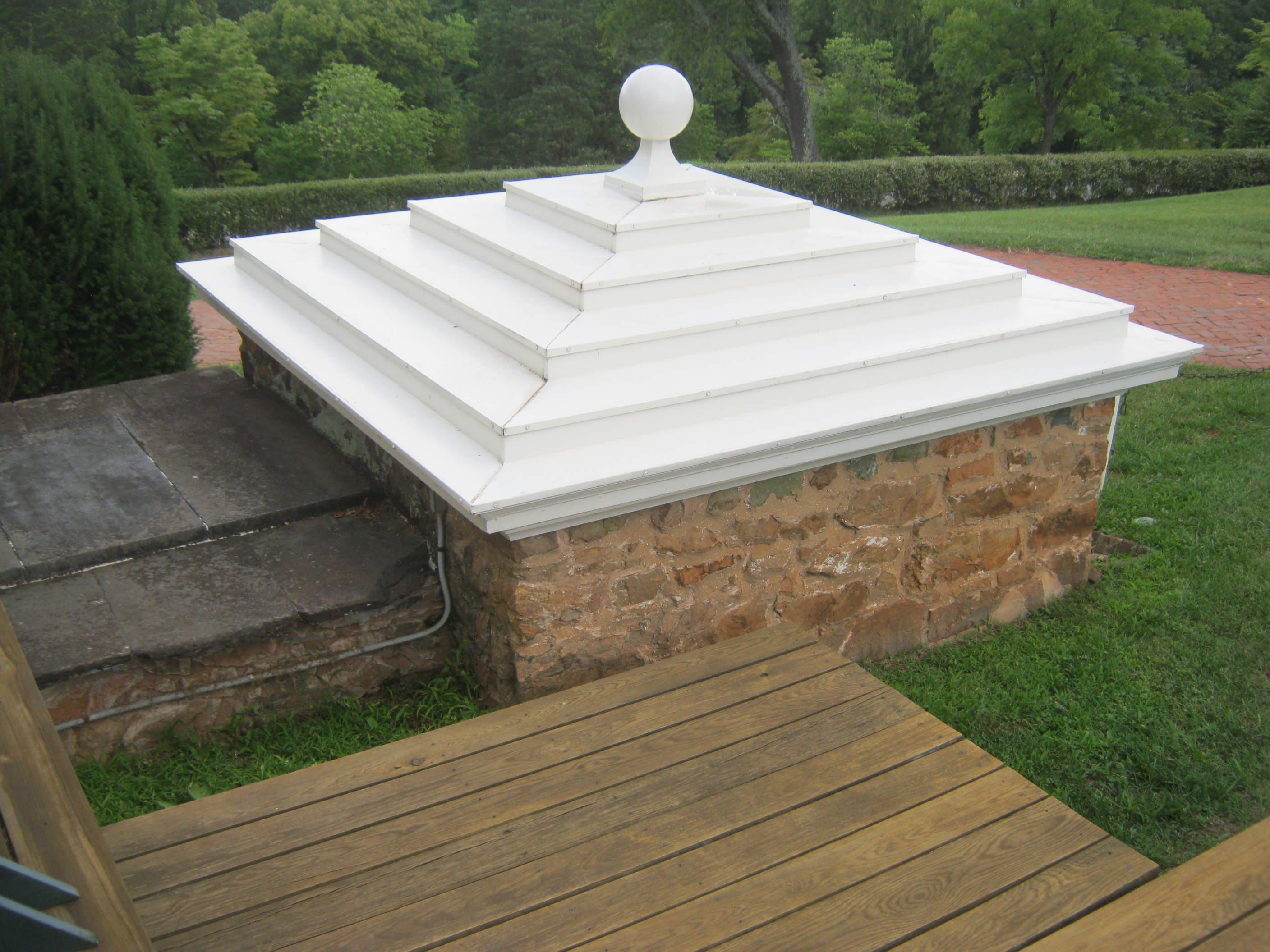
Although it was unusual for houses in the U.S. at the start of the 19th century to have toilets facilities inside them, but, Monticello had three: One near Jefferson’s bed-chamber and two on the south side of the house. Tow more privies were located nearby at the ends of the north and south passages. These non-flushing privies were attached to shafts that provided ventilation.
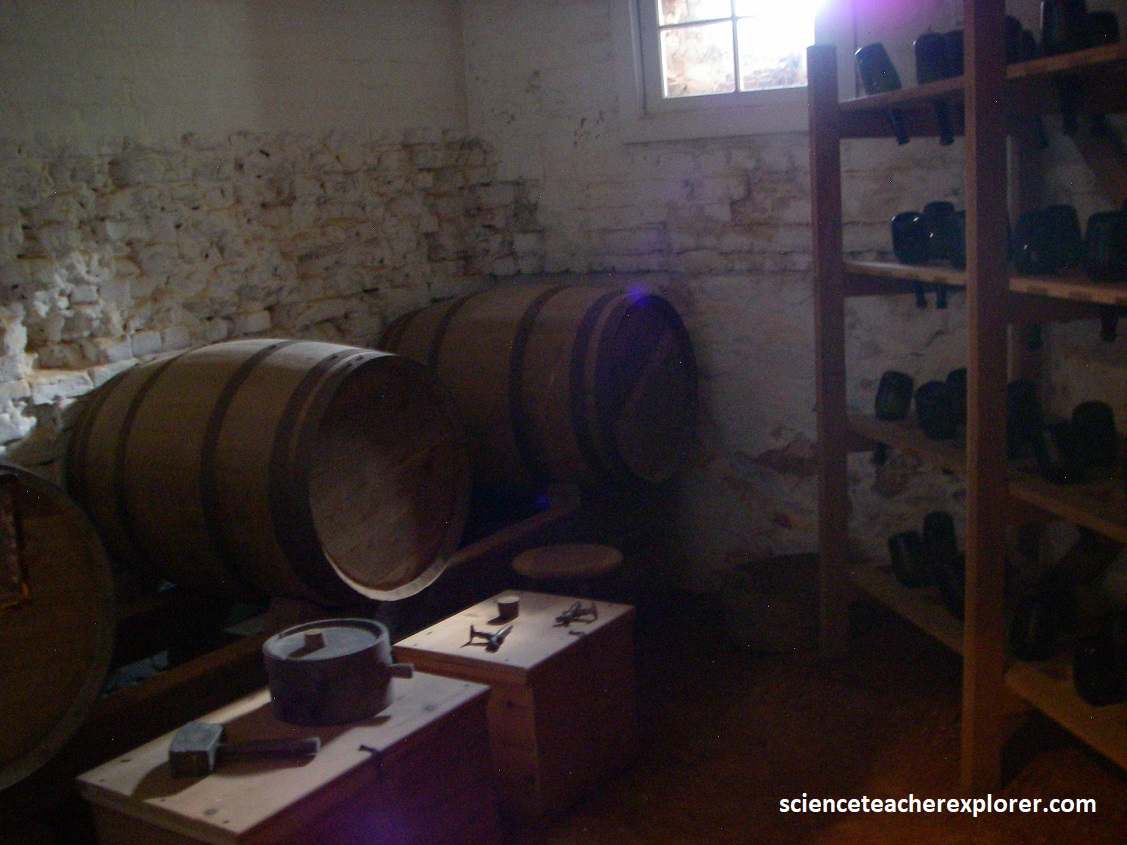

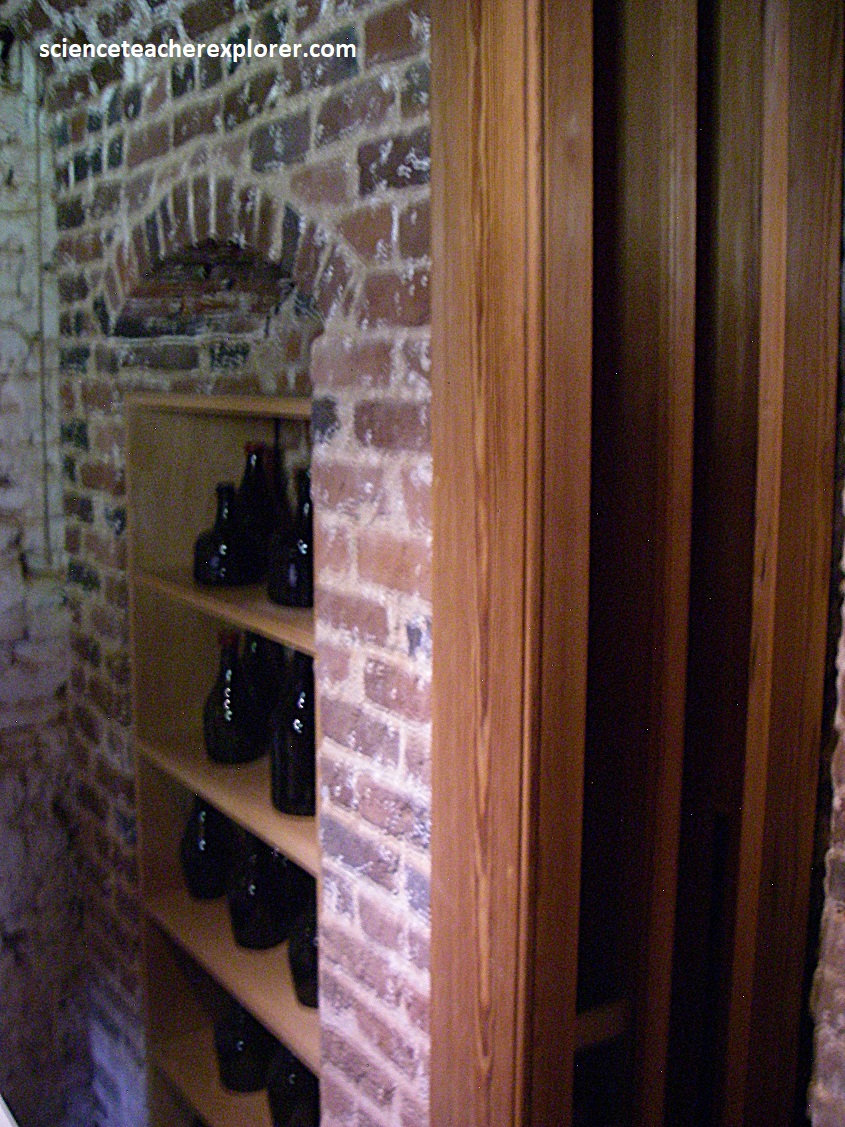
Jefferson was the most knowledgeable American wine connoisseur of his time, acting as advisor to Presidents Washington, Madison, and Monroe. He gained his expertise while serving in Paris as minister to France (1784-89) and through observations and tastings in European vineyards. He sought high-quality wines for importation to the United States and tried repeatedly, and unsuccessfully, to grow Vitis minefera at Monticello. After Jefferson returned form Europe in 1789, enthused about wine, he began stocking the cellar picture above, with carefully chosen wines from abroad. Pictured above, he equipped the cellar-fireplace with a dumbwaiter to carry bottles of wine to the Dining Room.
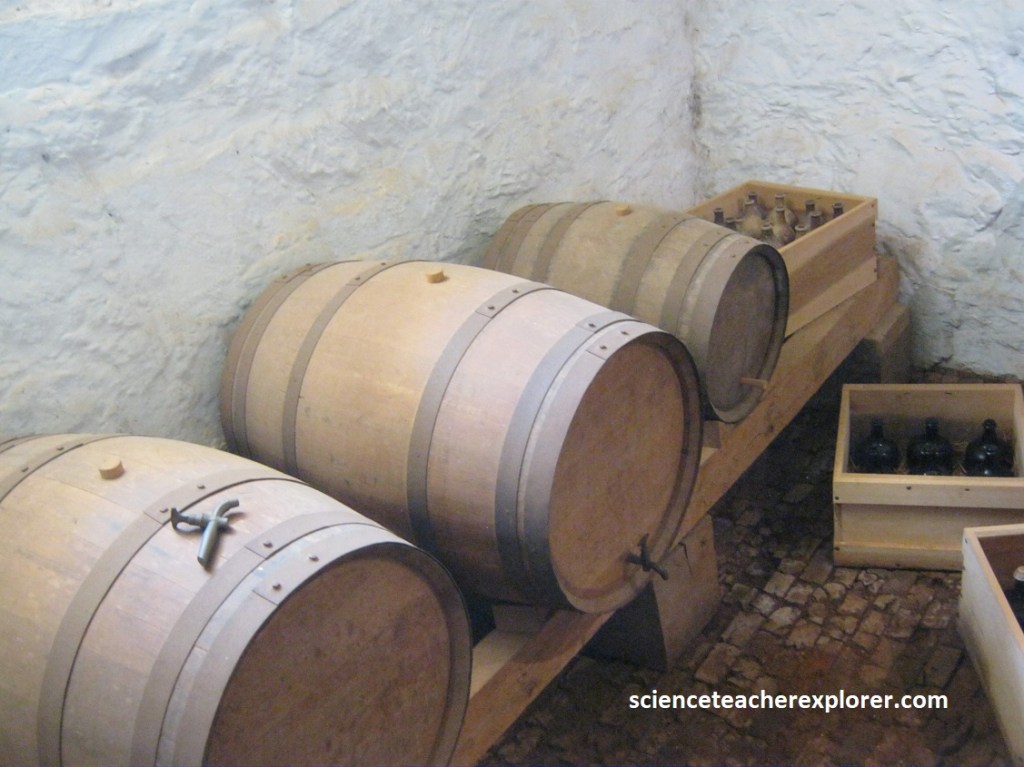
Beer, made in breweries and in households, was a popular beverage throughout early America. At Monticello, cider and beer were the “table liquors” typically served during dinner. Jefferson’s earliest designs for his plantation included spaces for brewing and the storage of beer. Pictured above, this room was furnished as a storage cellar for beer. Next to this room was an empty room called the Ware Room.
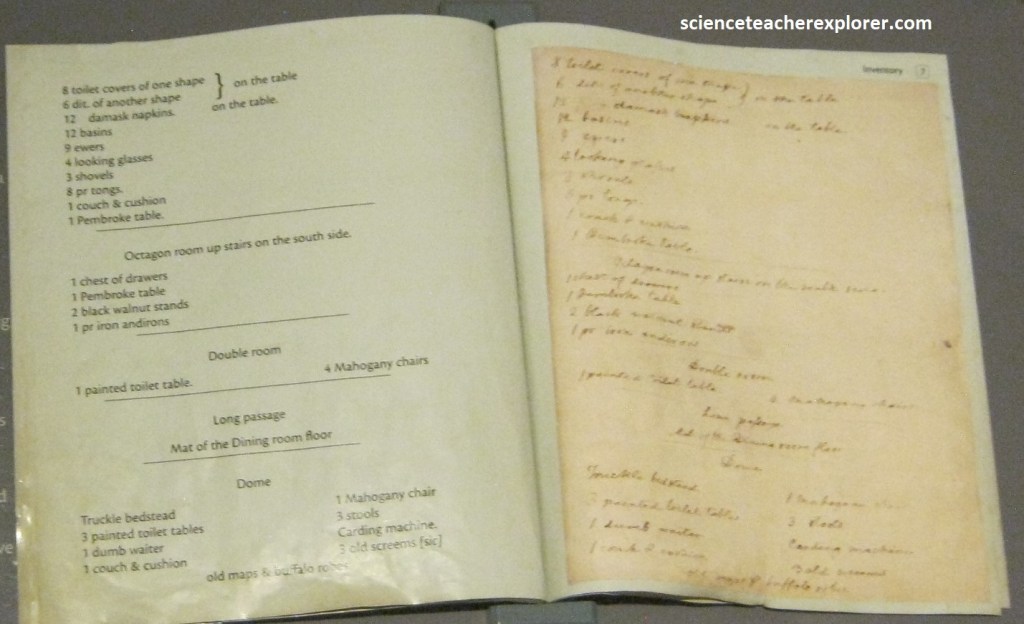
The women of the Jefferson family managed the Ware Room as part of their household duties. This entailed keeping it stocked and organized, maintaining current knowledge of what was there, and distributing daily ingredients to the cooks. A surviving household account book from the 1820s reveals that Martha Jefferson Randolph and her daughters kept records of the amounts of brown and white sugar, flour, tea, and other staples bought and used. An account book kept by Marth Jefferson, Jefferson’s wife, from 1772-82 reveals that she concerned herself with the same details that occupied her daughter and granddaughters forty years later.
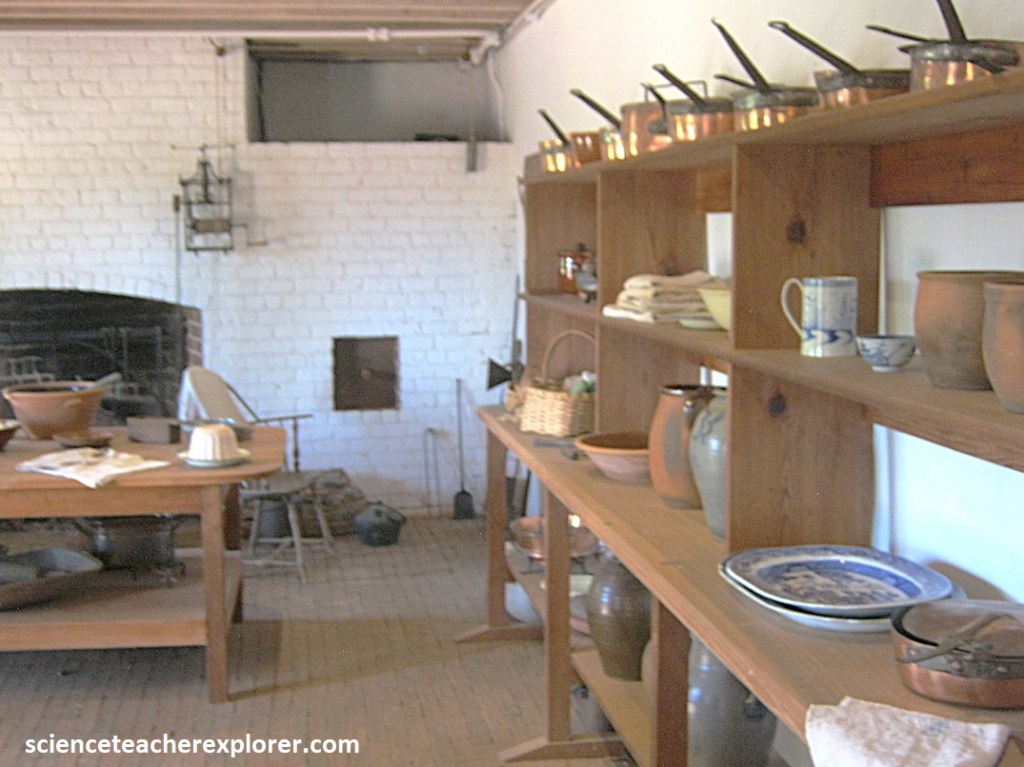
From the first year of Jefferson’s retirement in 1809, the space pictured above bustled with activity. The day began before dawn with the kindling of the cooking fires. Expert enslaved cooks rained in French culinary arts worked hard to prepare two meals a day, (a hearty breakfast and dinner). Jefferson’s table revealed his enthusiasm for French cuisine, cultivated during his diplomatic service in Paris. The unusually well-equipped kitchen contained a fireplace, a bake oven, set kettle, stew stove, and cooking equipment, including dozens of copper pots and pans sent home from France. Notice the “Spit Jake” on the wall far wall above the fireplace. This was driven by lead weight, slowly turned meats and poultry roasting on spits place near the fire. Pots and kettles hung from a crane in the fireplace.
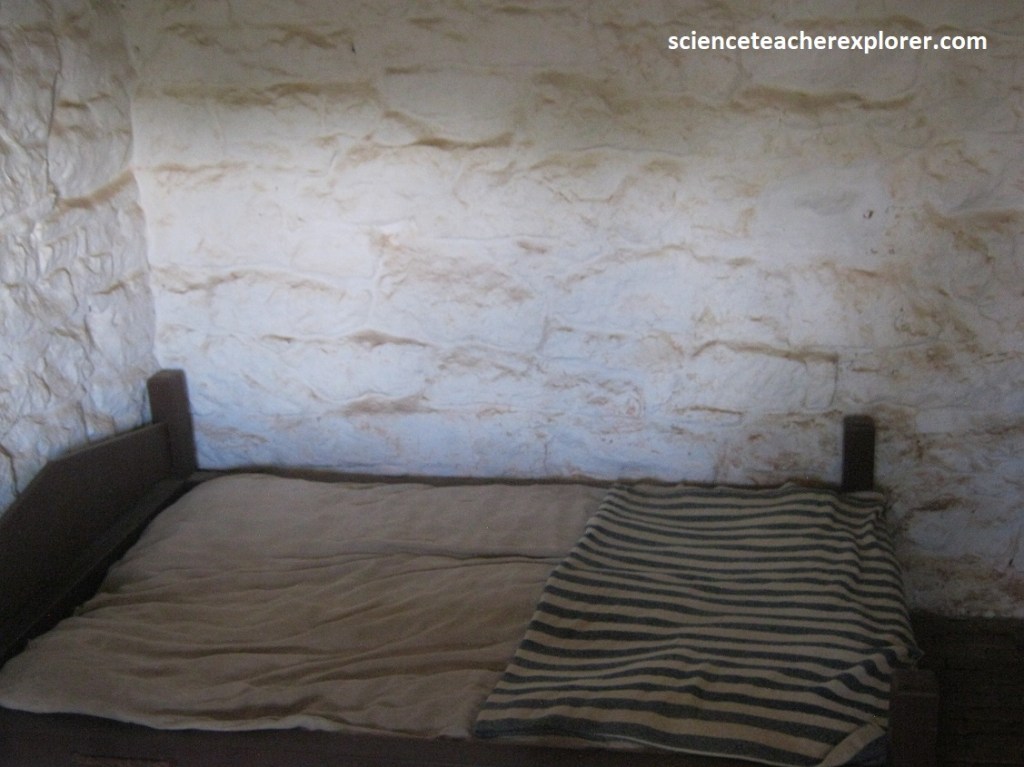
Pictured above, the Cook’s Room, adjacent to the Kitchen in the South Wing, was occupied by Monticello’s head cook. It was first used as living quarters by Peter Hemings, followed by Edith Fossett and her family in 1809. The Fossett family of 10 enslaved souls, shared the space of 140 square feet.
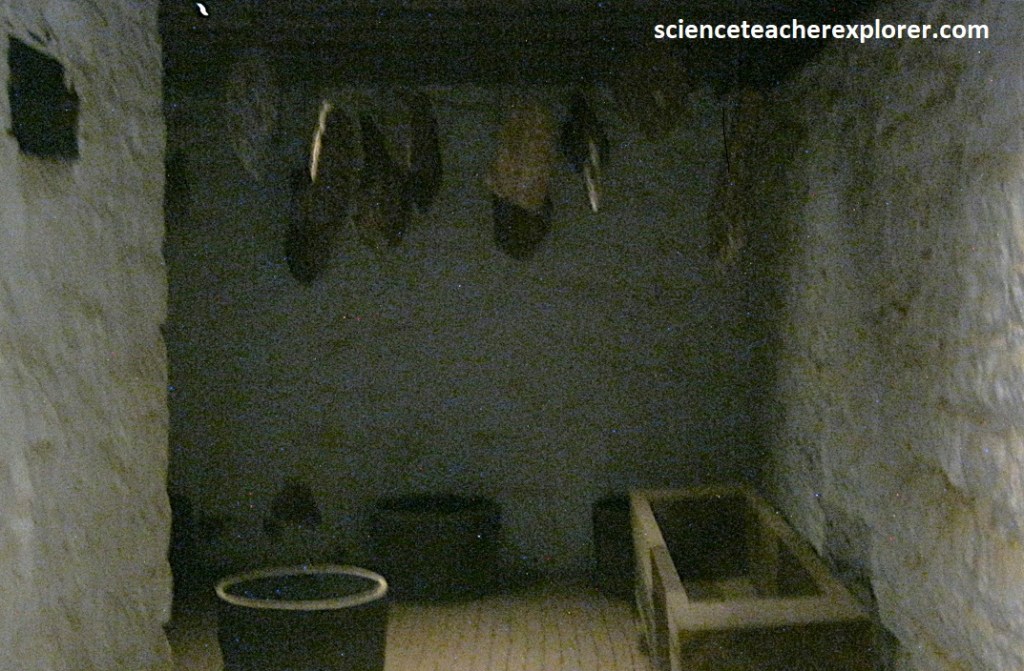
The smokehouse, (pictured above), included a fireplace that could be stoked from the outside while the meat remained locked away behind it. Once the main cuts of meat were butchered from a cow or pig, enslave servants cut the meat into smaller pieces, such as bacon; covered it in salt; and hung it by a low-burning fire to cure.
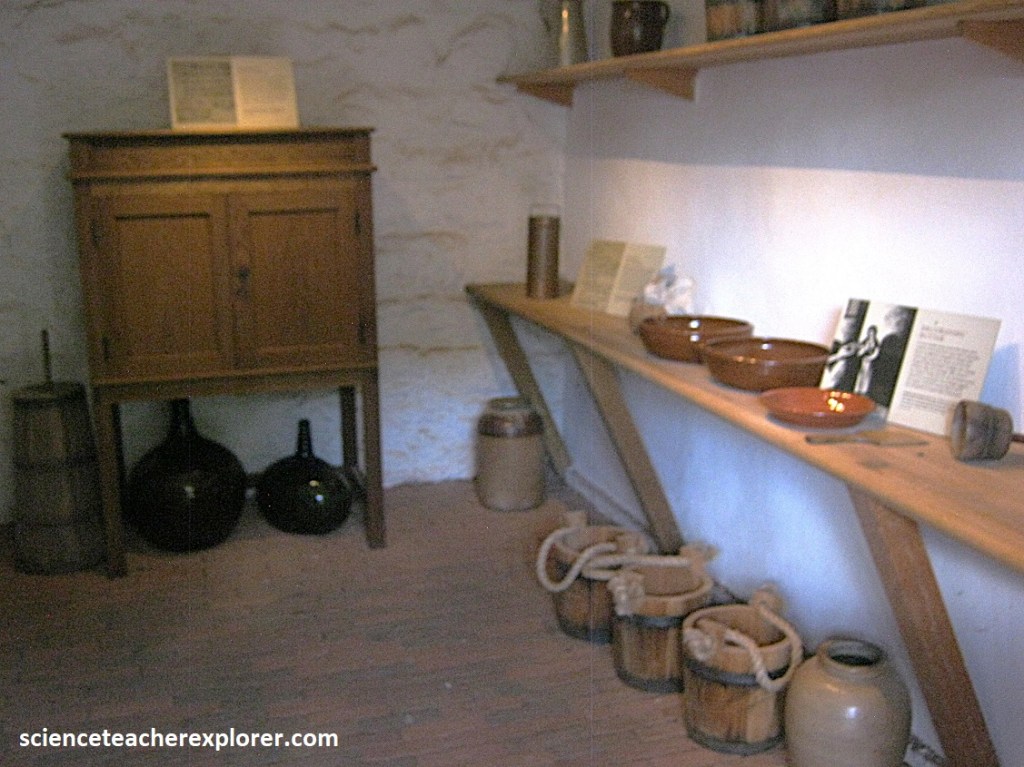
Enslaved dairymaids turned fresh milk into the cream, butter, and soft cheeses essential to Jefferson’s “half Virginian, half French” meals. Dairy products were processed and stored in the above photo, before being used by the enslaved cooks.
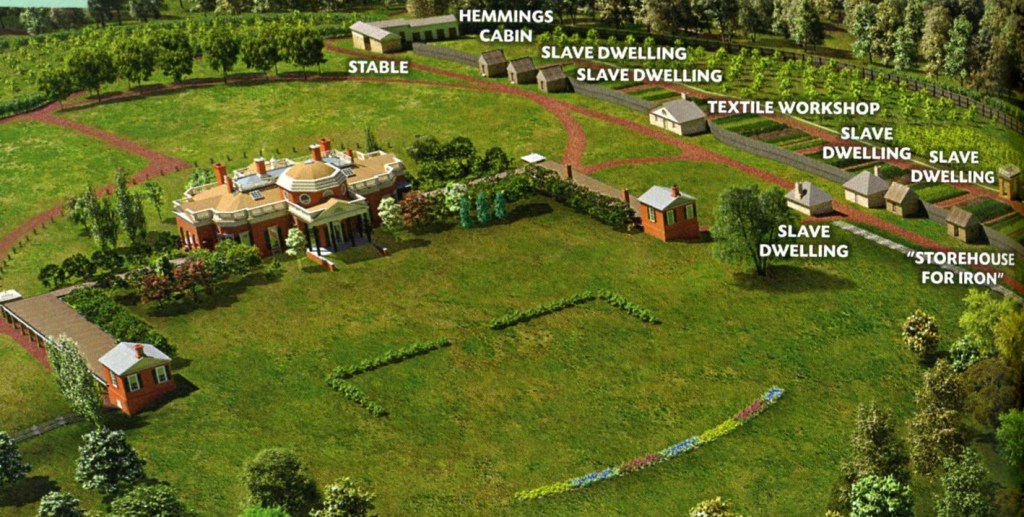
Pictured above, Mulberry Row is the ever-changing hub of this 5,000-acre plantation, once lined with more than 25 dwellings, workshops, and sheds. Enslaved people, free blacks, and free and indentured white workmen lived and worked here as weavers, spinners, blacksmiths, nail-makers, carpenters, joiners, gardeners, stablemen, and domestic servants. The remains of 4 original structures and a few re-created ones hint at the complexity of the Monticello plantation.
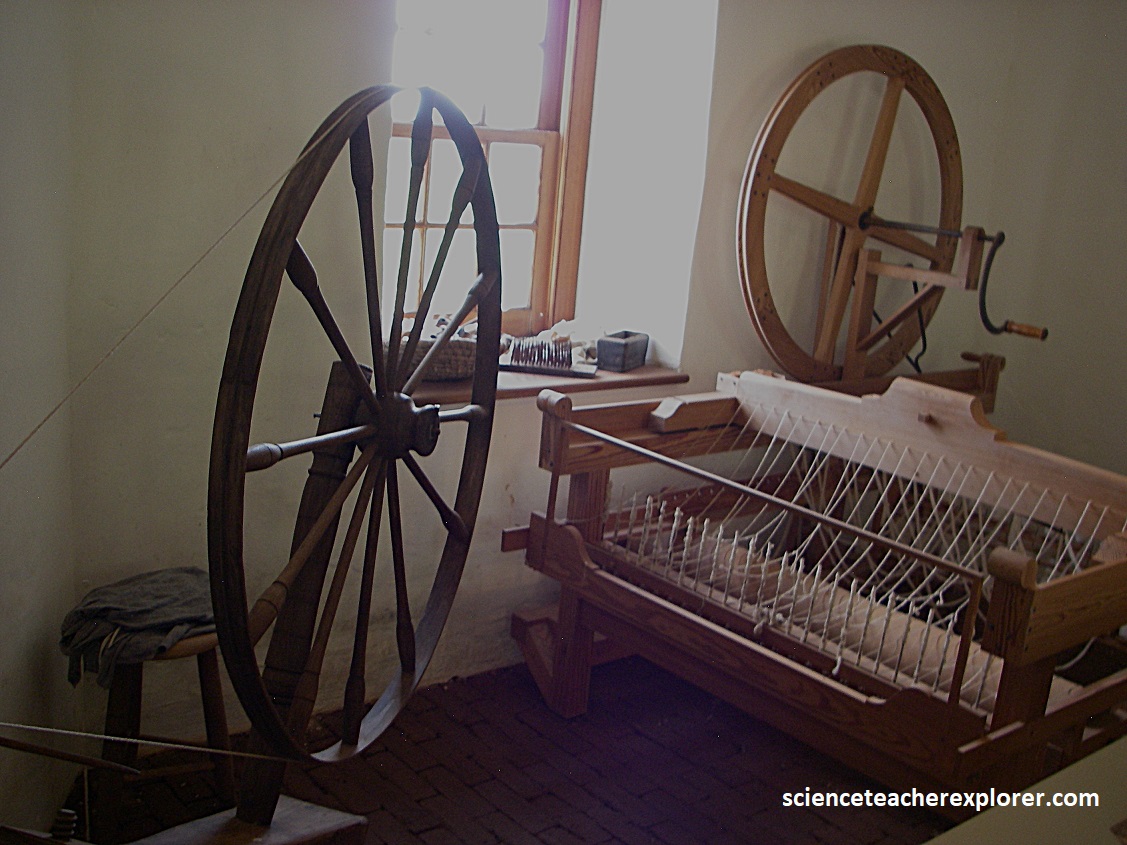
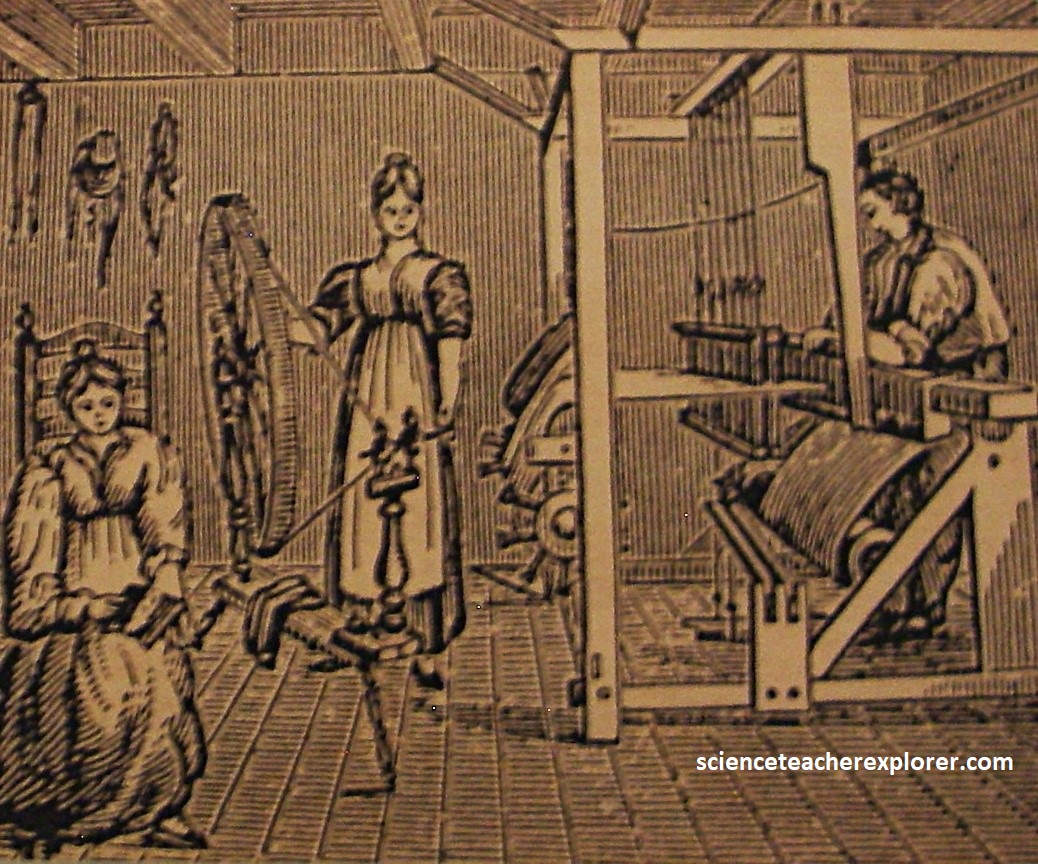
Pictured above, in 1811, Thomas Jefferson fitted tis building for domestic textile production. Trade embargoes and impending war with Britain curtailed the availability of inexpensive British fabrics. Jefferson introduced machinery, operated by enslaved women, children & invalids who could do little in the farm to produce enough coarse cloth to clothe the enslaved workforce at Monticello annually. The multigenerational workforce ranged from young boys and girls to experienced female spinners and weavers in their thirties and forties. Jefferson hoped to make Monticello self-sufficient, capitalize on the labor of underutilized people, and create a domestic example of the industrialized factories emerging in the norther states in the early nineteenth century. Pictured above is a Spinning Jenny in which mechanized spinning is done by linking multiple spindles, and dramatically increase yarn production. The spinner put fibers on the spindles, moved the drawbar back and forth, and turned the wheel, casing all the spindles to spin simultaneously. The above image on the right is a loom with a flying shuttle. In this case the weaver worked the loom by pulling a wheeled shuttle with the yank of a cord, sending it flying across the strands of yarn (the warp), to lay down the interwoven weft yarn. {Note this image was taken from an interpretive sign on-site}.
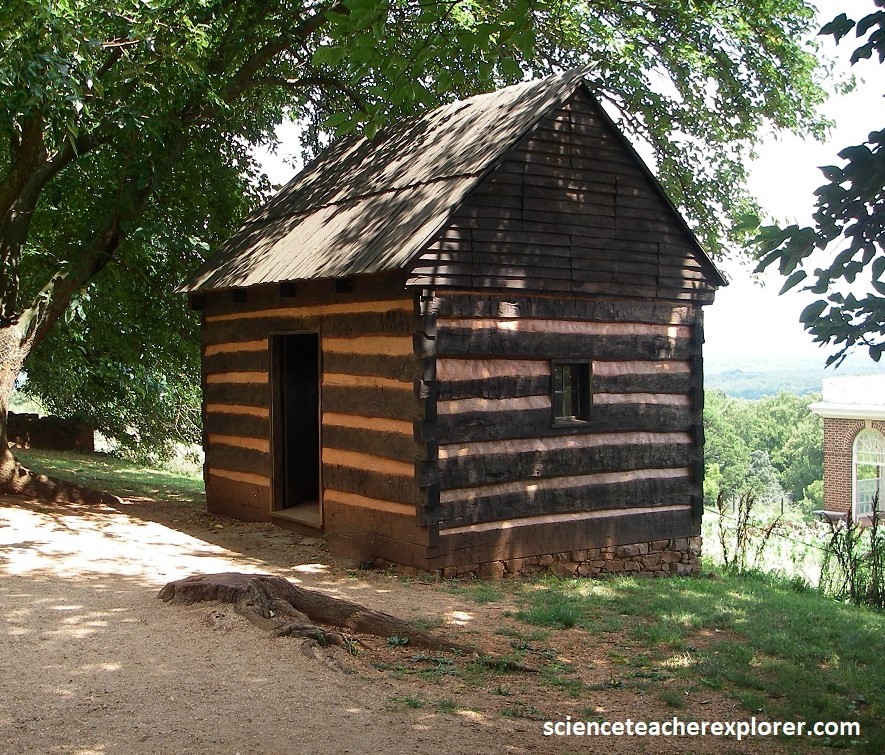
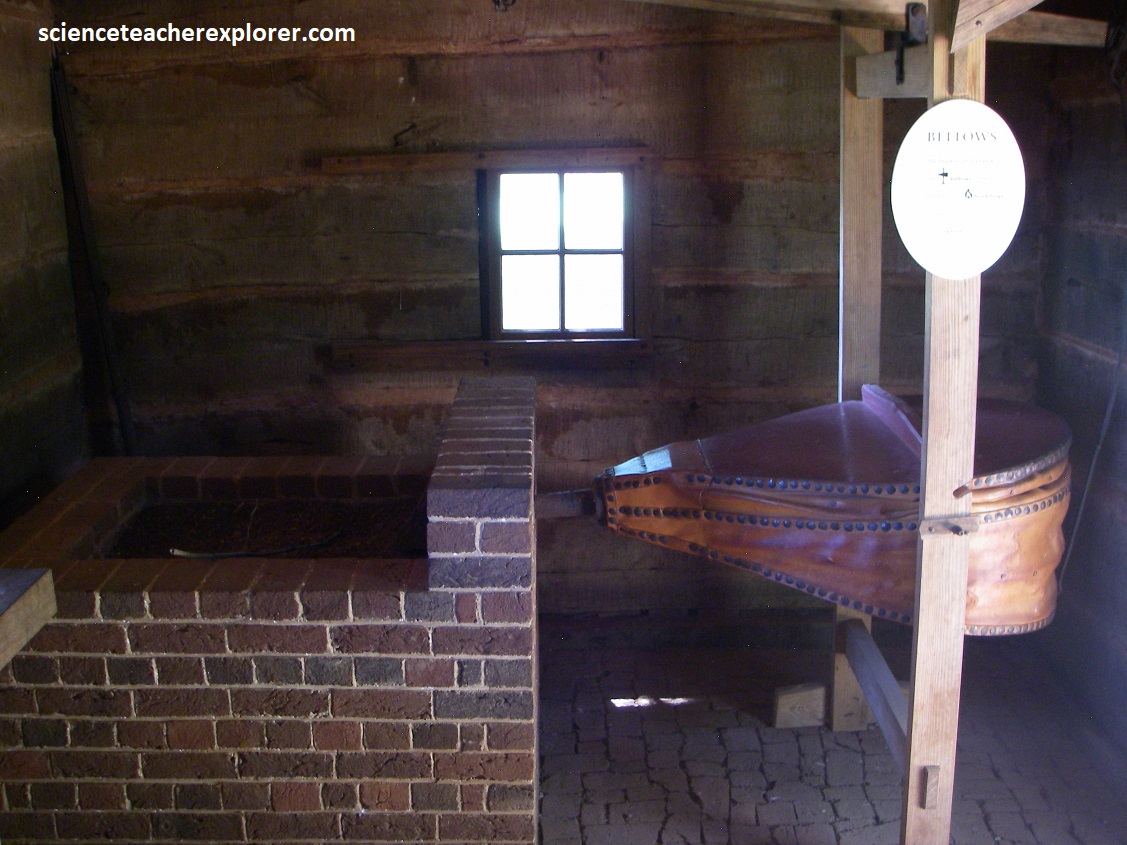
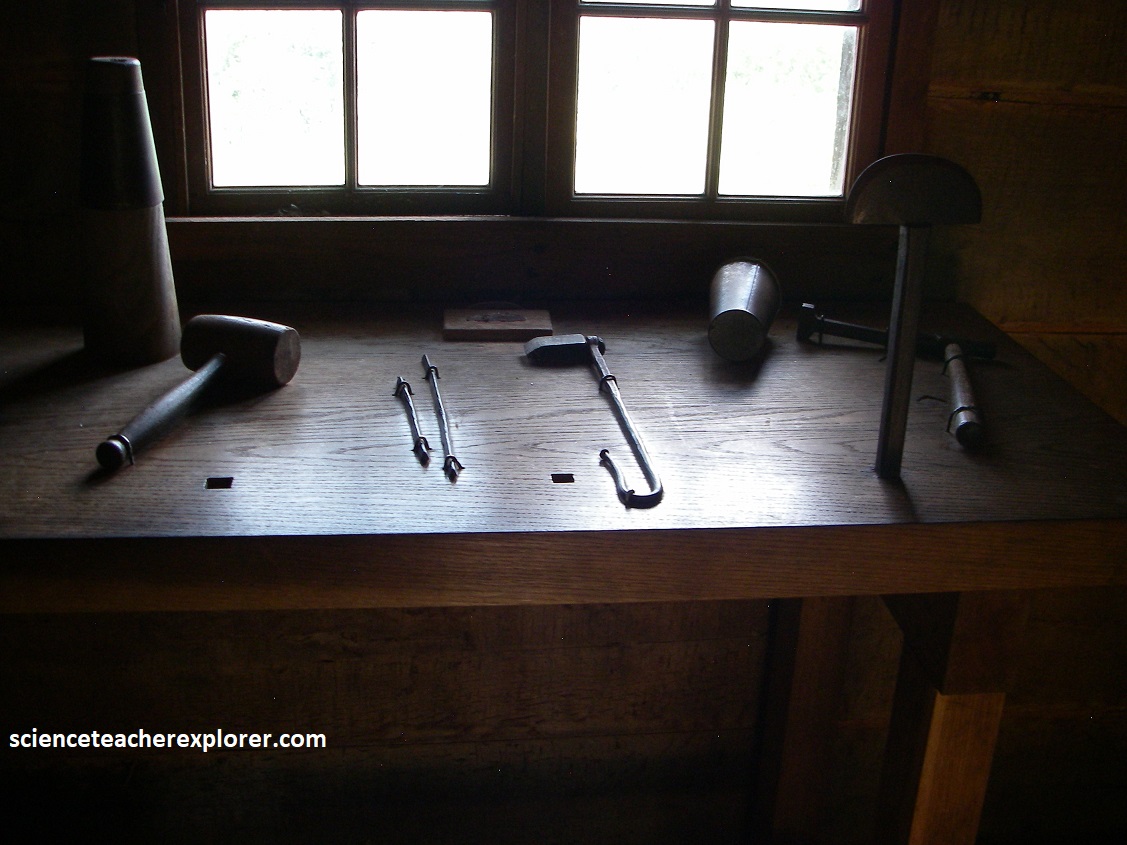
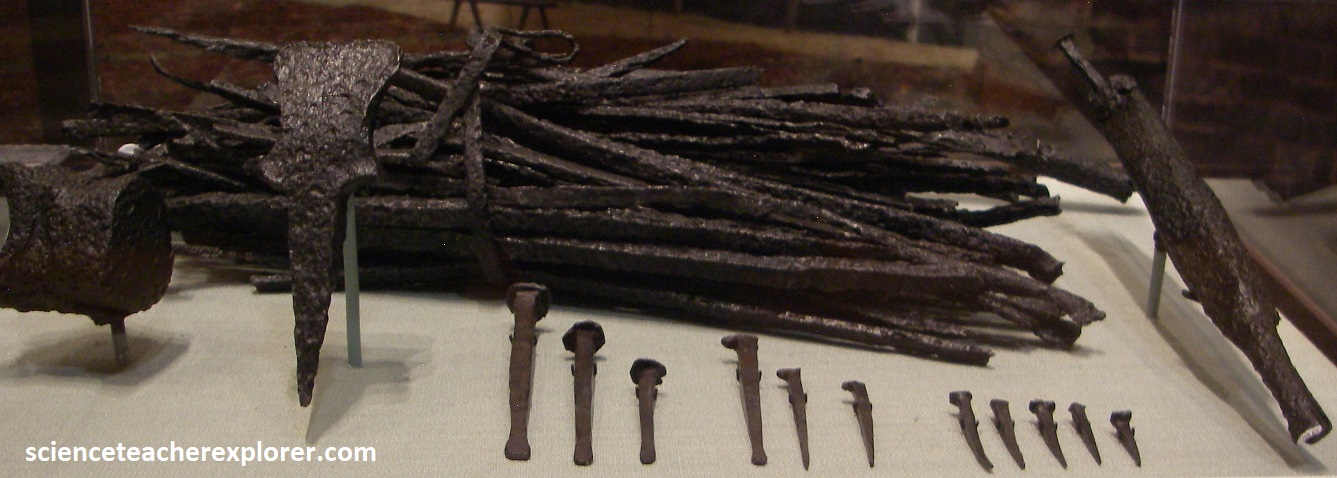
Isaac Granger Jefferson worked the forge in the original building, pictured above, which housed a “storehouse for iron” in 1796, a short-lived tin-smithing operation, a small nail making shop, and also served as quarters for enslaved people. The use of buildings on Mulberry Row changed during the long construction of the house and as Jefferson set up small industries to increase the plantation’s self-sufficiency. Jefferson shifted enslaved workers from task to task and location to location, often giving or hiring them to his family members. Isaac mastered three trades and belonged to three different members of Jefferson’s family before becoming free. Pictured above on the right, the blacksmith pumped the bellows to fan the fire in the brick forge so that he could quickly heat the nail-rod and hammer it into shape on an anvil. The other picture are tools used to make a tin-cup.
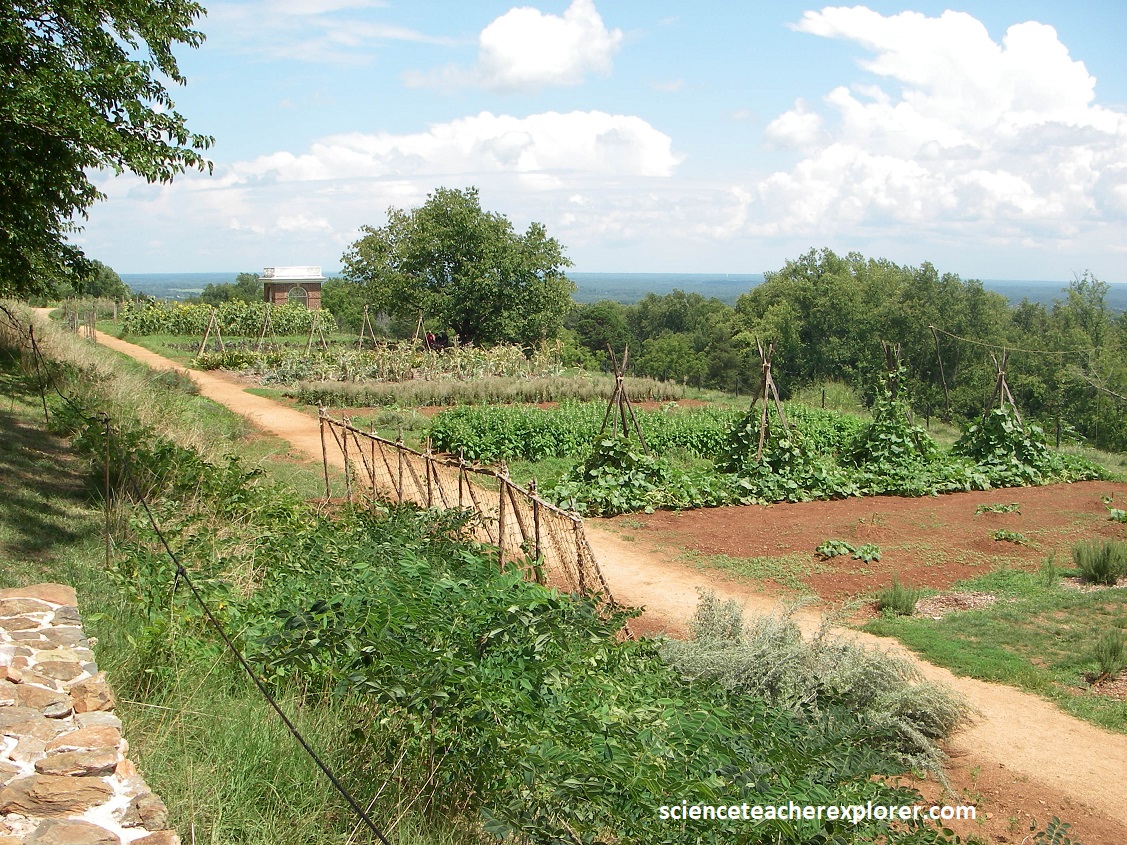
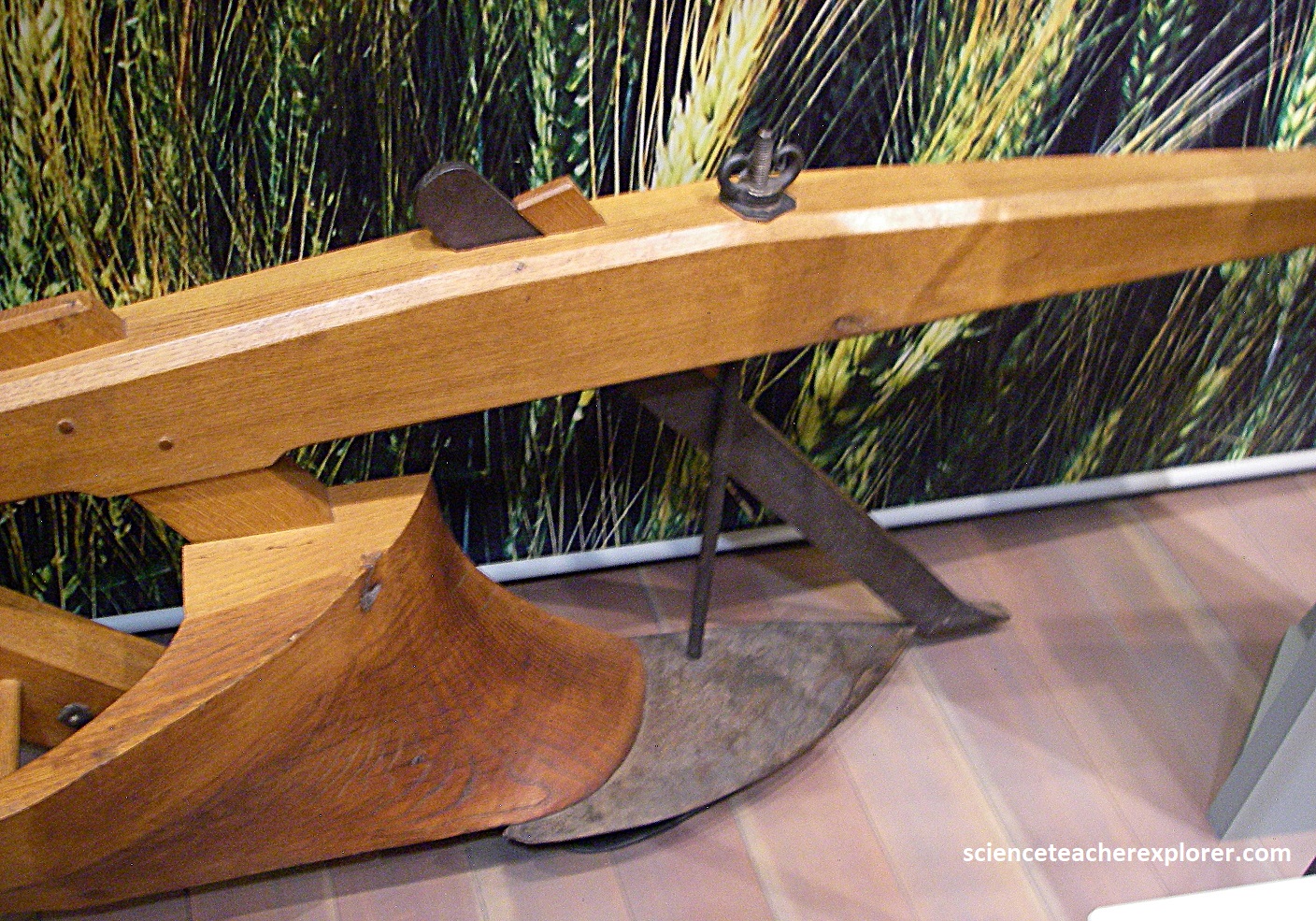
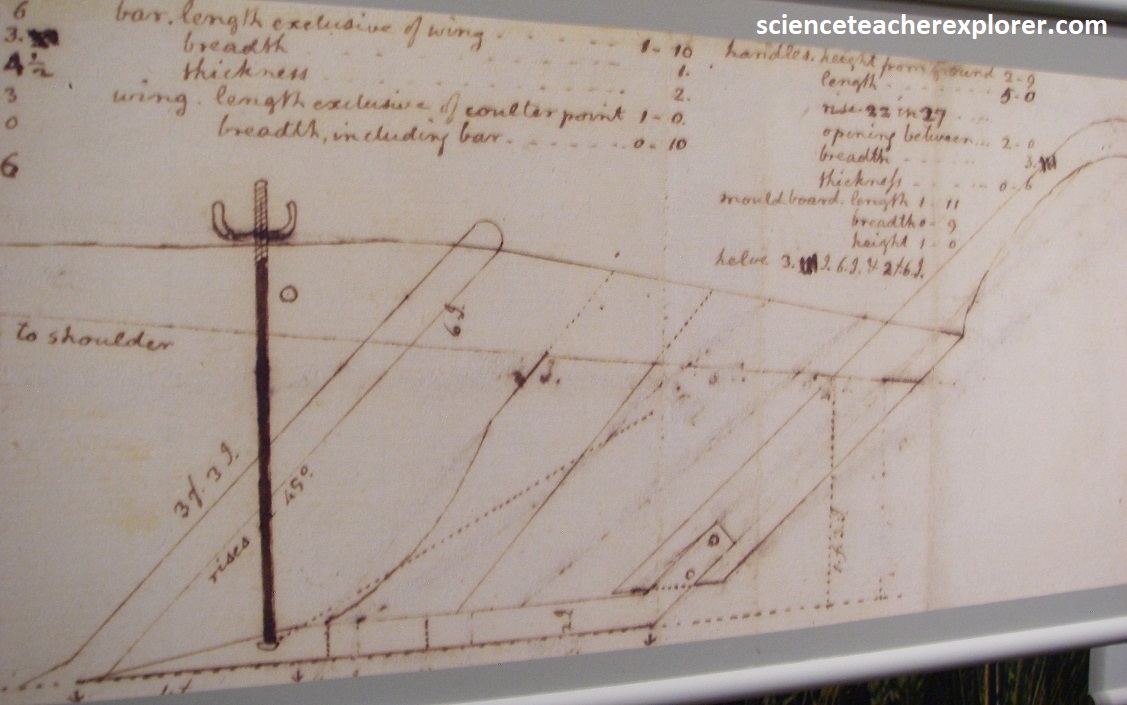
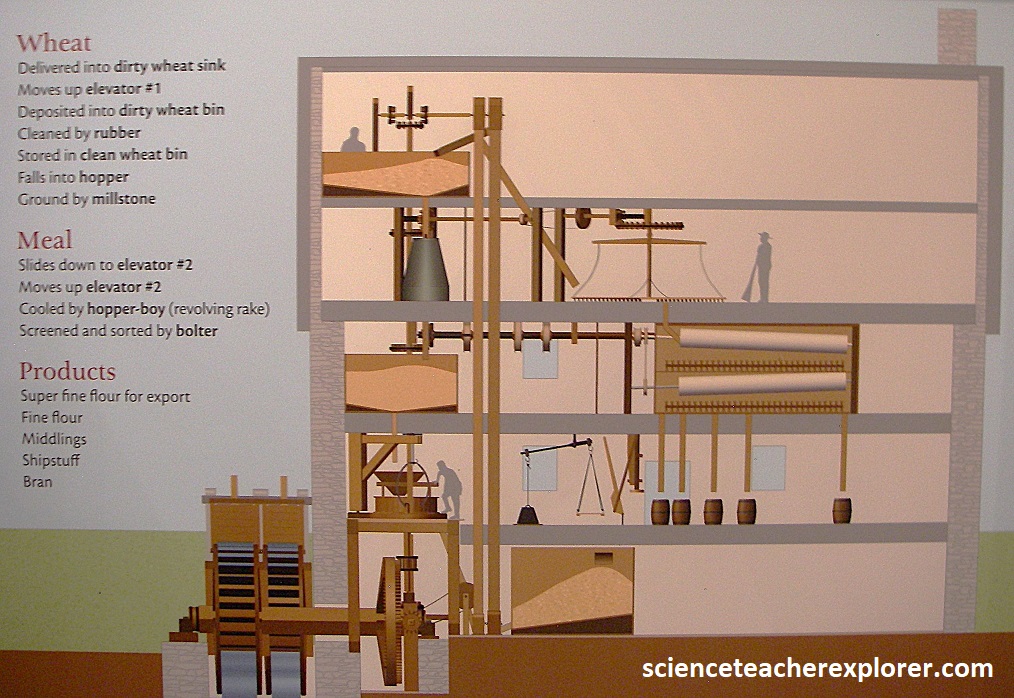
Jefferson raised commercial crops on his plantation’s three “quarter farms” (Tufton, Shadwell & Lego), adjacent to the Monticello farm. Enslaved men and women cultivated the crops; tended the livestock; and repaired fence, buildings, and machinery under the eye of an overseer at each farm. Until the 1790s, tobacco was Jefferson’s main cash crop. But after his retirement as secretary of state in 1794, he switched to wheat and rye. The grains were processed into flour at two state-of-the-art mills Jefferson owned at Shadwell, (design imaged above). They were then packed in barrels made by Jefferson’s coopers and sipped down the Rivanna River to Richmond. Note the Jefferson’s Plow pictured above. It was designed and made to improve the performance of his plows. The moldboard, (the wooden part that lifts and turns the sod), uses the principle of the wedge as the “instrument of least resistance”. {Note that the design images above of the plow and mill were taken from an interpretive sign on-site}.
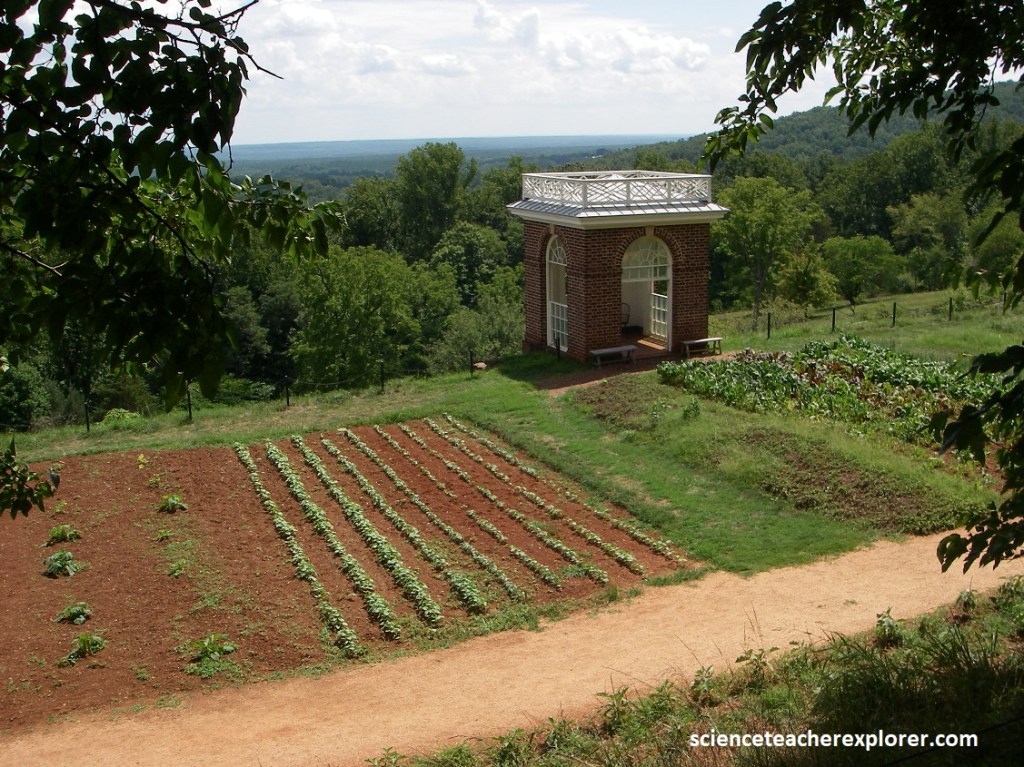
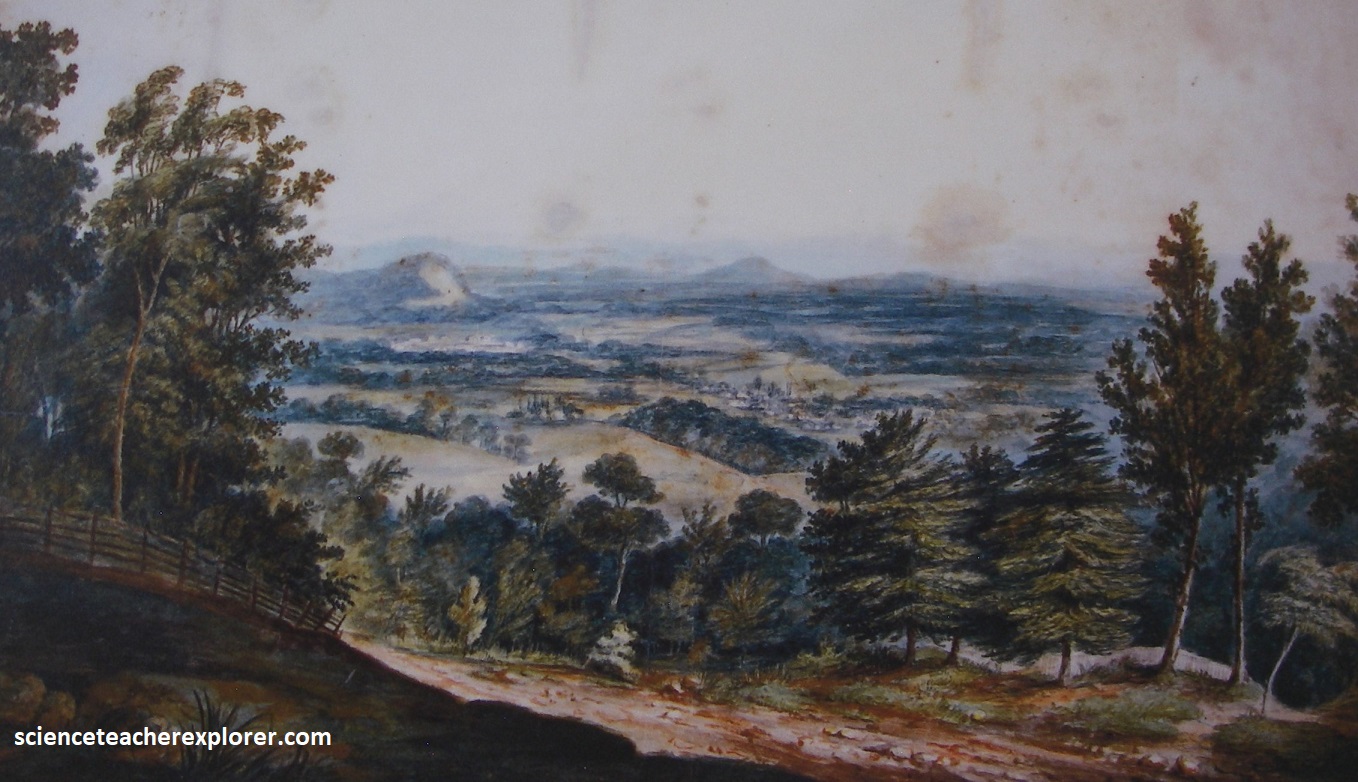
In 1812, Jefferson divided his vegetable garden into 24 rational plots, according to the part of the plant to be harvested: fruits (tomatoes, beans, etc.), roots (beets), and leaves (lettuce, cabbage). Built on a terrace facing southeast with a long retaining wall, the garden was a grand experiment. He kept meticulous notes on the day seeds were sowed or plants harvested. To supply salads, Jefferson had lettuce and radishes planted every week. {Note the painting below is of a view from Monticello looking towards Charlottesville by Jane Braddick Peticolas in 1825 and the Stable Scene painting is by George Morland in 1790; Both were taken from an interpretive sign on-site}.
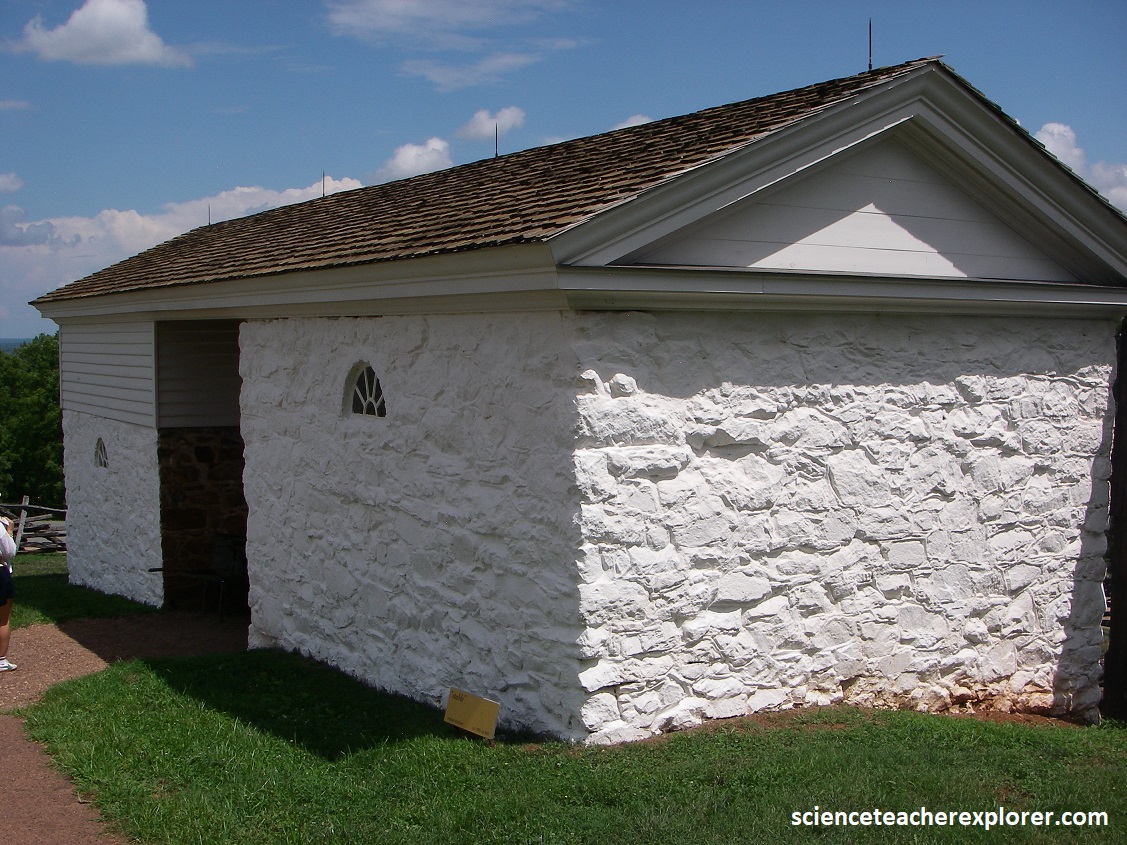
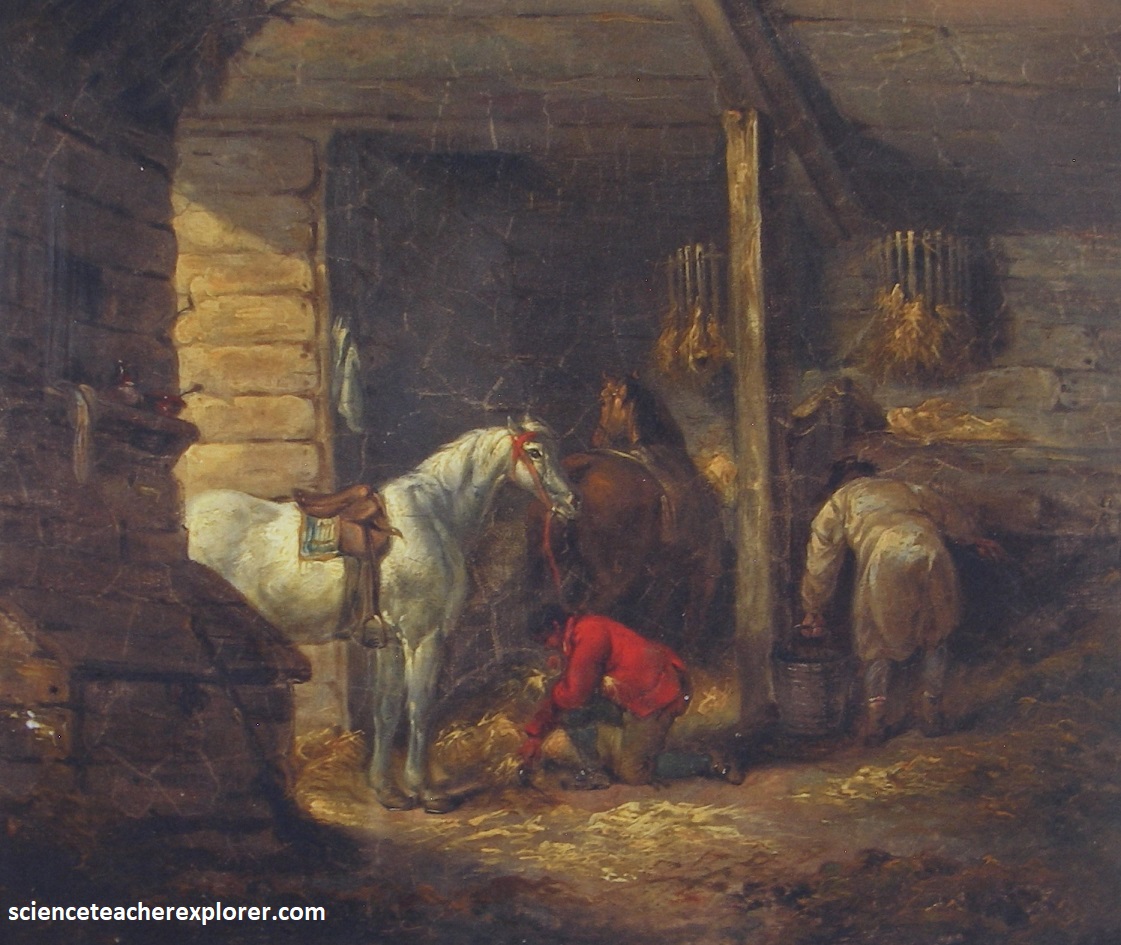
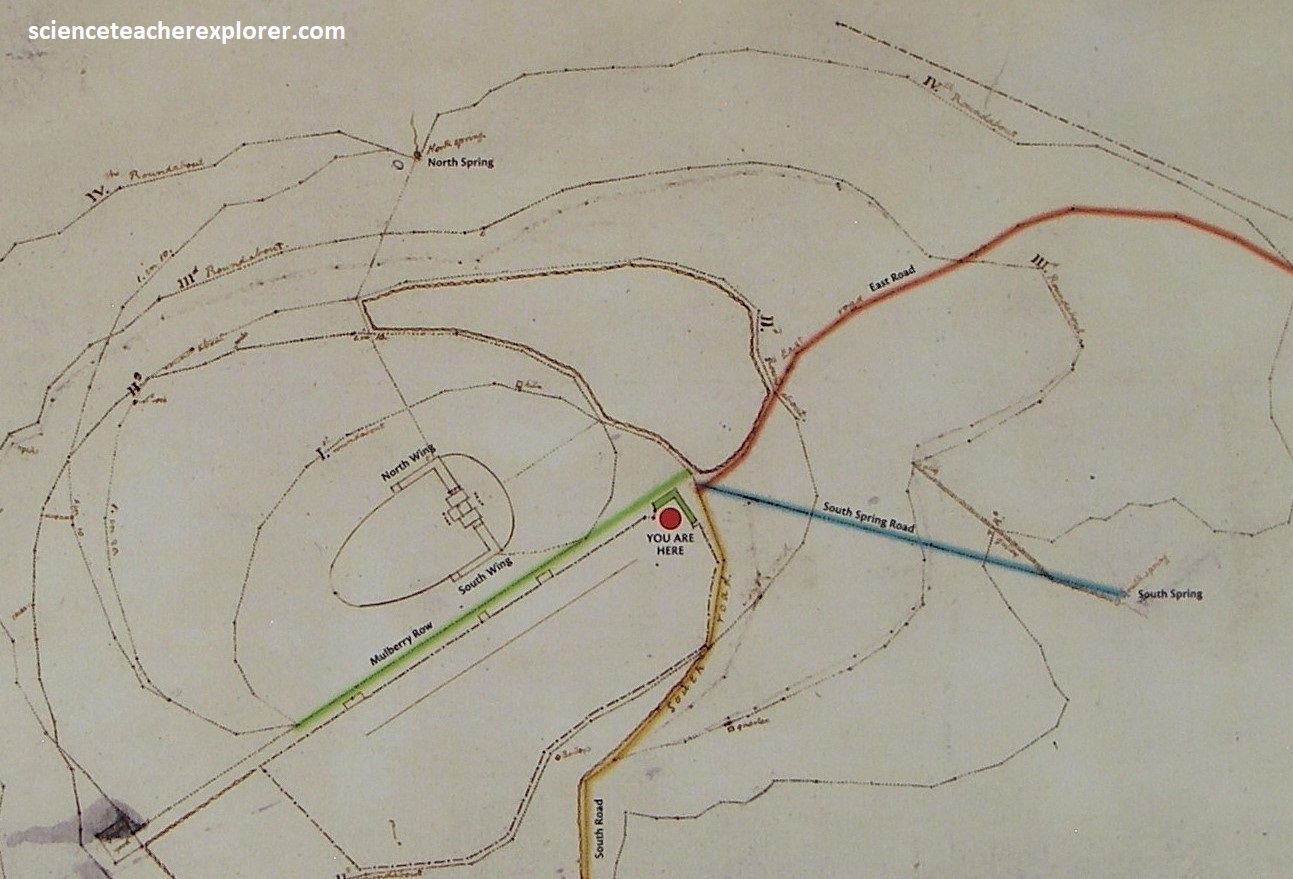
Pictured above, the structure was once part of a larger stable complex completed in 1809. Jefferson, an avid horseman, quartered 5-7 prized riding and carriage horses and stored tack and feed in this central location. Jupiter, Wormley Hughes, and other enslaved hostlers (stable hands or grooms) prepared horses for Jefferson’s ride or pulling carriages here. The stables also may have occasionally sheltered visitors’ carriages. Additional stables on the quarter farms and near the overseer’s house a the foot of Monticello mountain housed the workhorses, mules and oxen that pulled ploughs, carts, and wagons across the plantation’s fields and roads. All roads linking the plantation with the wider world came together at the Stable. The East Road, tied Monticello to the road southeast to Richmond and Williamsburg, and the road north to Washington. The South Road led from the Stable to the “old gate” and to Milton on the Rivanna River, the closest depot for boats from the James River. The “Thorofare” gate, and entrance at the foot of the mountain, connected Monticello to the road to Charlotteville. The closest water source, 800 feet downhill, was located on the South Spring Road. {The above map was taken from an interpretive sign on-site}.
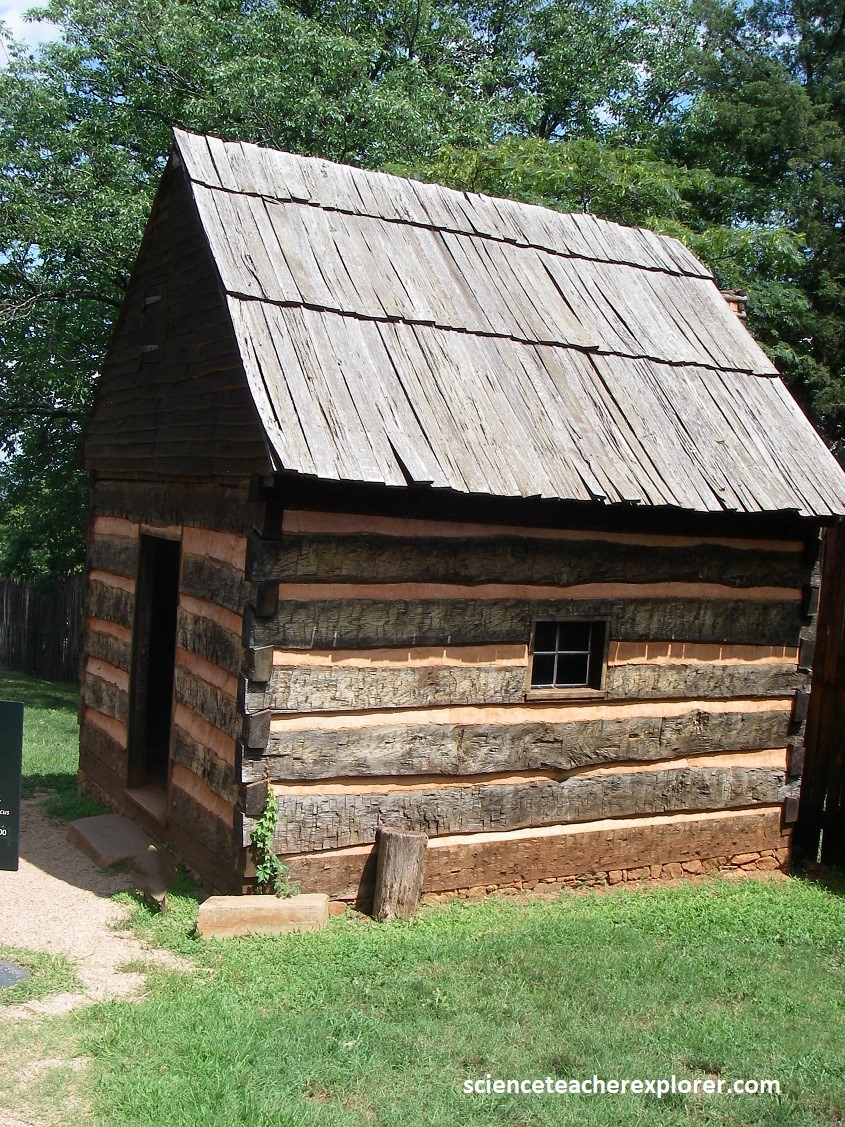
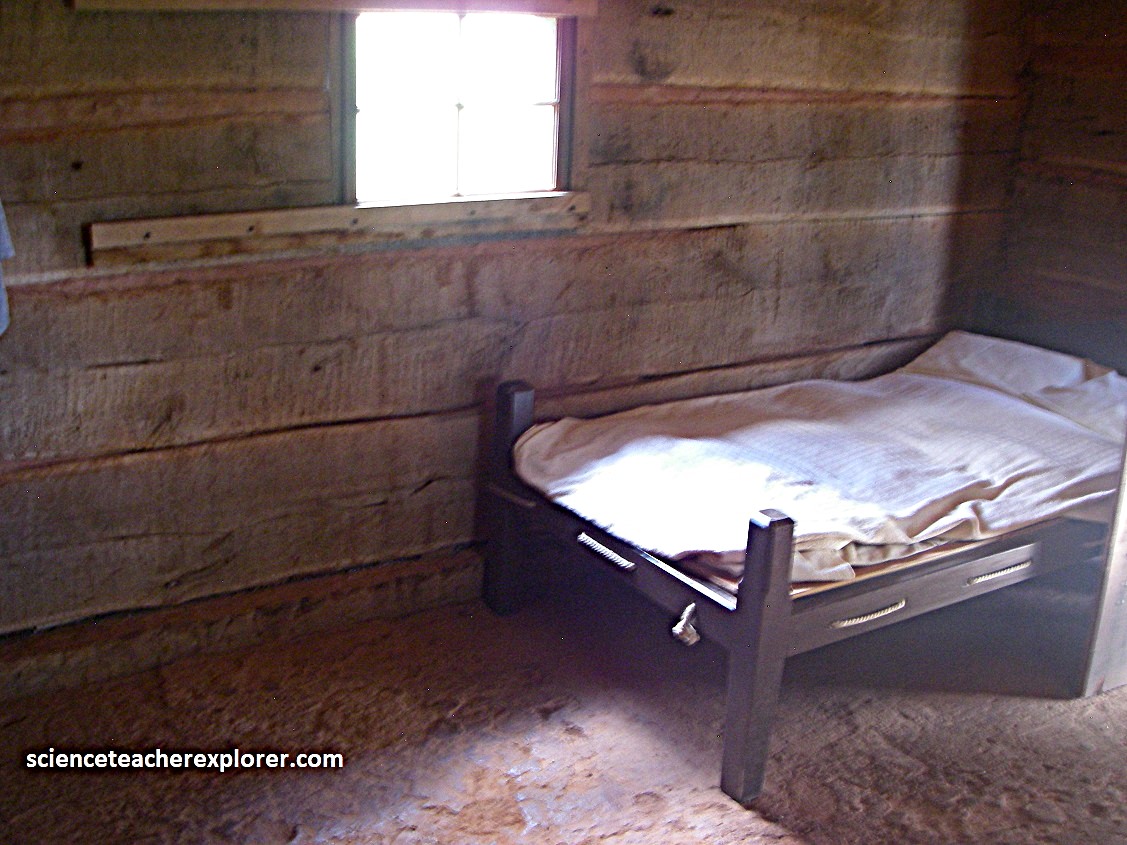
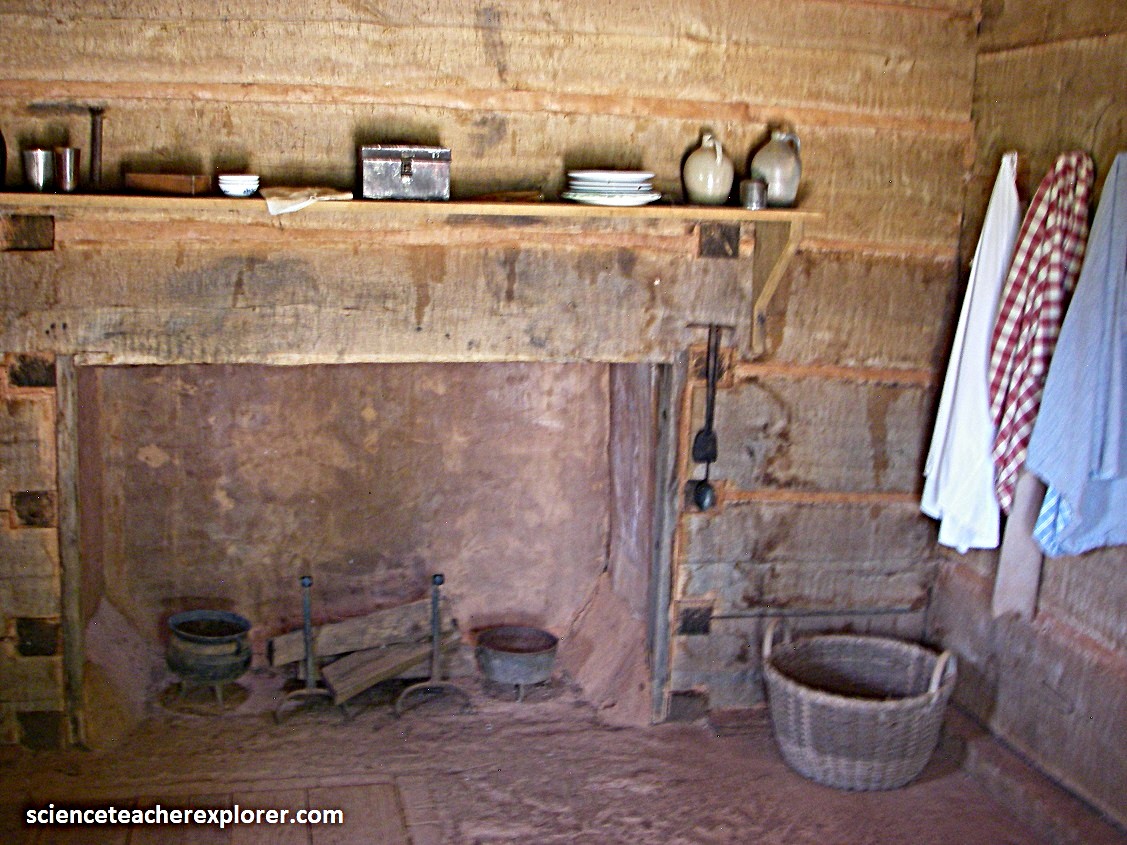
Pictured above, this “Servant’s House” may have housed the head joiner (woodworker) John Hemmings and his wife Priscilla nurse to Jefferson’s grandchildren. This reconstructed slave dwelling is based on archaeological and historical research. They had a close relationship with the Jefferson family. Their house was more comfortably furnished than typical slave dwellings. John helped build this and two adjacent, single-family log houses in 1793. Other family members, (Critta, Peter, and Sally Hemings), at times lived next door. In a Virginia newspaper in 1802, James Callender broke the story of Sally Hemings as Thomas Jefferson’s “concubine” and the mother of a number of his children. Jefferson never responded to the accusation. His recognized family denied his paternity of Hemings’s children, while his unrecognized family considered their connection to Jefferson an important family truth.
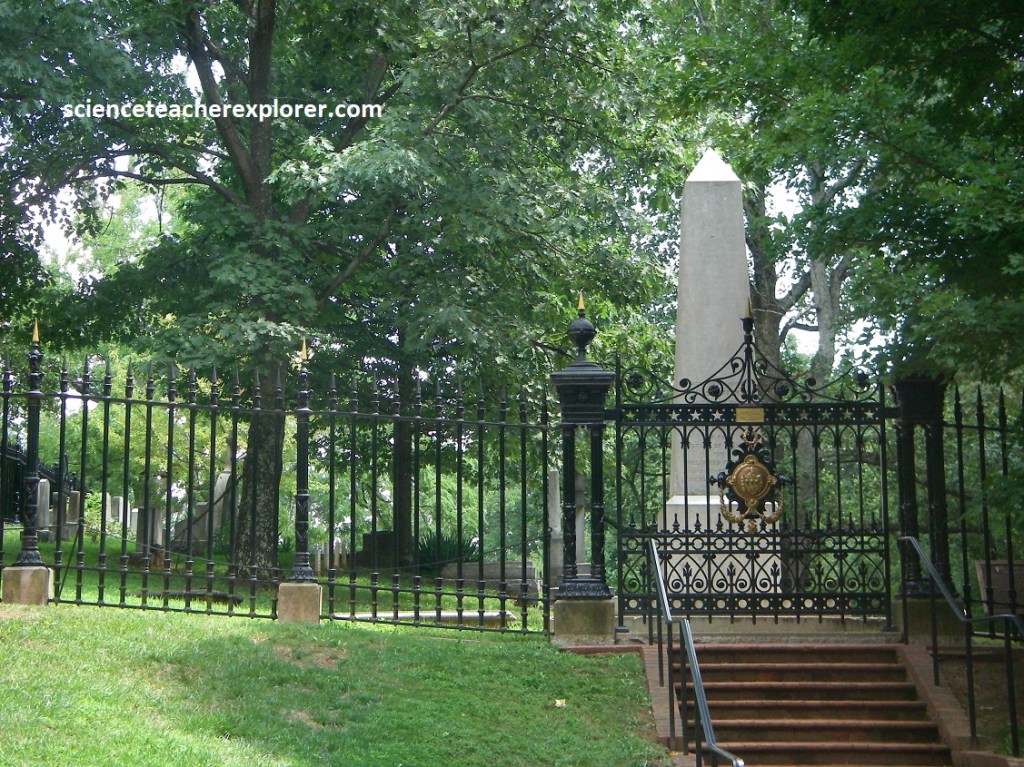
The path from the southwest end of Mulberry Row leads to Thomas Jefferson’s final resting place in a family cemetery still owned by descendants of his daughters Martha and Maria. On July 4th, 1826, the 50th anniversary of the adoption of the Declaration of Independence, Jefferson died at Monticello and was buried the next day in the family graveyard.
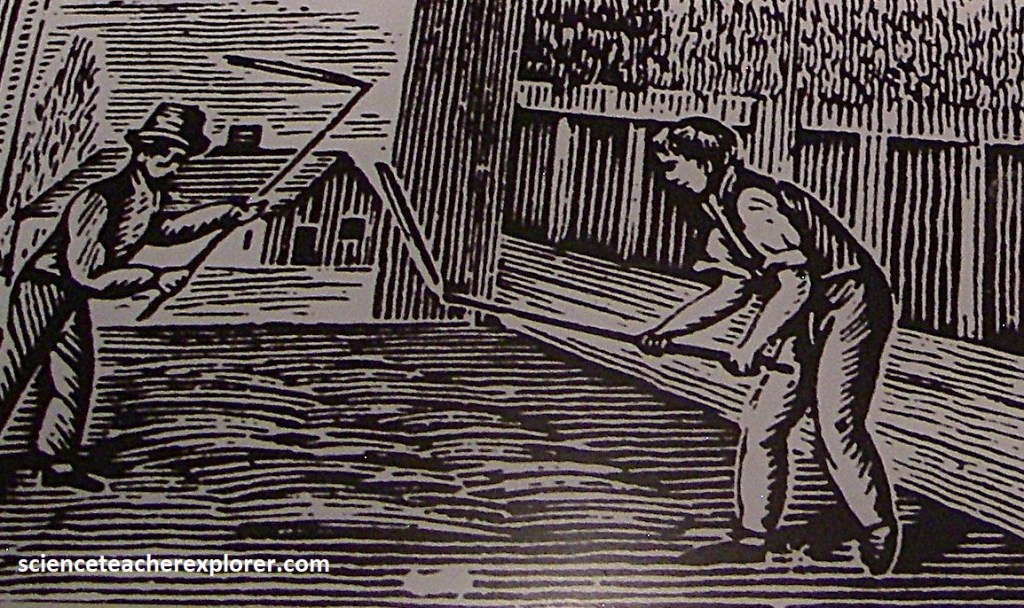
Thomas Jefferson helped to create a new nation based on individual freedom and self-government. His words in the Declaration of Independence expressed the aspirations of the new nation. African Americans, however, were excluded from the promise of “Life, Liberty, and the pursuit of Happiness” that was asserted in the declaration. Jefferson called slavery an “abominable crime,” yet he was a lifelong slaveholder. Fearful of dividing the fragile new nation, he and other founders who opposed slavery did not insist on abolishing it. More than 600 slaves worked at Monticello and Jefferson’s other properties during his lifetime. The majority of slaves at Monticello were farm laborers who lived near the fields they worked. Enslaved house servants and artisans lived in log dwellings on the mountaintop along Mulberry Row or in rooms beneath the South Terrace of the main house.
 Explorer/Trekker