Vallee De Mai, SC
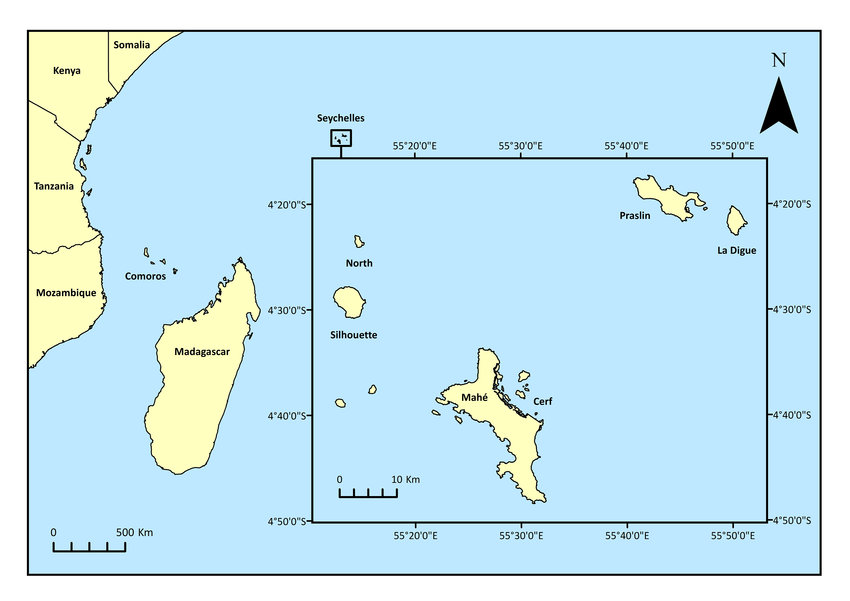
My trekking buddy, Mike Stevens, and I explored the Seychilles Islands in March of 2024, (image below).
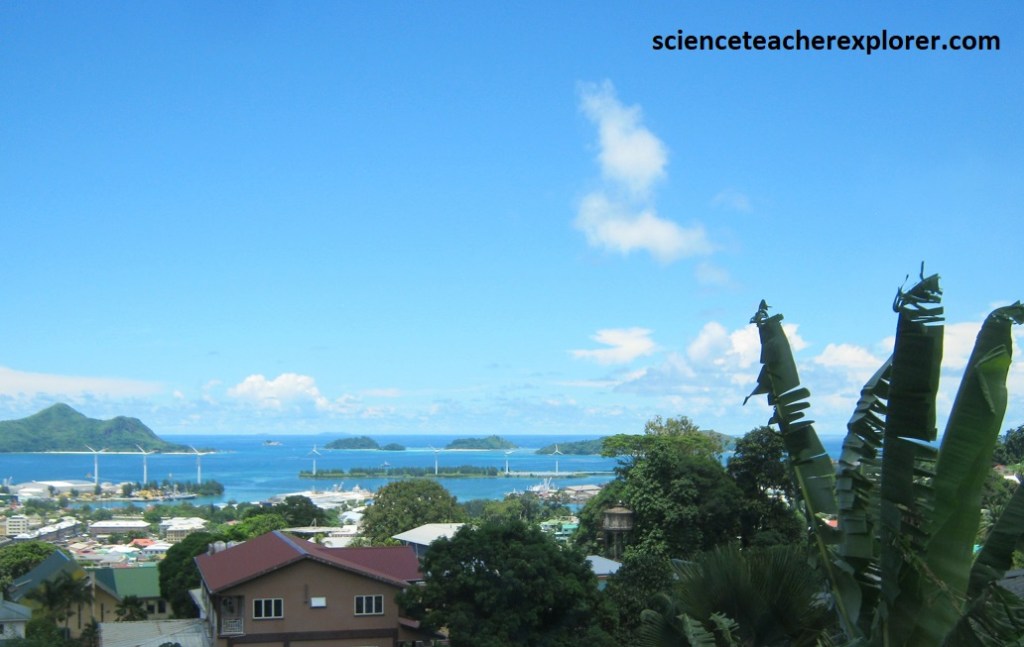
Mahé is the largest island and our entry point to the Seychelles, with the small capital city of Victoria. Imaged below, Victoria is one of the world’s smallest capital cities & home to about a third of the Seychelles’ population.
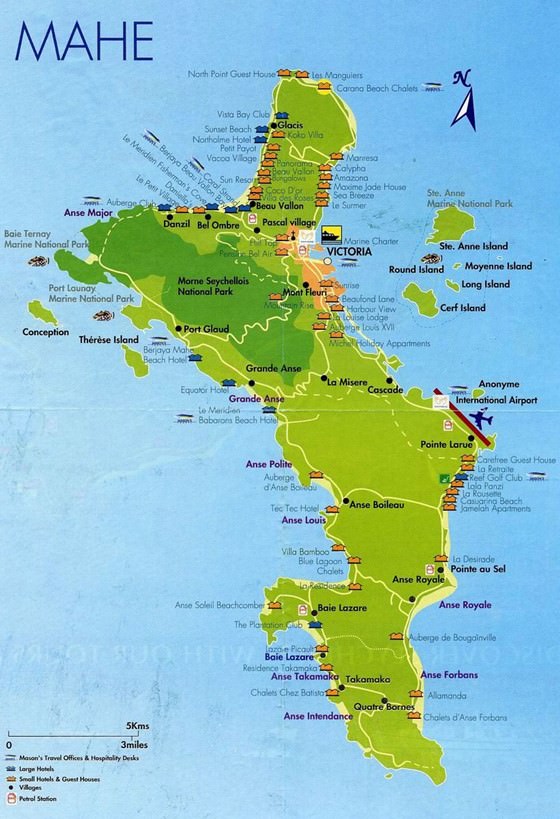
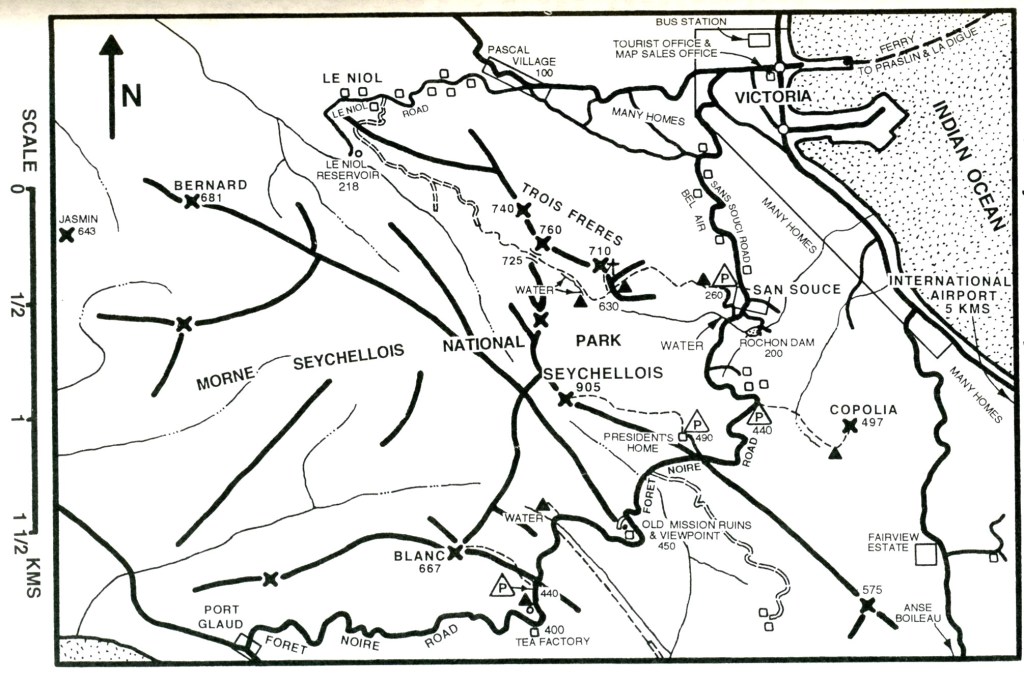
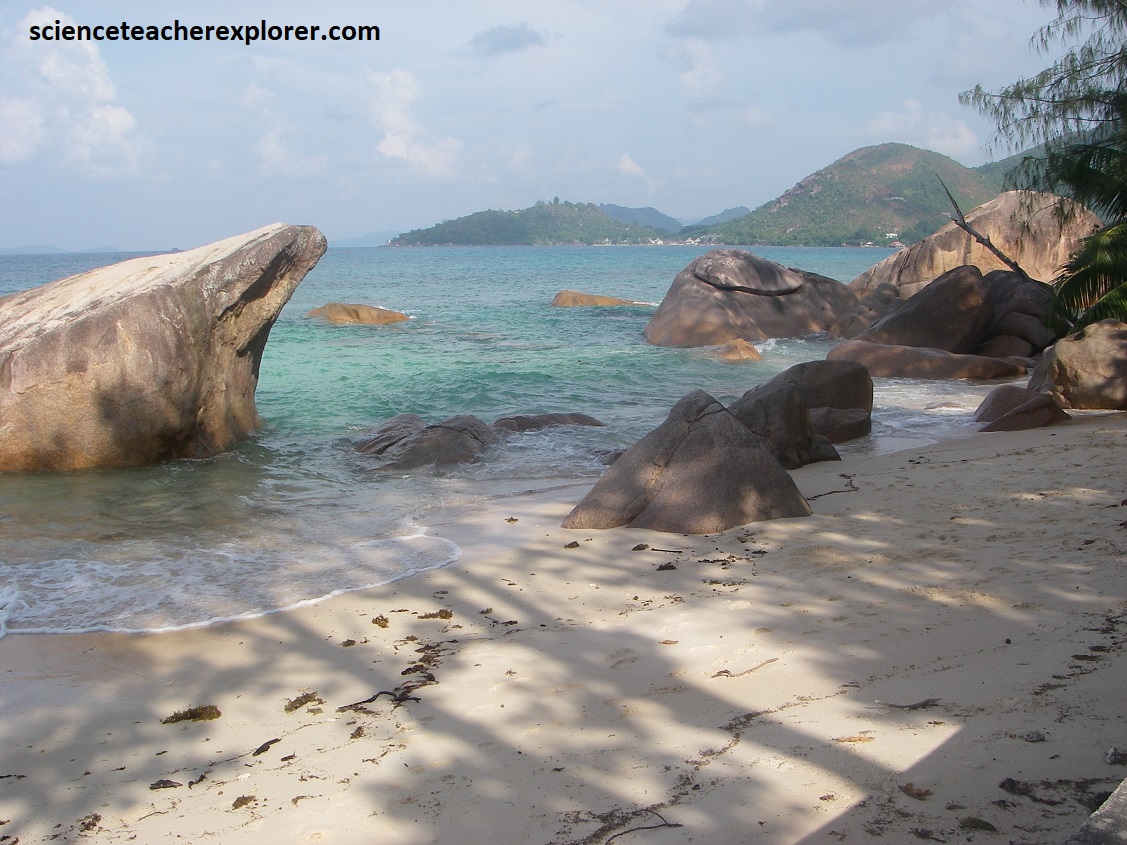
Spellbinding beaches are the main attraction for the Seychelles. Exquisite ribbons of sand lapped by turquoise waters and backed by lush hills, palm trees and Dali-esque boulders. We began our stay on the southern tip of the Morne Seychellois National Park, (pictured below).
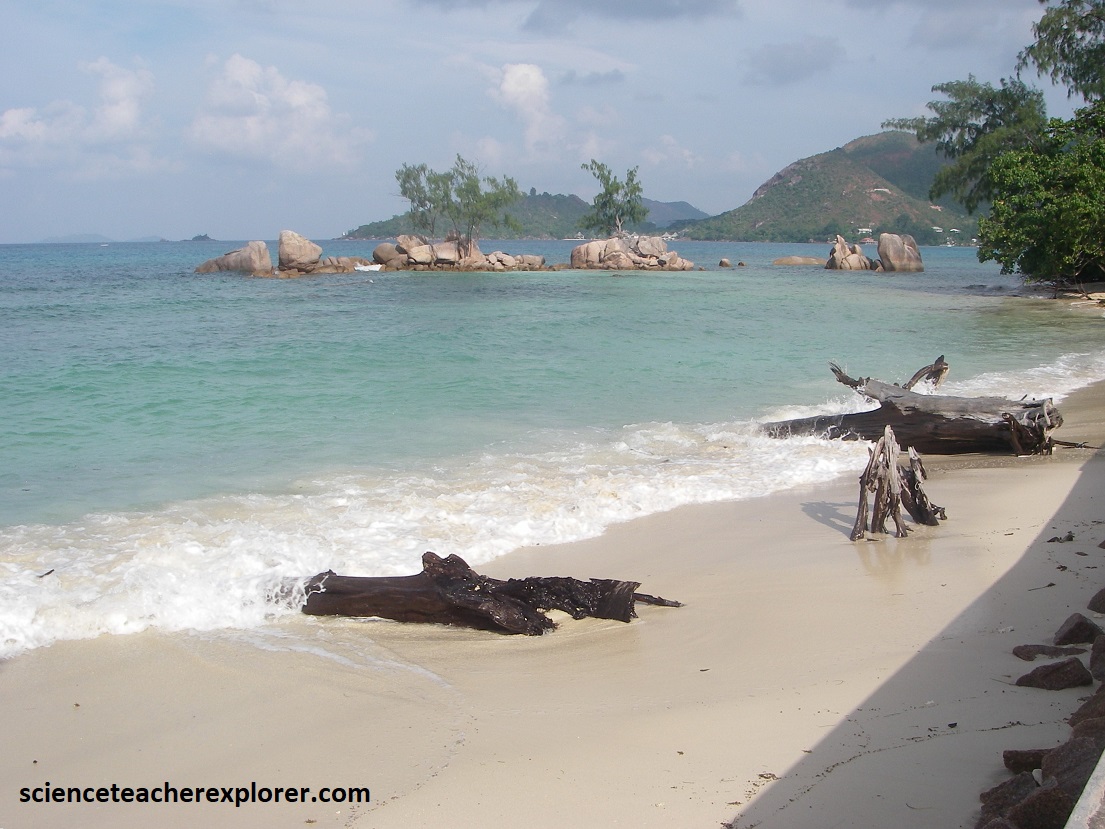
While on Mahé, we rented a vehicle and drove around the entire island. Pictured below, the west coast of Mahé, is one long of stunning beaches.
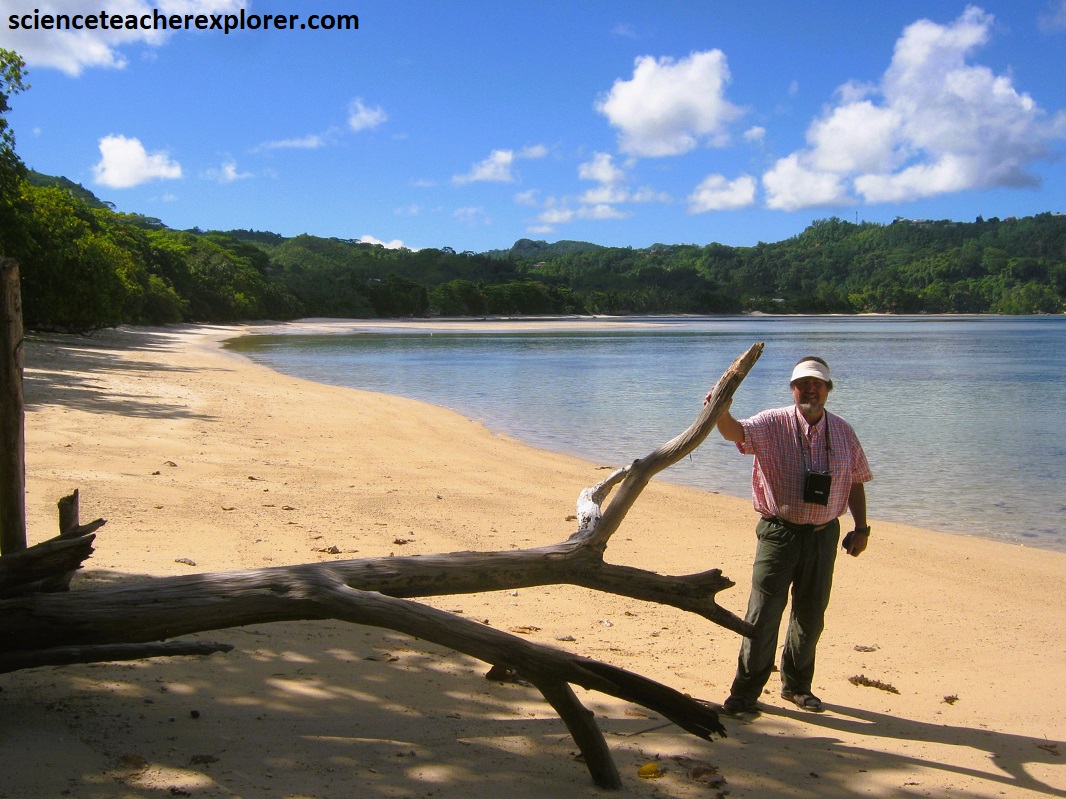
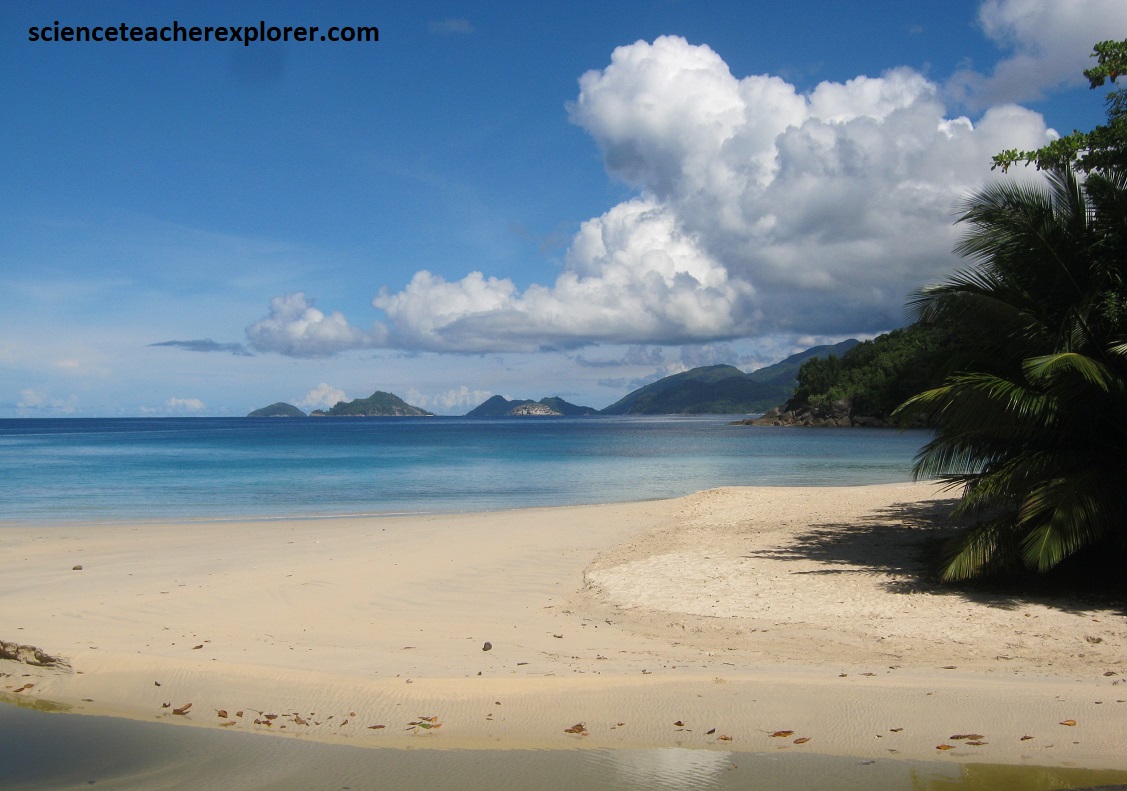
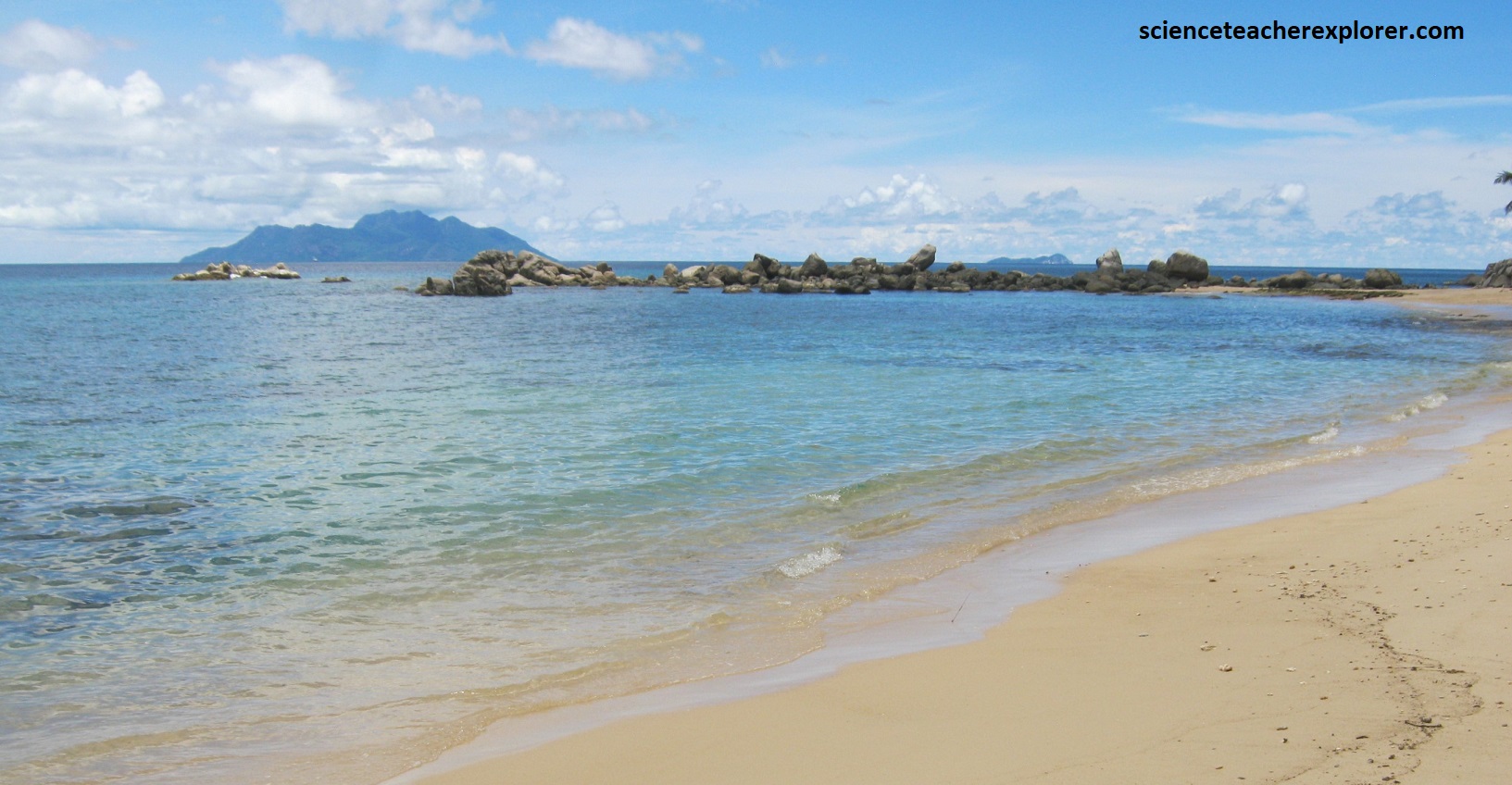
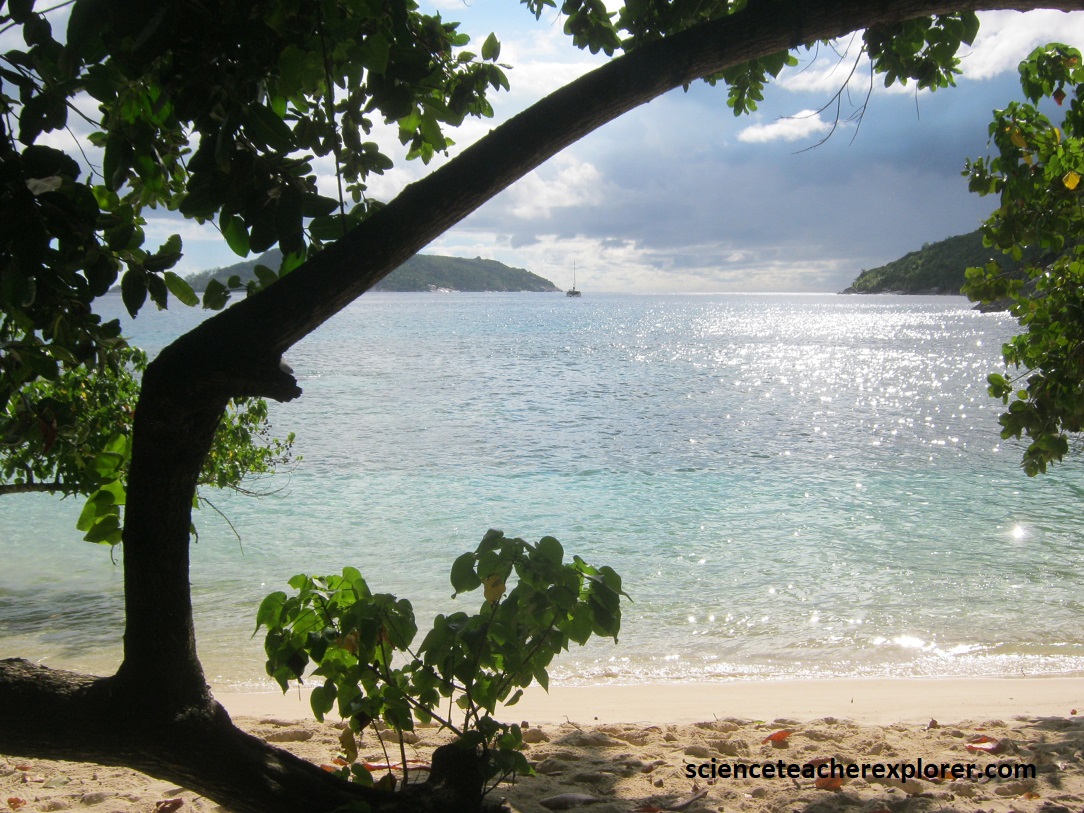
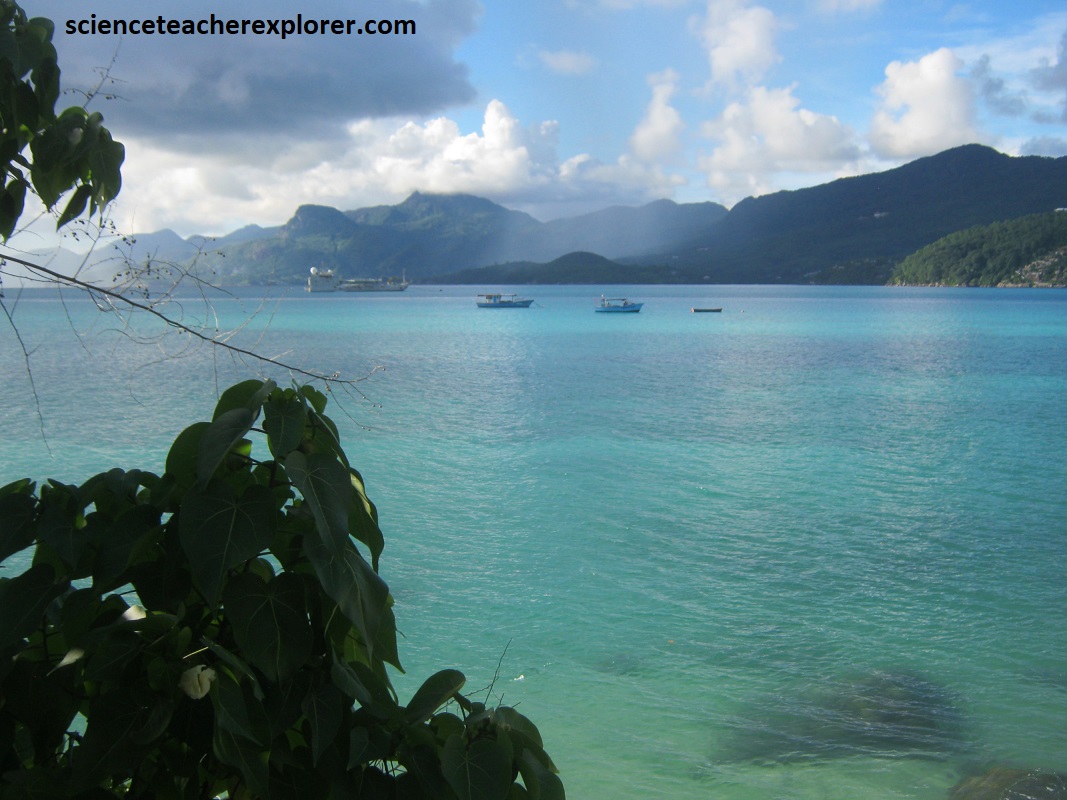
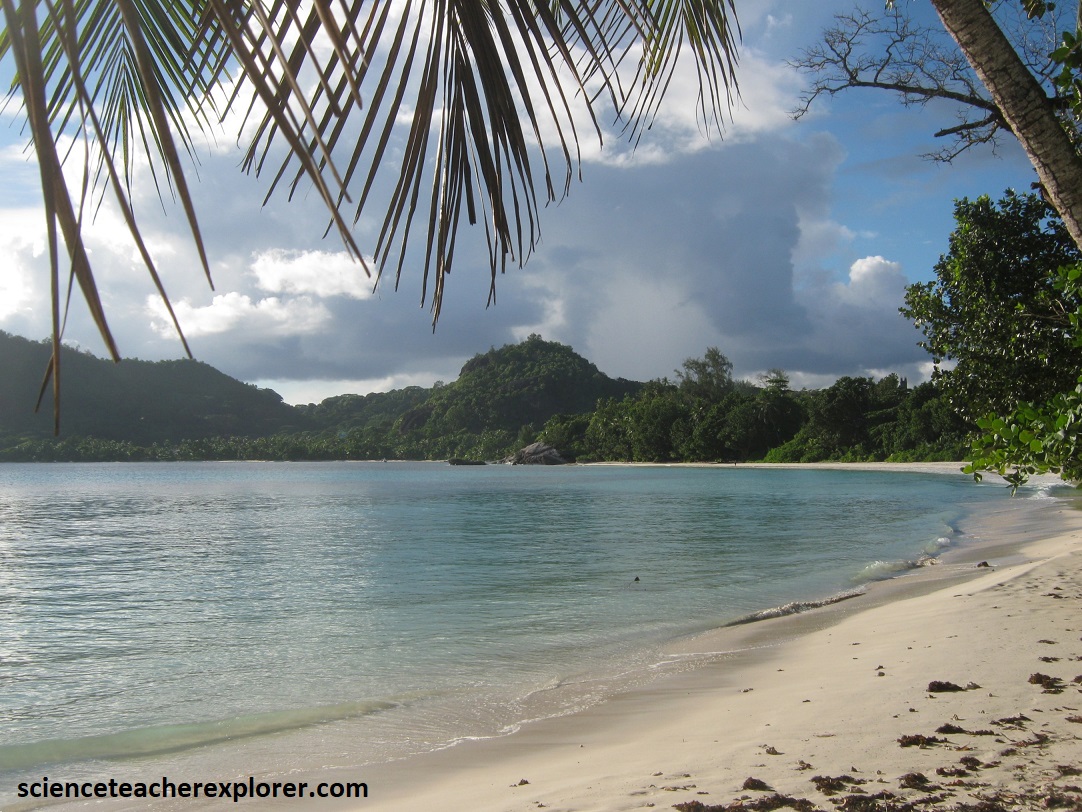
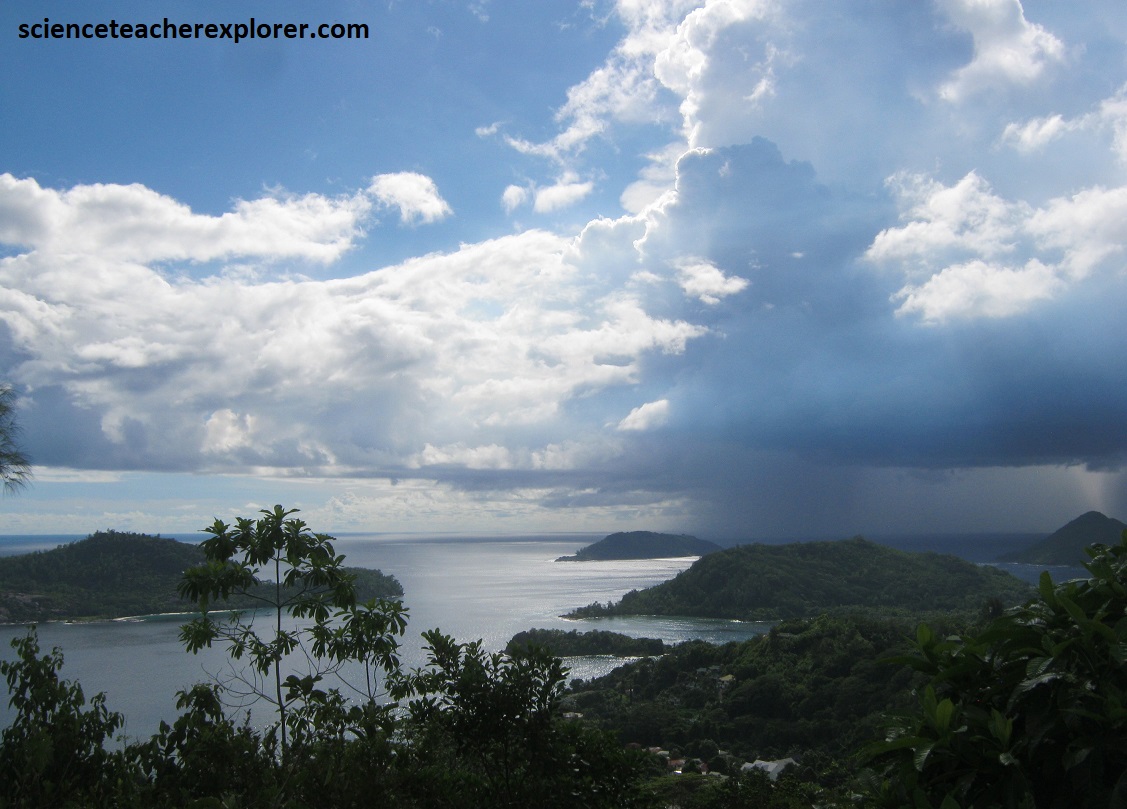
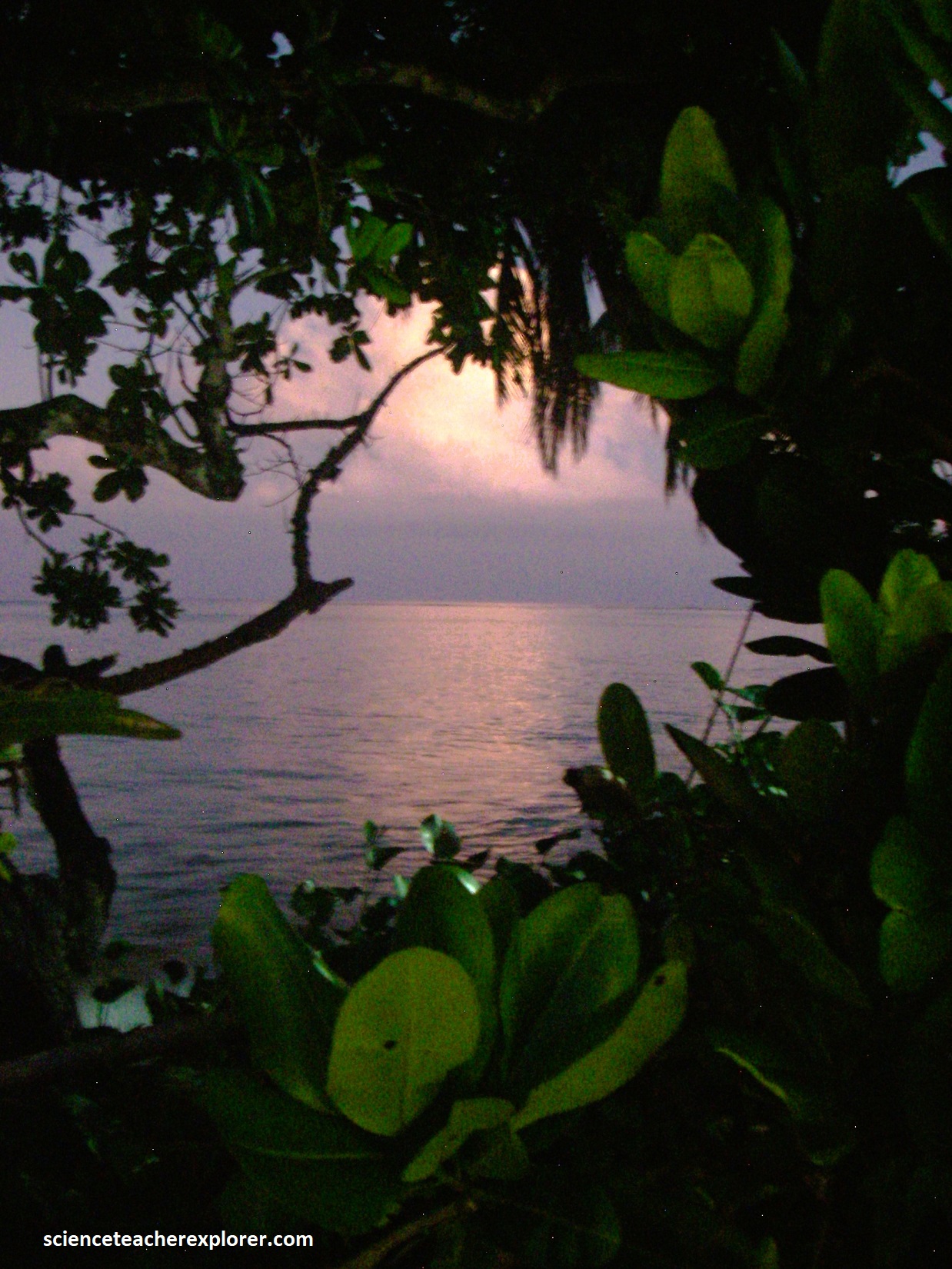
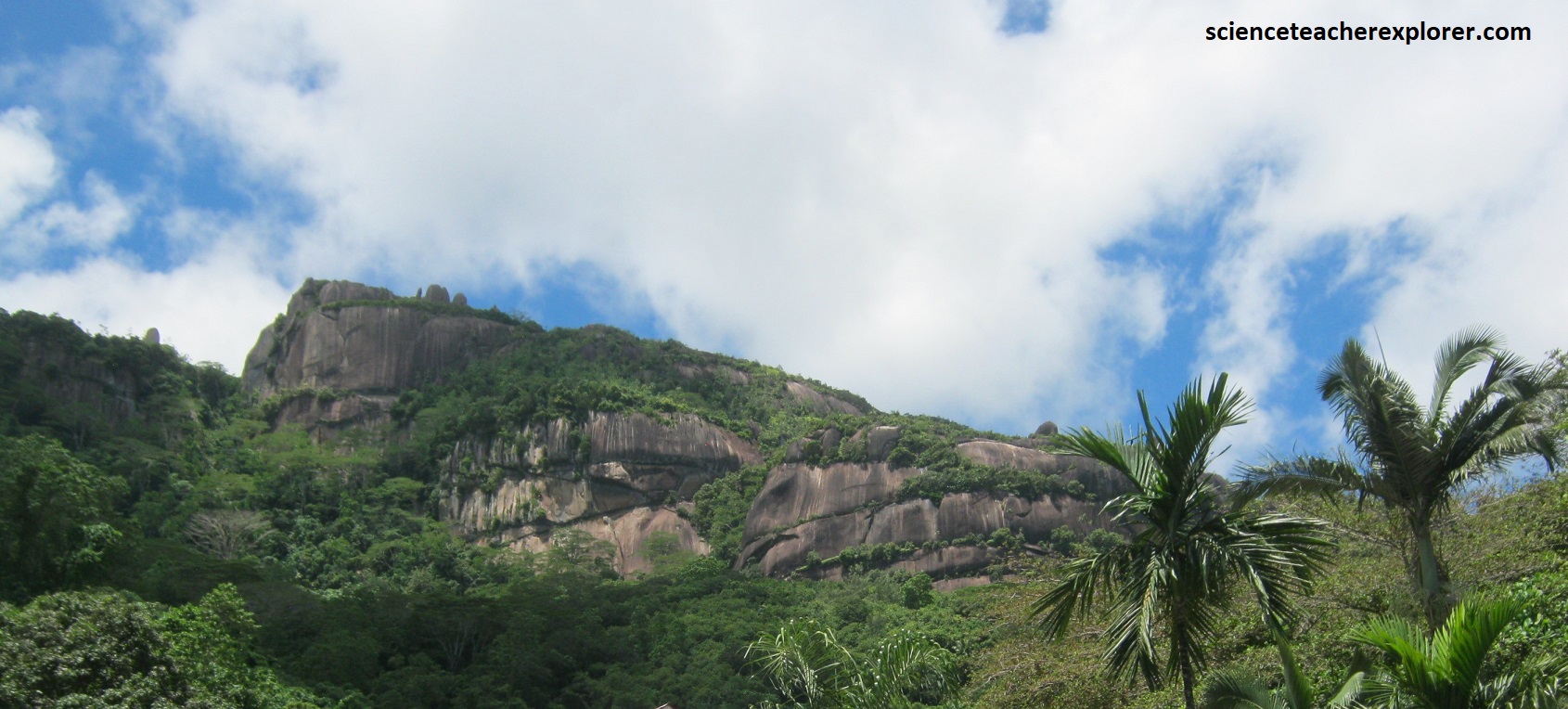
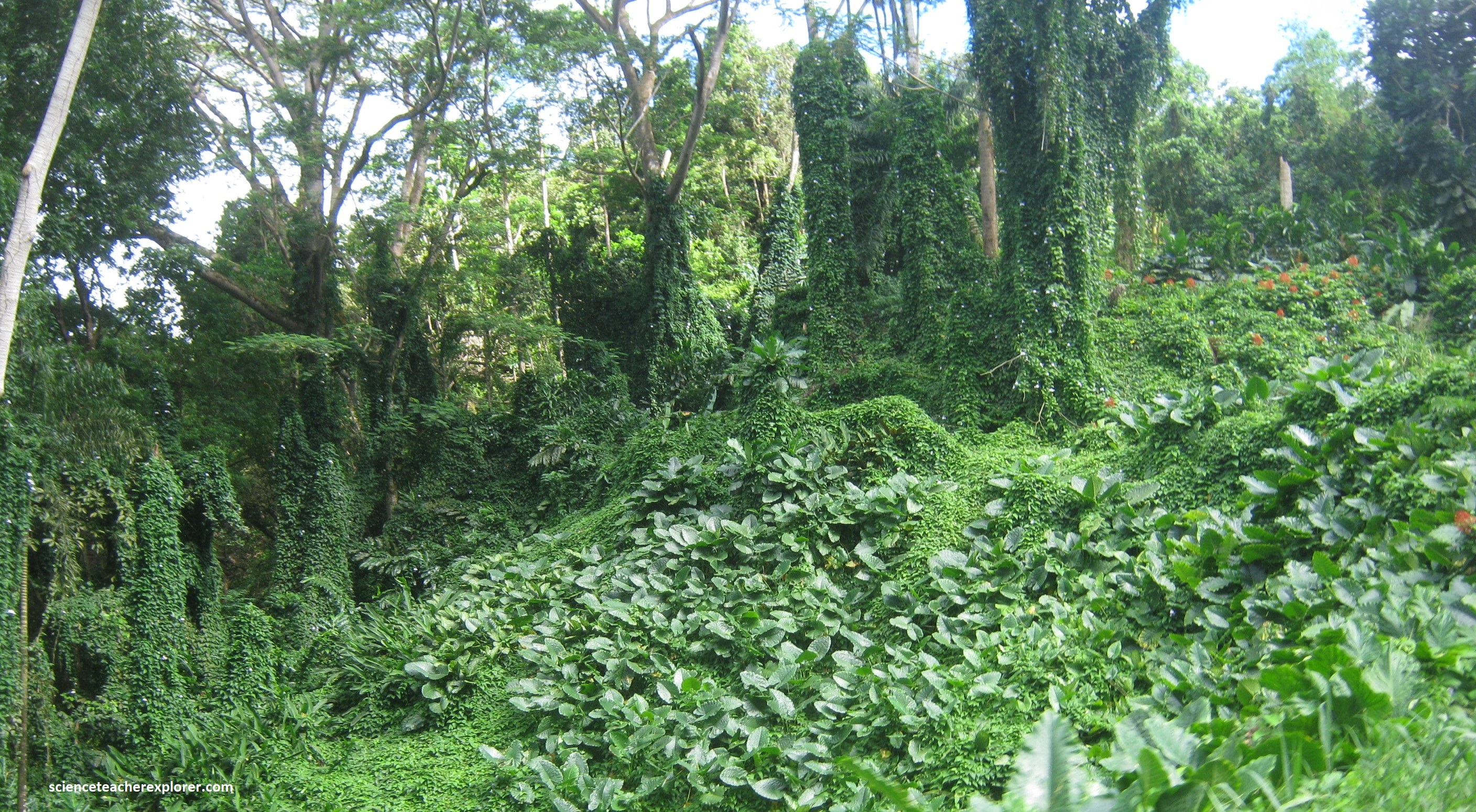
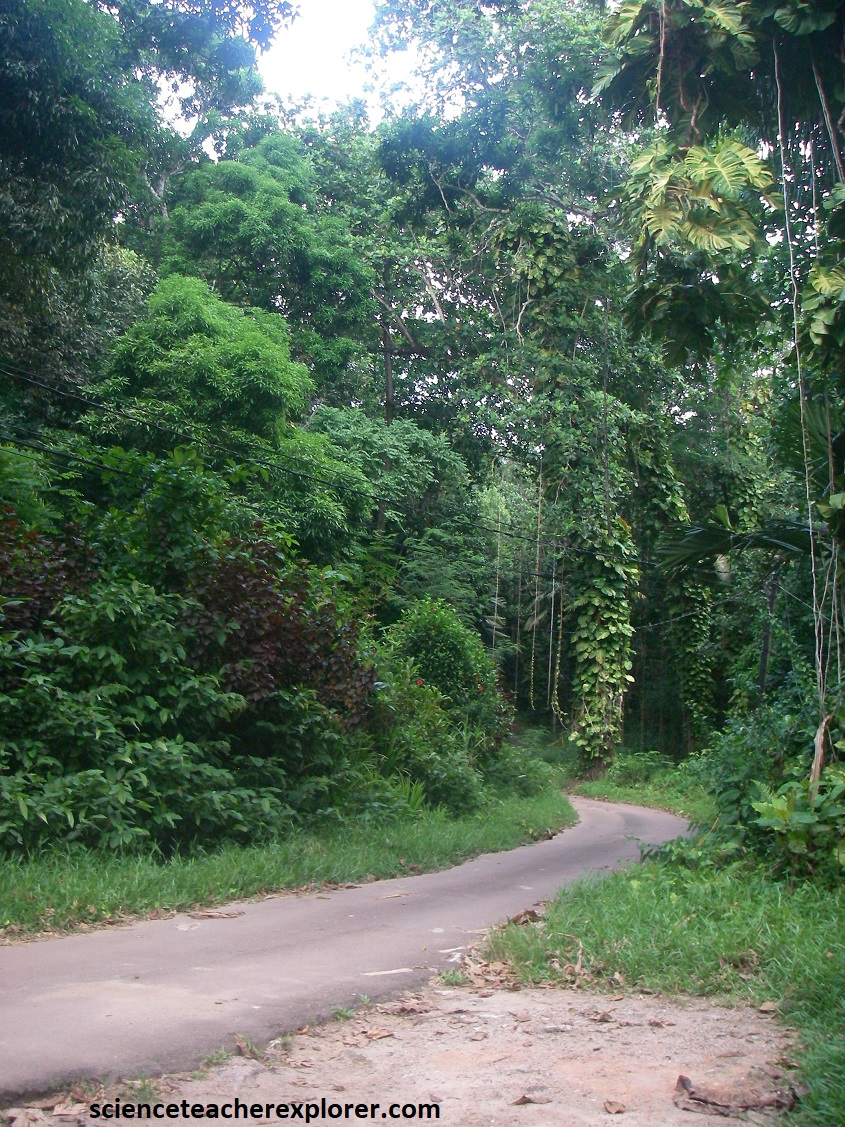
While the dazzling coastline of Mahé is undoubtedly the island’s main attraction, its mountainous interior is a dramatic landscape that’s wonderful to explore. The splendid Morne Seychellois National Park encompasses an impressive 20% of the land area of Mahé and contains a wide variety of habitats, from coastal mangrove forests up to the country’s highest peak, the Morn Seychellois (905m). Pictured below, choked in thick forest, the enigmatic central part of the park is virtually deserted and can only be reached by walking trails.
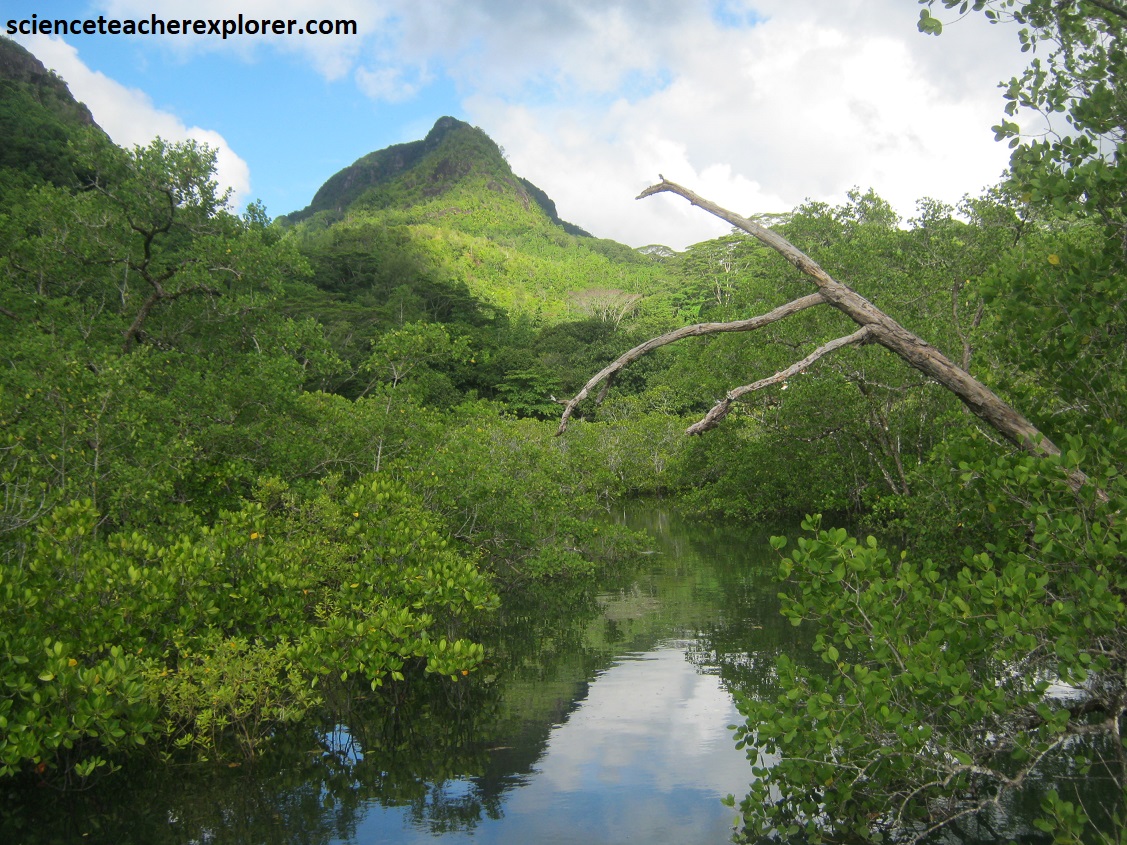
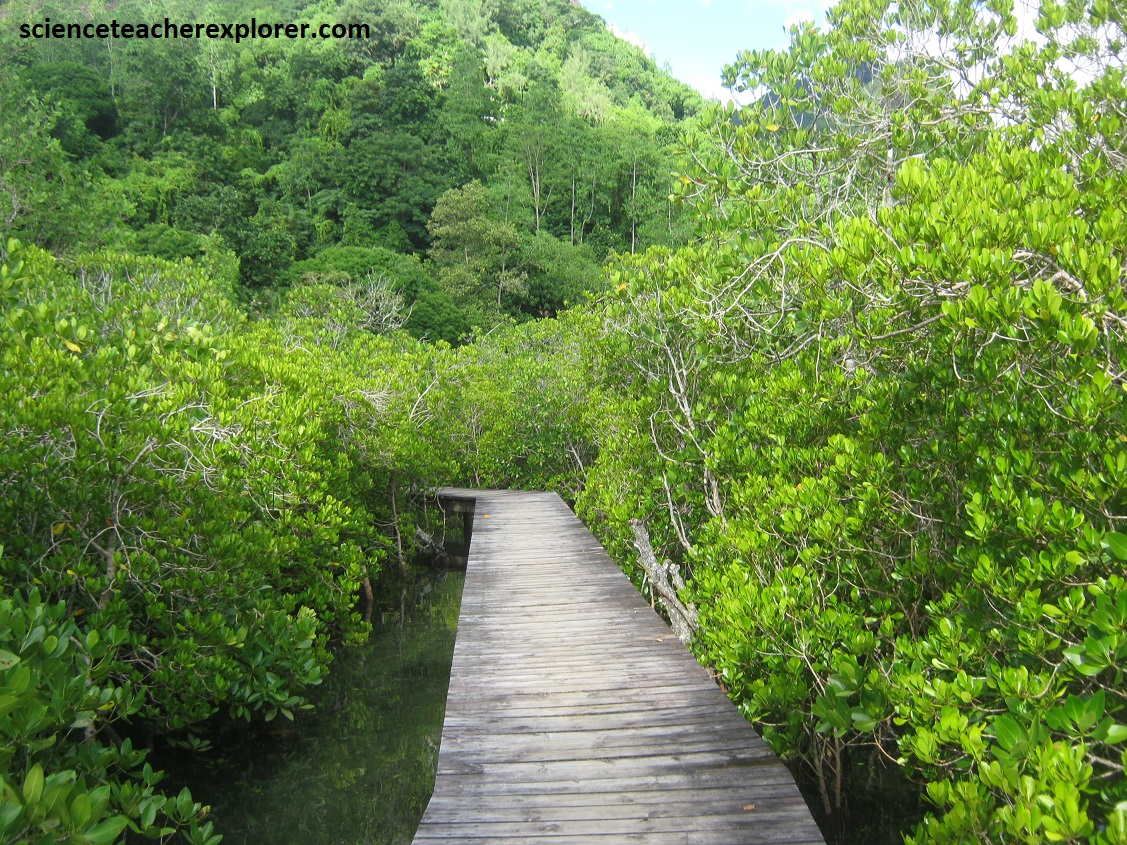
Pictured above in the last two photos are of the Port Launay mangrove forest. It is the best example of a mangrove wetland on Mahé, supporting all seven species of mangrove tree which are found in the country. Before Seychelles was discovered and settled in the 1700s, there were mangrove swamps fringing in many areas of the island. However, these were eventually logged, cleared and filled to make way for human settlements, leaving only a few remnant swamps. In the year 2004, the Port Launay mangrove was designated as Seychelles’ first Ramsar Site, (meaning a wetland site of international importance), recognized under the Ramsar Convention for wetland conservation.
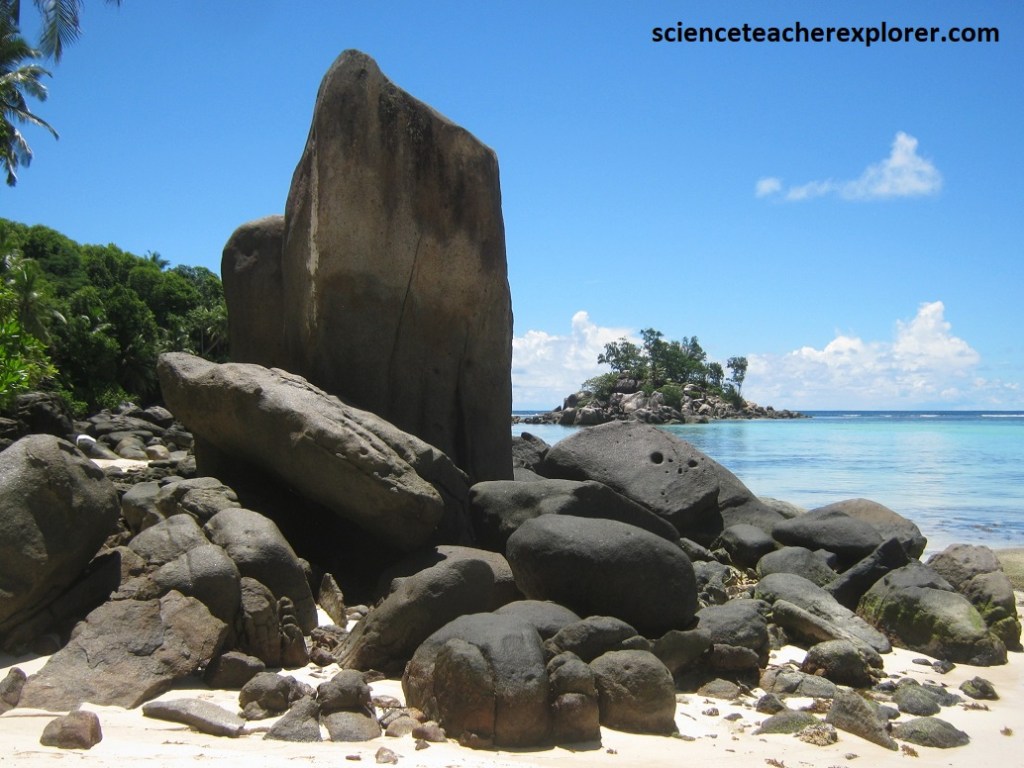
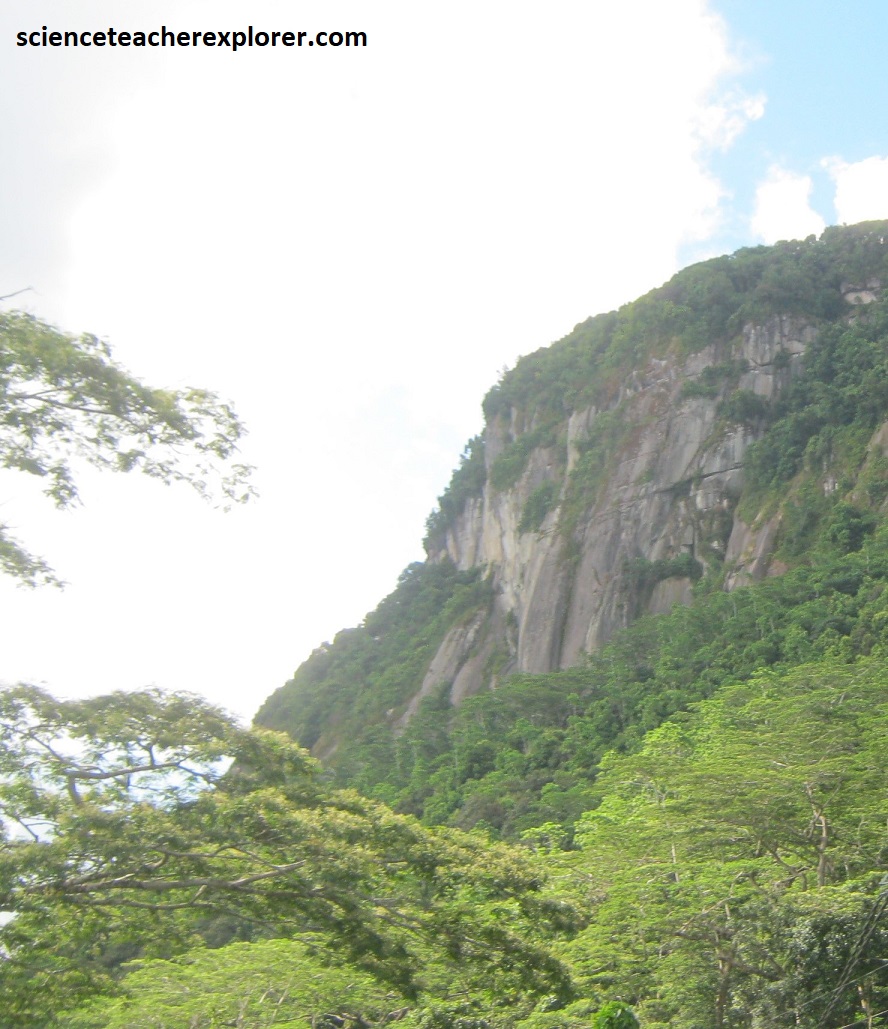
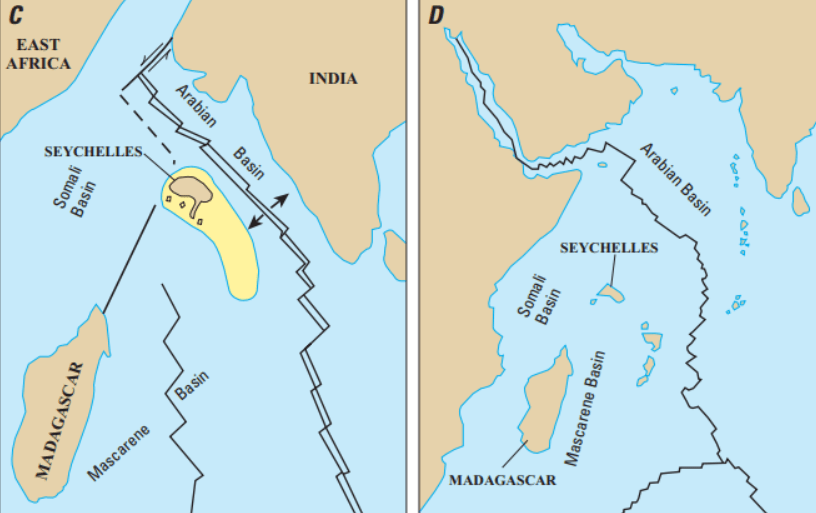
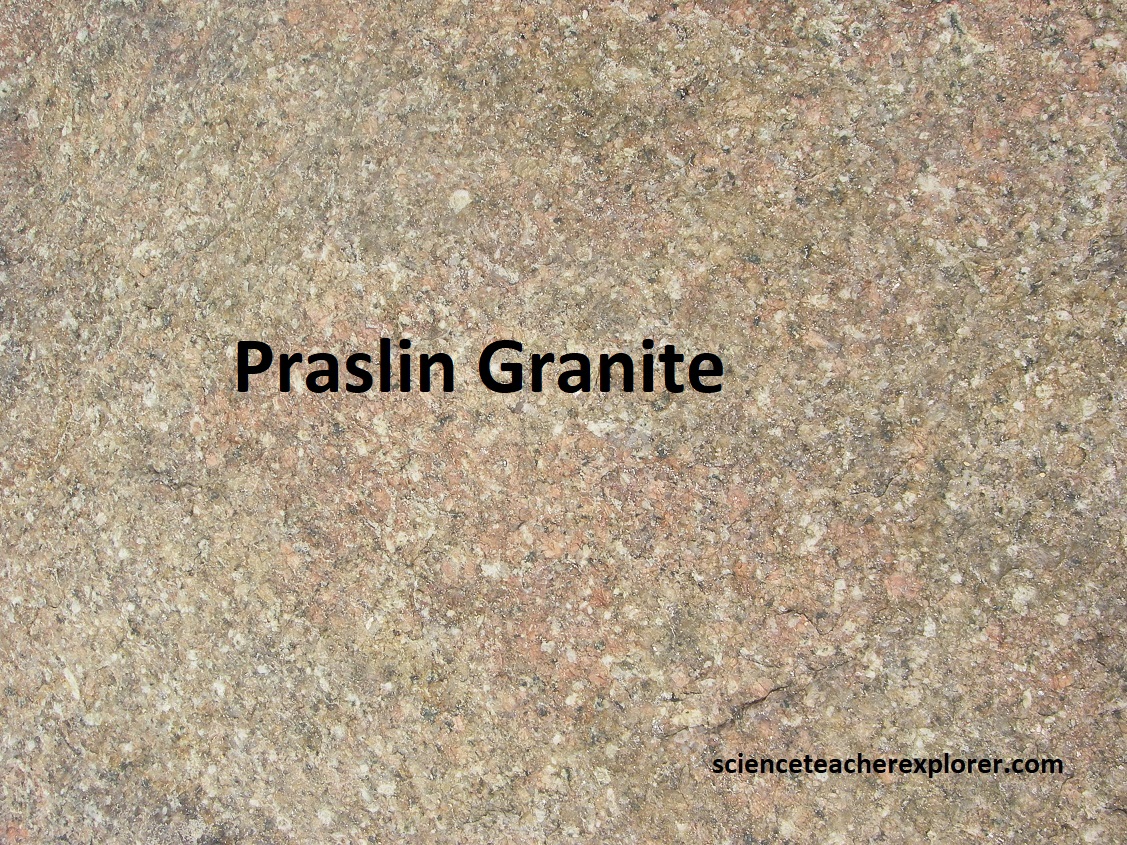
Pictured above, the Seychelles islands has the only mid-ocean granite rocks in the world. How is this the case? In geology, granite requires a continent to develop. Originally, Seychelles was part of Africa, annexed to the supercontinent Gondwana 160 million years ago, (image below).
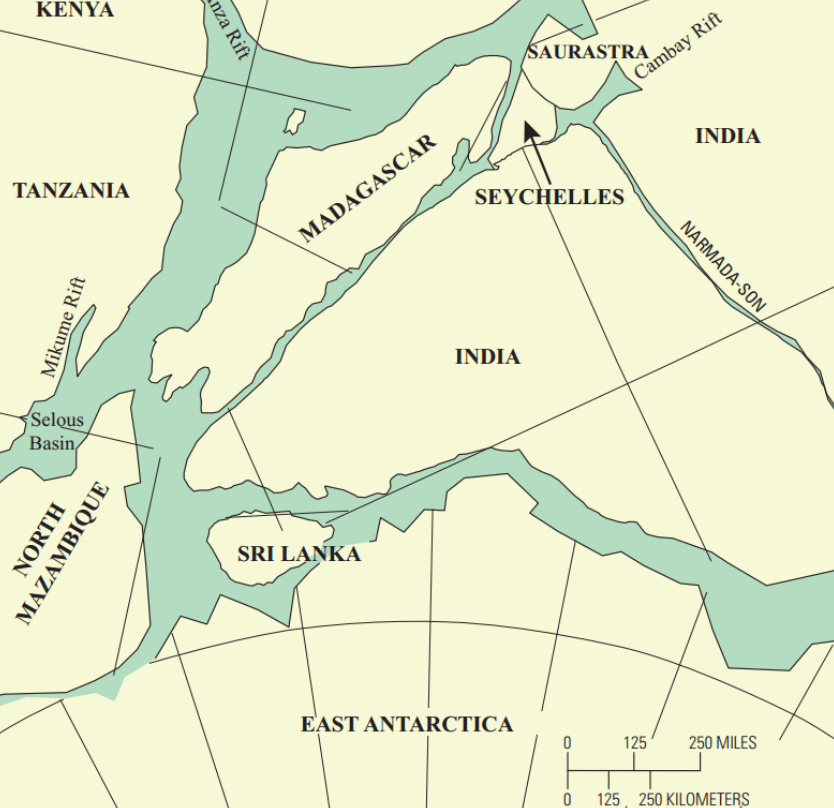
Then, a large chunk of land split from Africa: Madagascar, India, and Seychelles. India broke off, smashed into Asia and created the Himalayas. Madagascar and Seychelles split due to a period of massive volcanic activity, which ended up forming Mauritius & Reunion, currently located to the East.
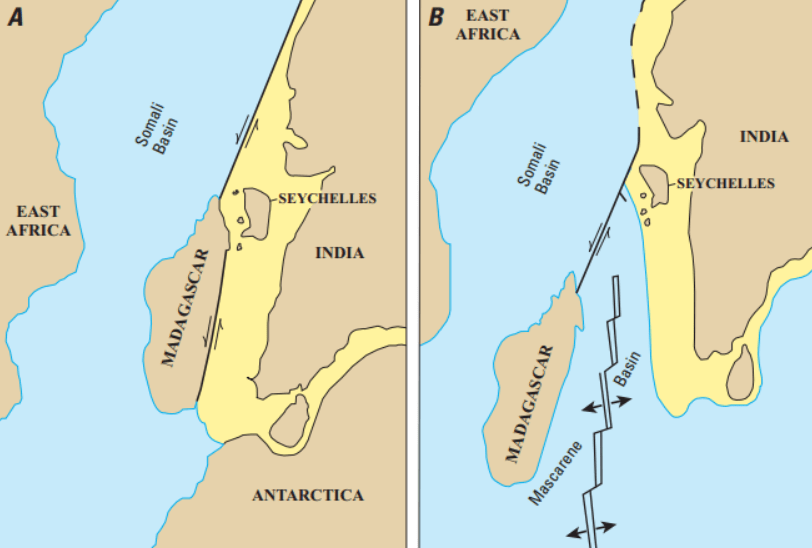
According to Geophsiists, the Seychelles Islands then underwent two more stages of rifting to isolate it from Madagascar and India. Imaged above, between 84 and 95 million years ago, rifting separated Seychelles/India from Madagascar. An initial period of transform rifting moved the Seychelles/India block northward. Around 84 million years ago, oceanic crust started to form in the Mascarene Bain, causing a rotation of the Seychelles/India land mass. This continued until 66 million years ago when new rifting severed the Seychelles from India, forming the Arabian Basin and the currently active Carlsberg Ridge, (imaged below).
The rift jump coincided with the maximum output of the Deccan Traps and granitic-volcanics found on the Seychelles Plateau.
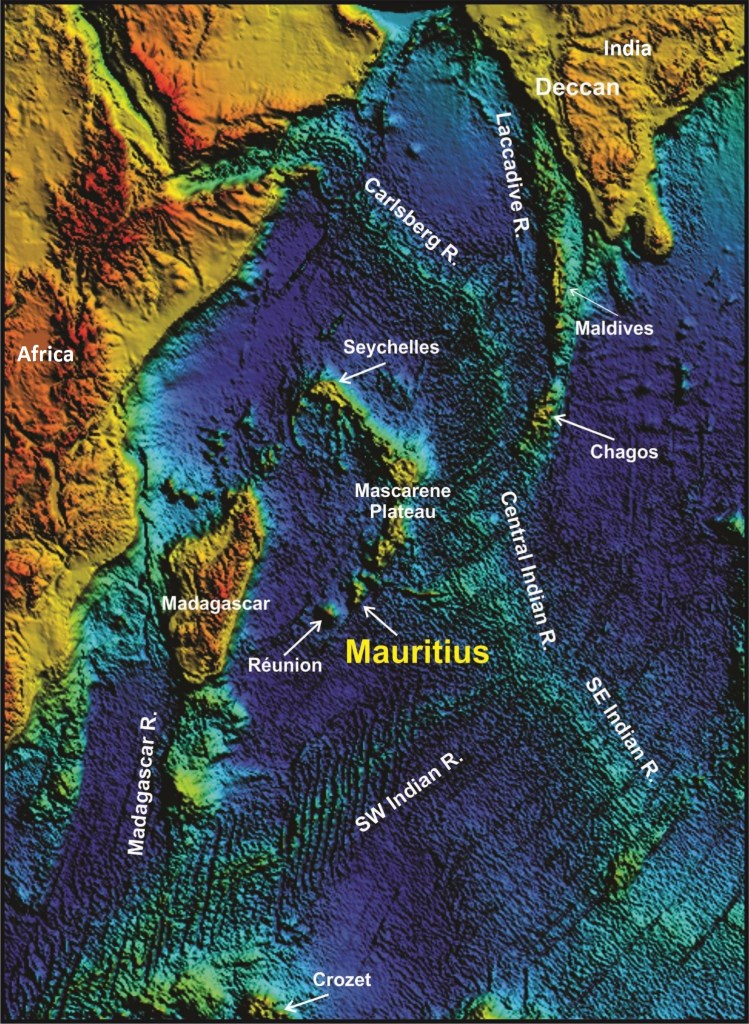
Therefore, the Seychelles Islands have been isolated from any major landmass since the time of the dinosaurs, and have many strange plants and animals. Granitic in origin, the second largest island is Praslin, and at its center is a mysterious valley full of palms, the Vallee de Mai, our primary destination.
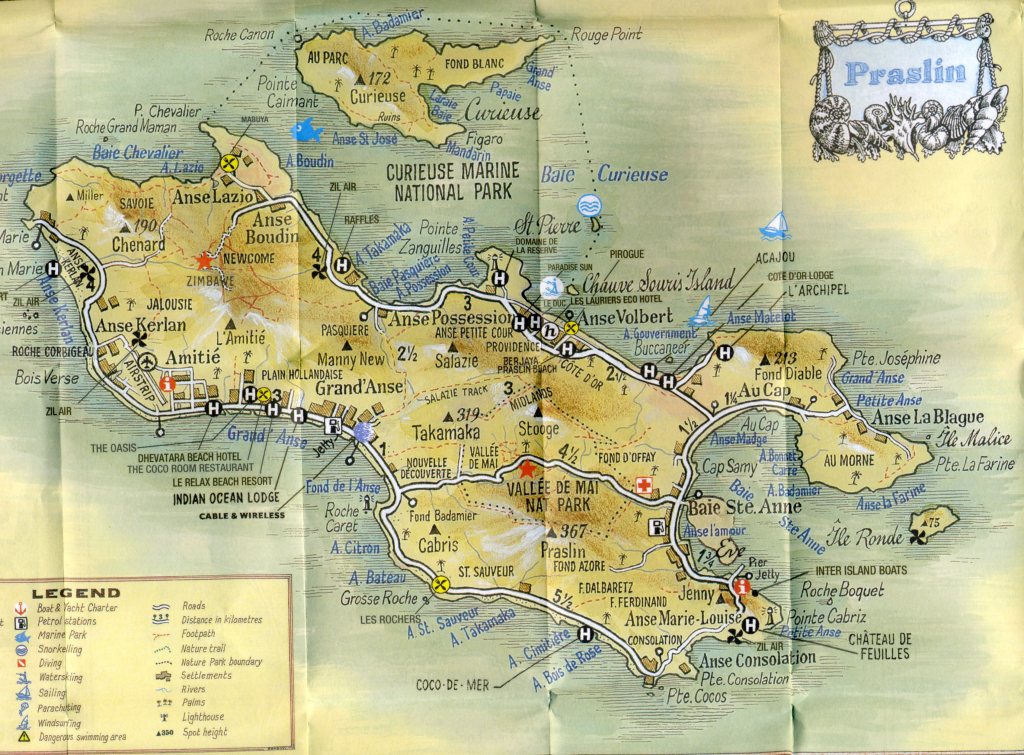
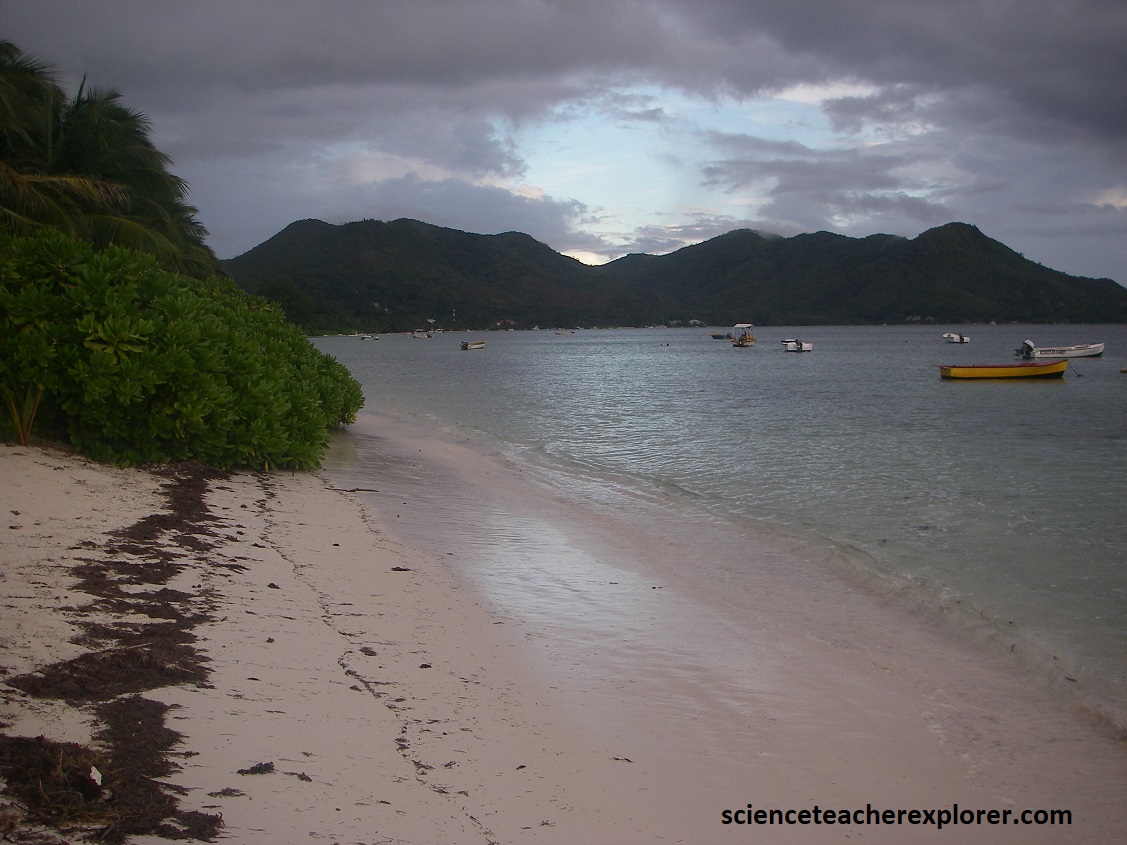
Pictured below, lying bout 45km northeast of Mahé, Praslin is a granite island, with pristine beaches and a ridge of small mountains running east-west along the center, and the svelte interior, especially the Vallee de Mai. is fascinating for its flora and birdlife.
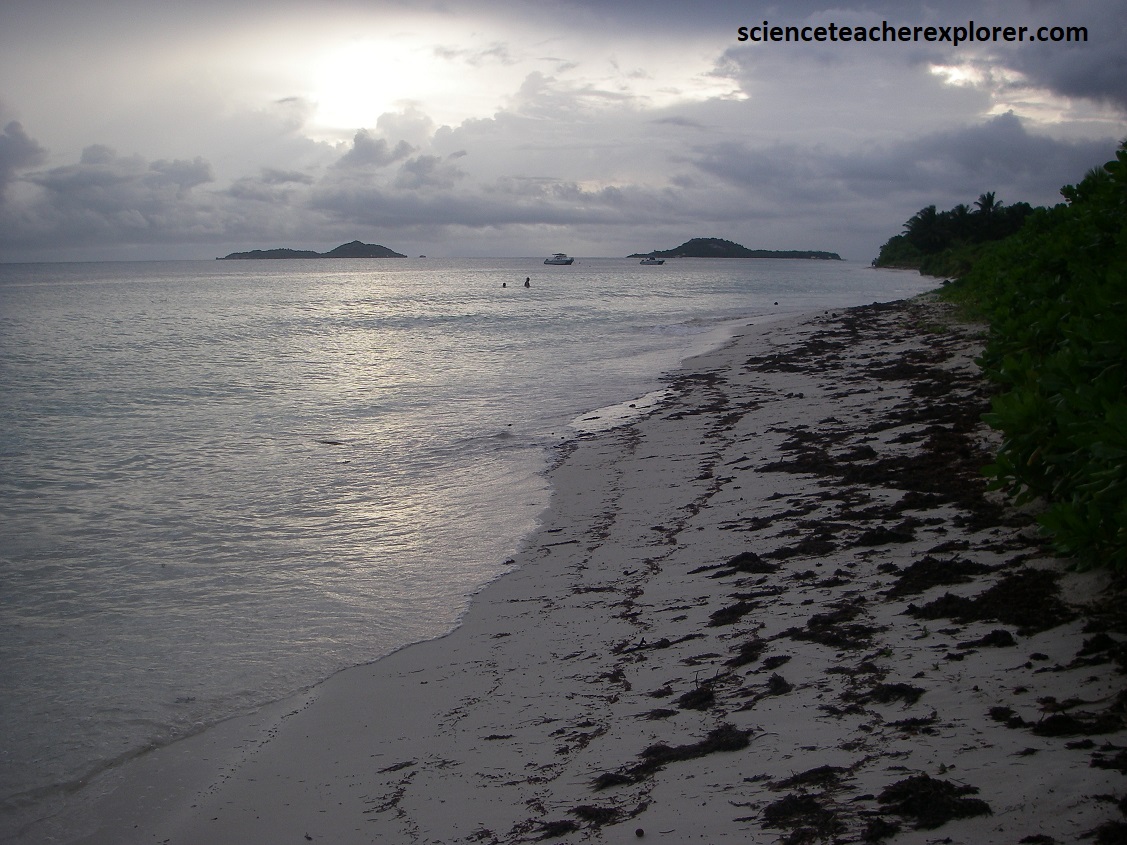
At Praslin’s center is a mysterious valley full of palms, (the Vallee de Mai). In places the canopy is so dense that no sunlight filters through, (making photography difficult). Freshwater crabs and giant crayfish inhabit the streams, and rare birds flit among rare trees. Many famous visitors in history have called it the “Garden of Eden”! [This is what brought me here to explore].
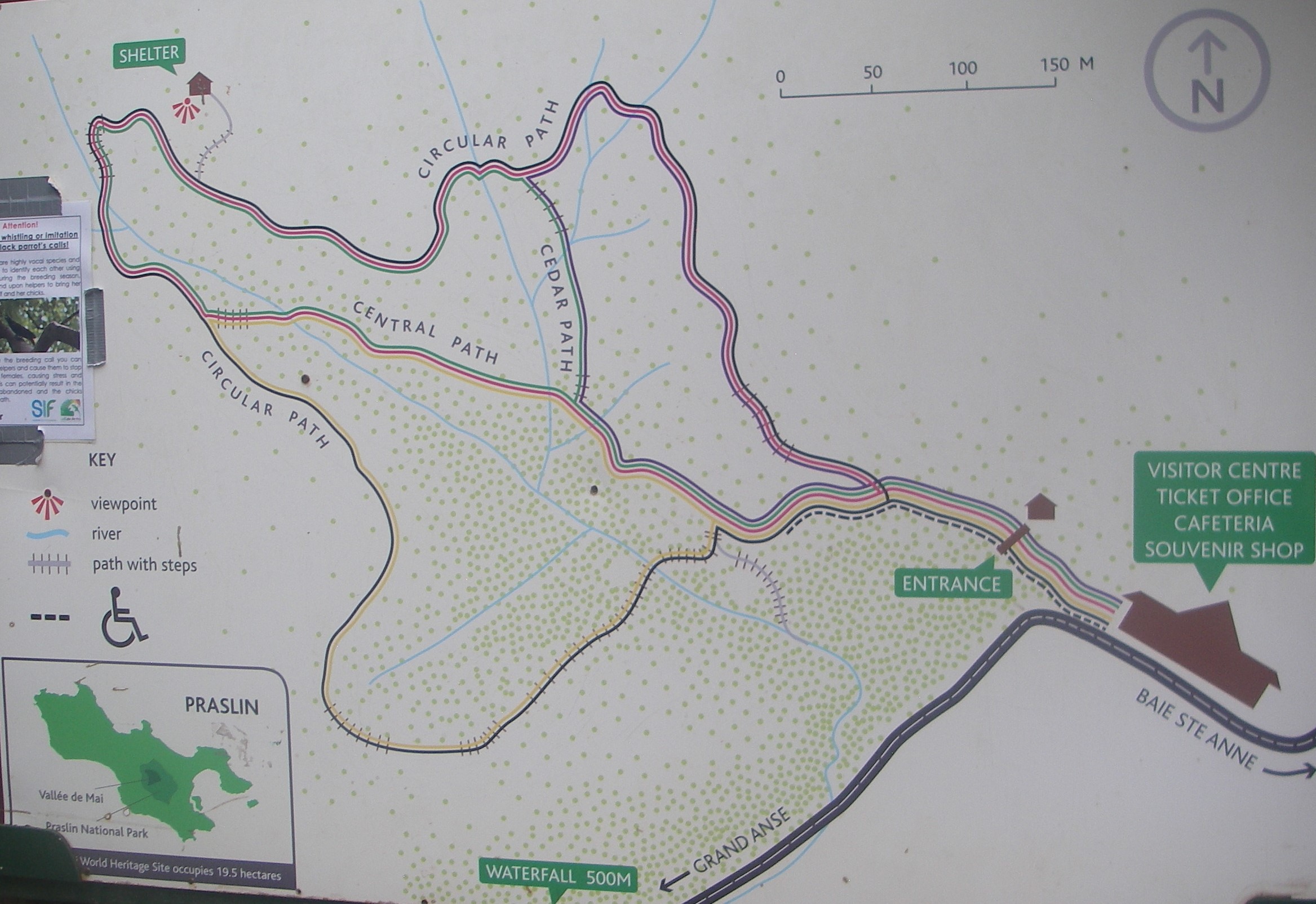
{Above are photos taken from interpretive boards on-site}
Vallee de Mai is first and foremost a unique primeval palm forest, The forest gives shelter to all 6 of the Seychelles’ endemic palms. Being endemic means, that the plant (or animals) is to be found in the wild no where else but in that particular bounded area.
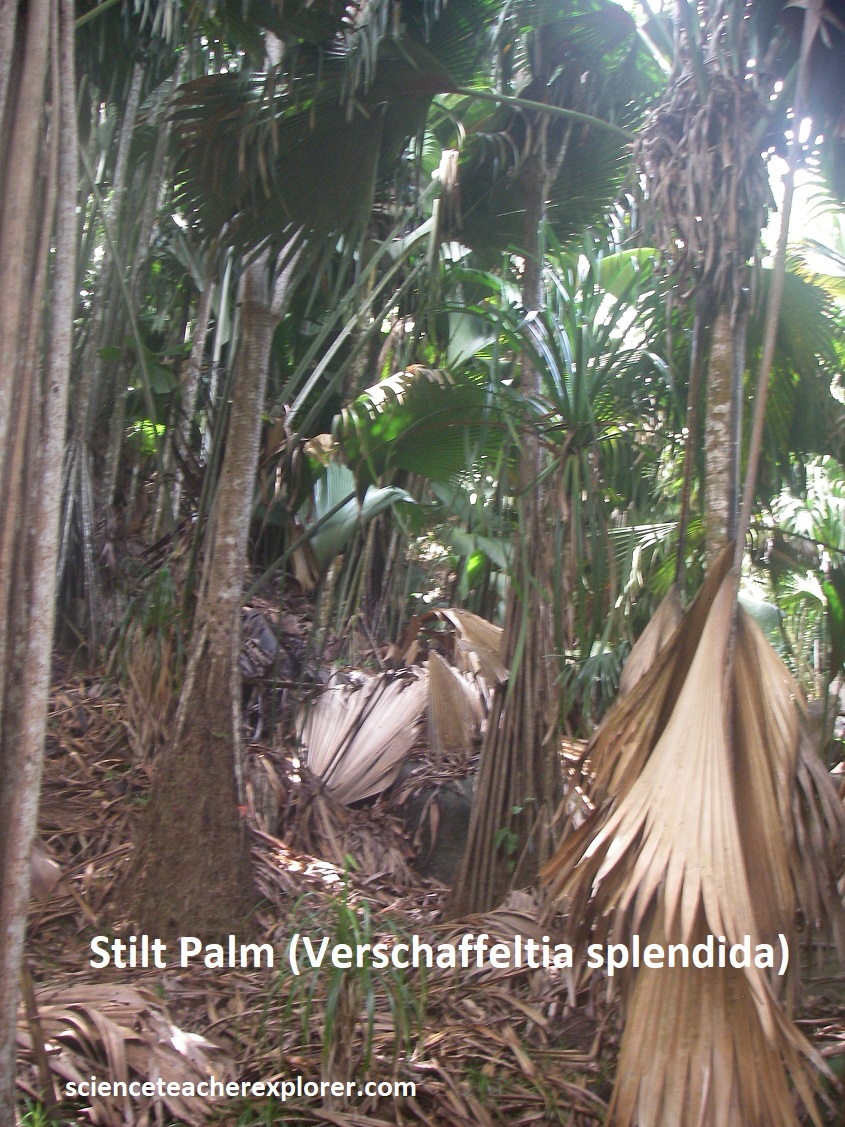
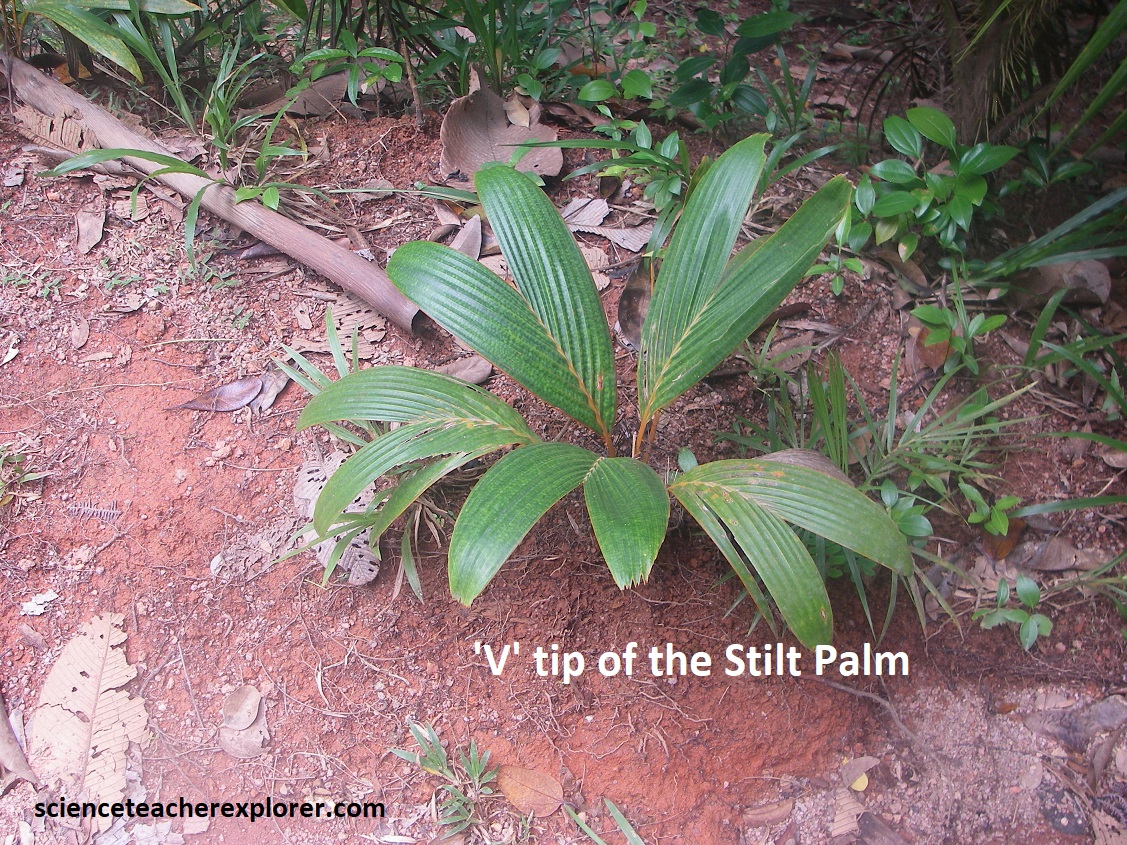
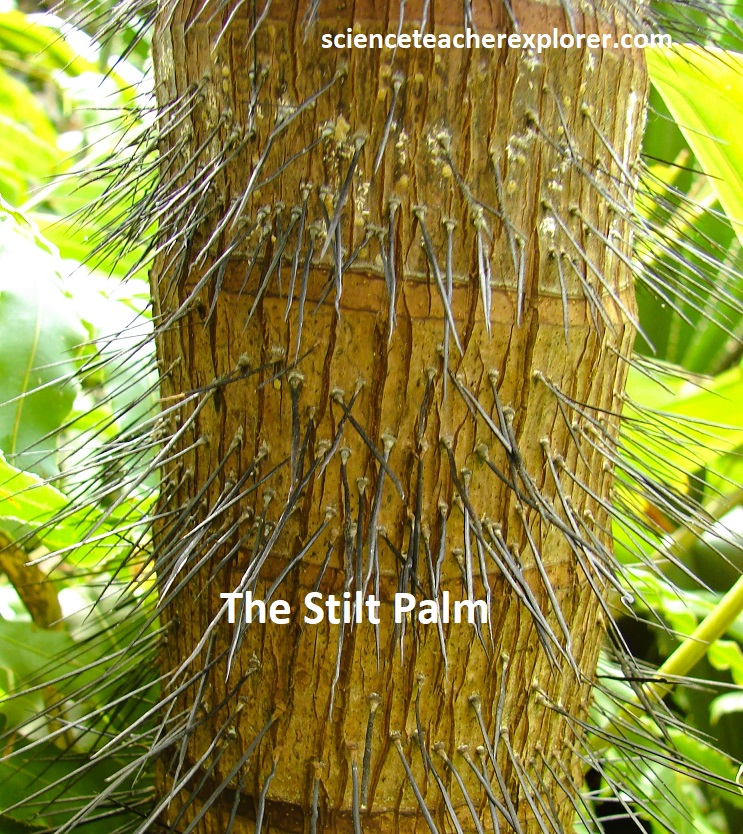
I. The Stilt Palm (Verschaffeltia splendida) is an erect and impressive to 30m tall palm with a cone of stilt roots at the base, (pictured above). The stilt roots are a stabilizing adaptation to steep slopes and potentially dynamic growth conditions. The leaves are large, entire or unbroken, to 3m, with an open ‘V” at the tip and regular toothed, (similar Thief Palm). The inflorescences to 2m long are slender, branched and more or less dropping, but now below the crown.
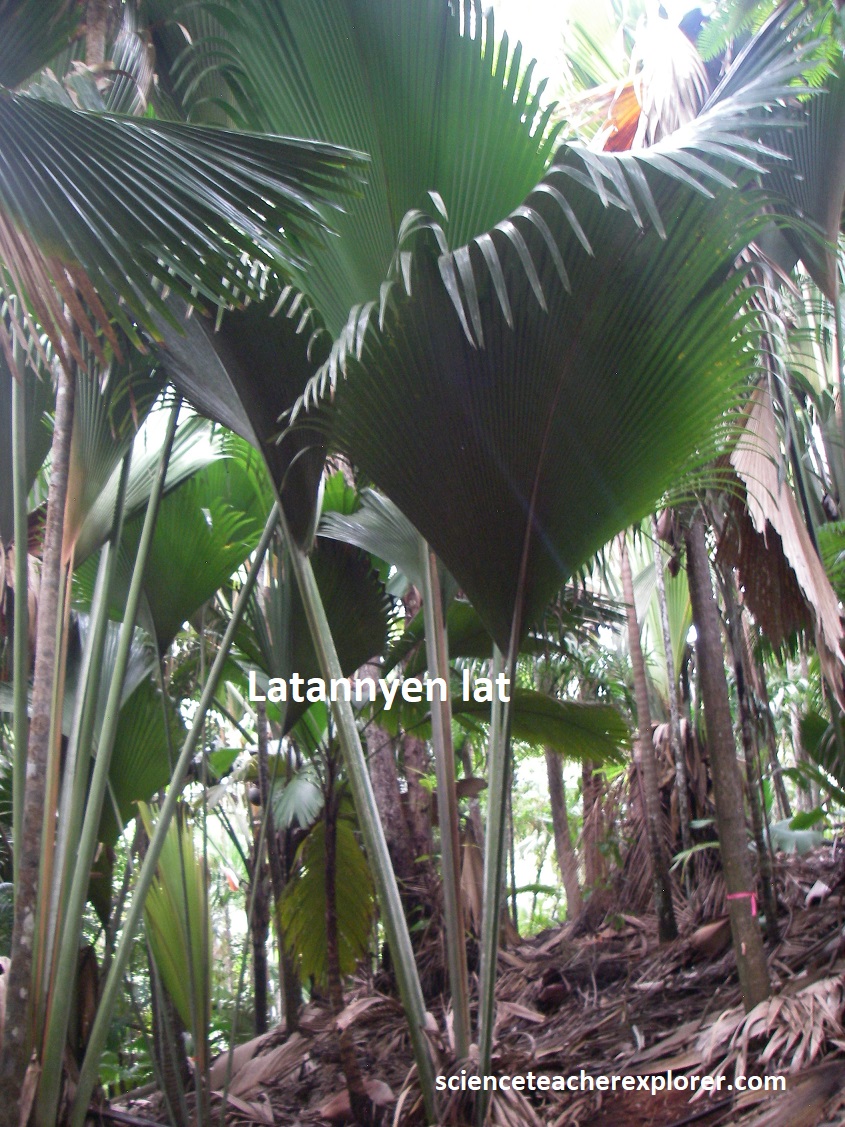
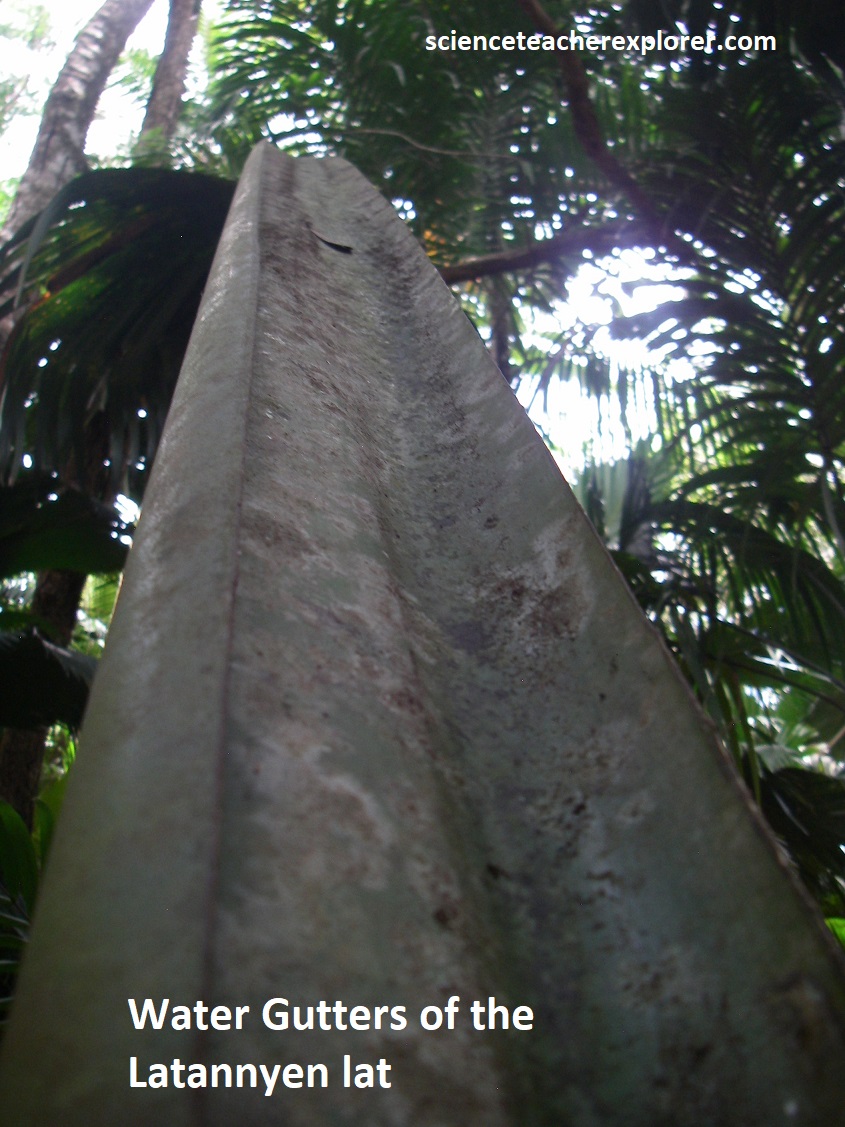
[Pictured above, the Creole name ‘Latannyen lat’ derives from the French ‘latanier’ meaning ‘fan palm’ and ‘latte’ meaning’laths’ thus referring to the fact, that the trunk in the past has served well to produce very much esteemed laths, i.e. long narrow strips for amongst others water gutters.]
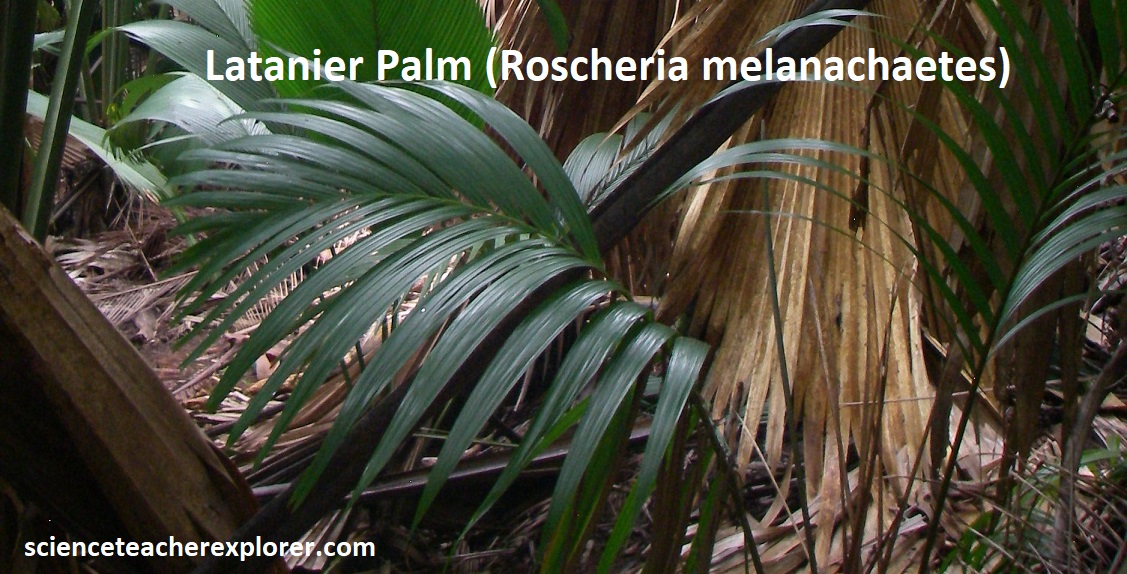
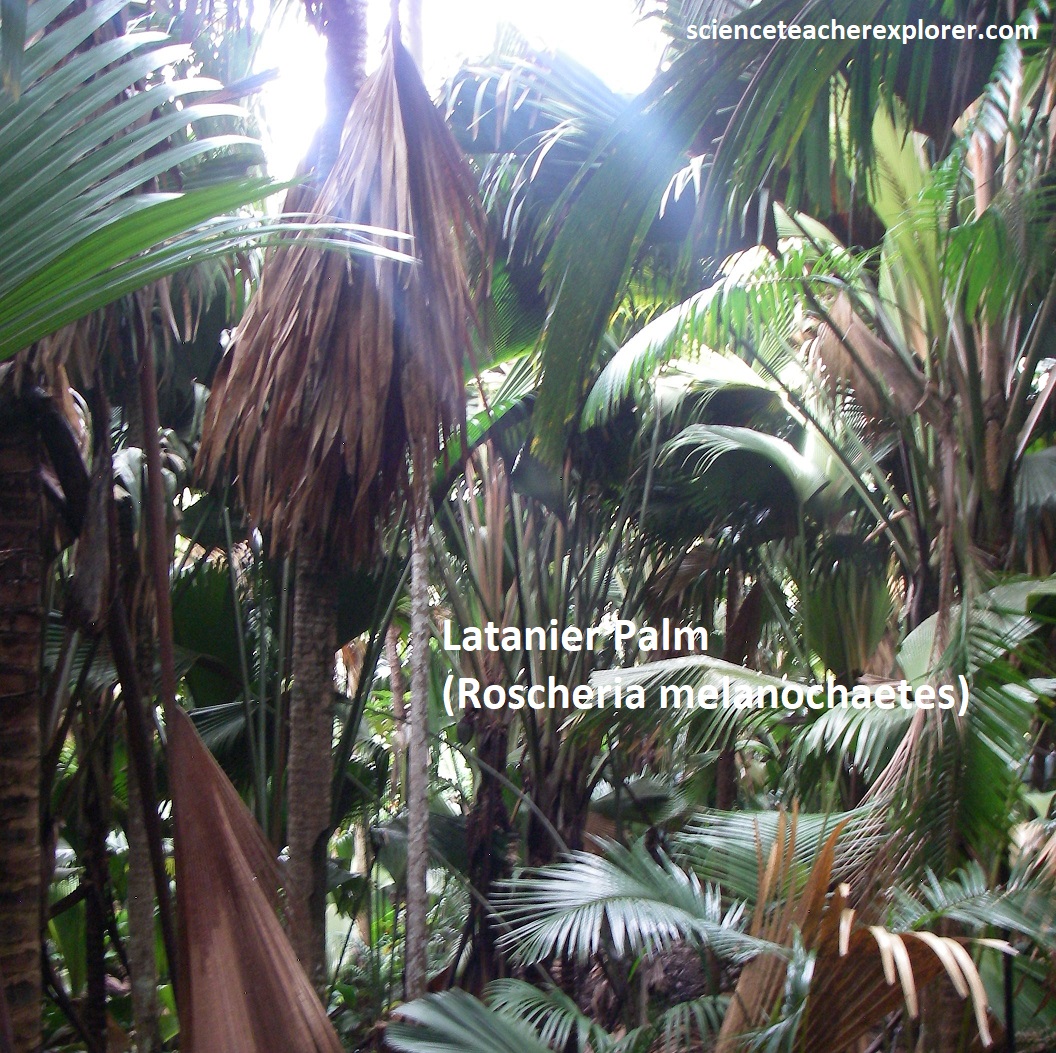
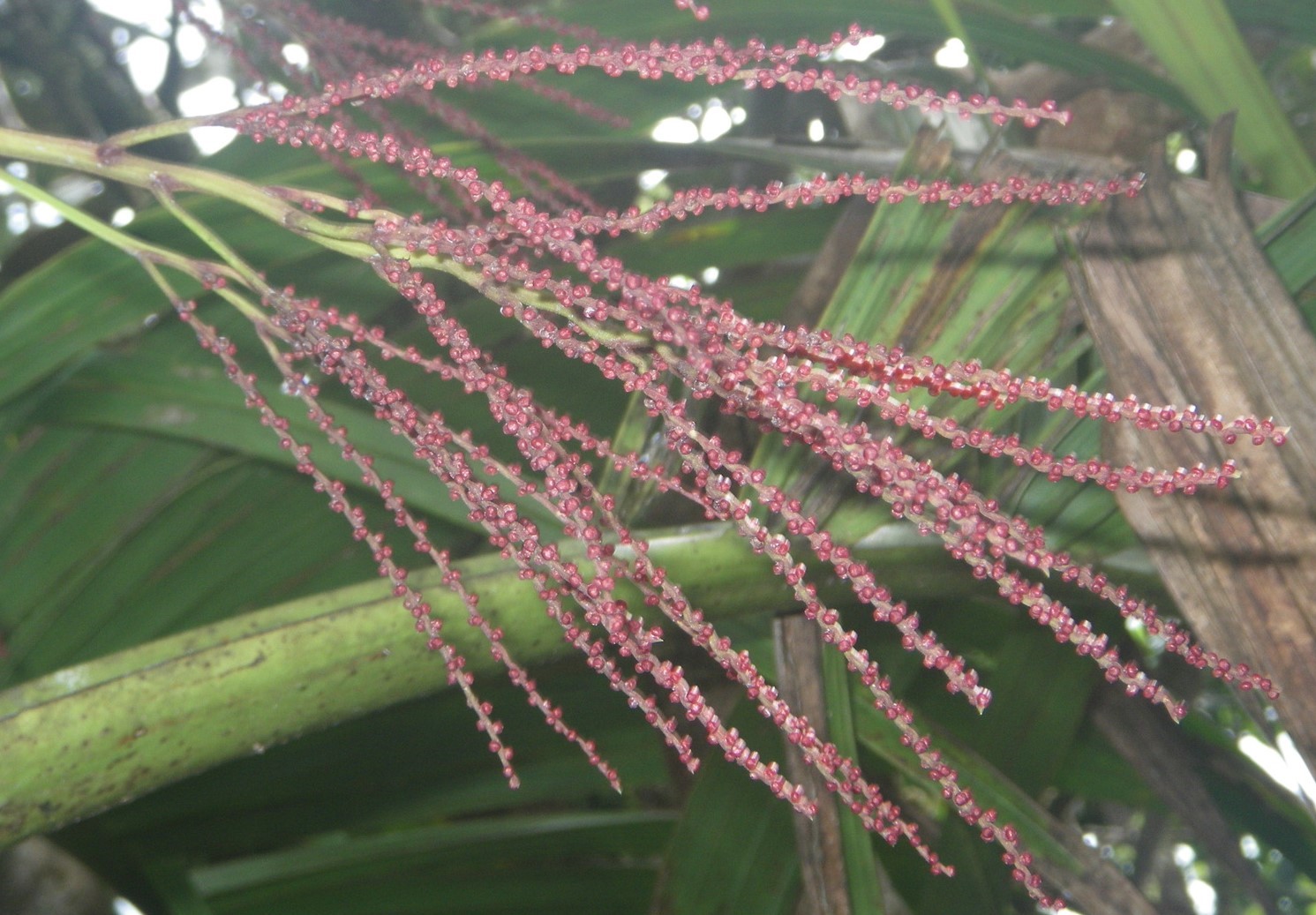
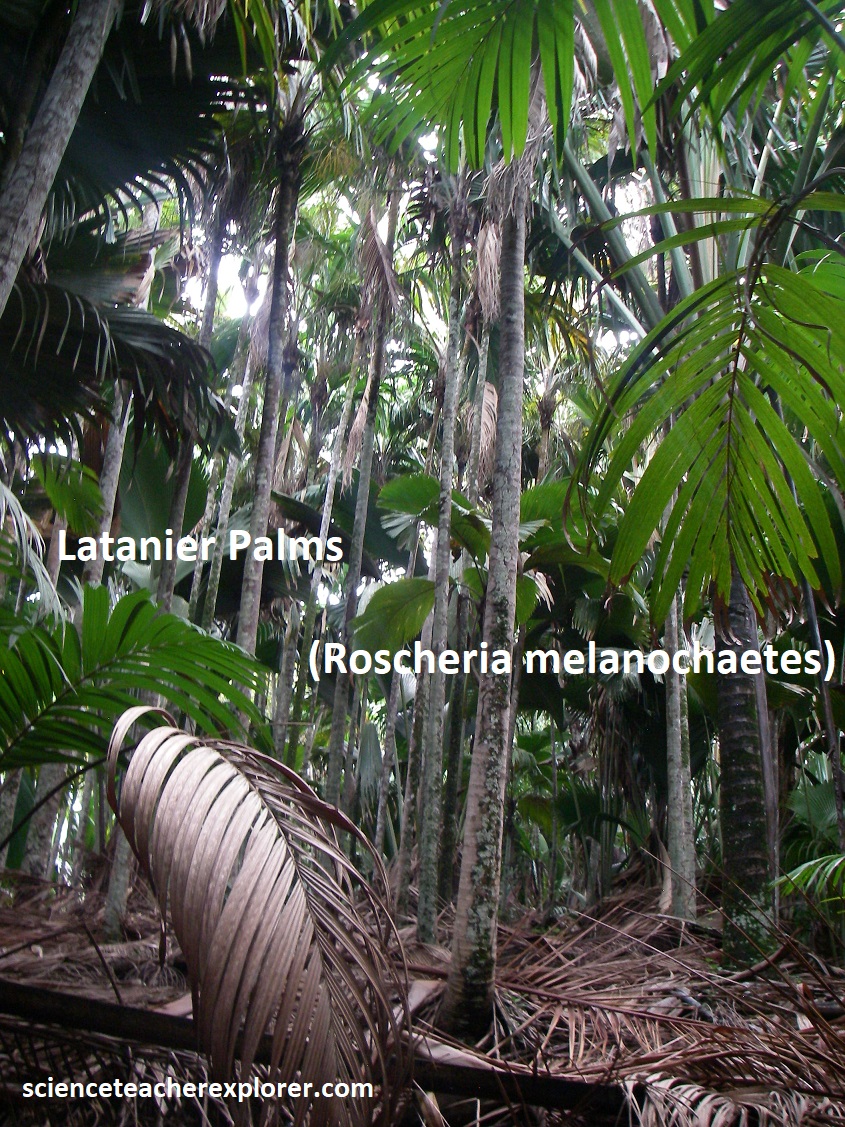
II. The Latanier Palm (Roscheria melanachaetes) is the smallest of the Seychelles’s endemic palms reaching only some 8m high, (pictured above). Small stilt roots. Large, pinnate leaves to 2.5m long, divided into irregular, broad and blunt tipped leaflets, Flowers tend to turn reddish along with underside of leaf. This palm is less common.
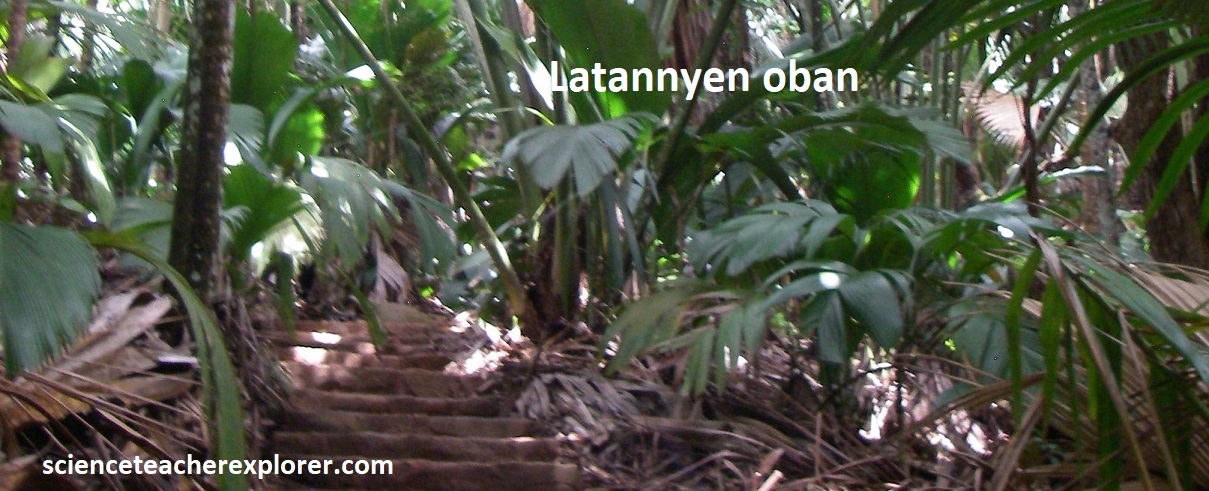
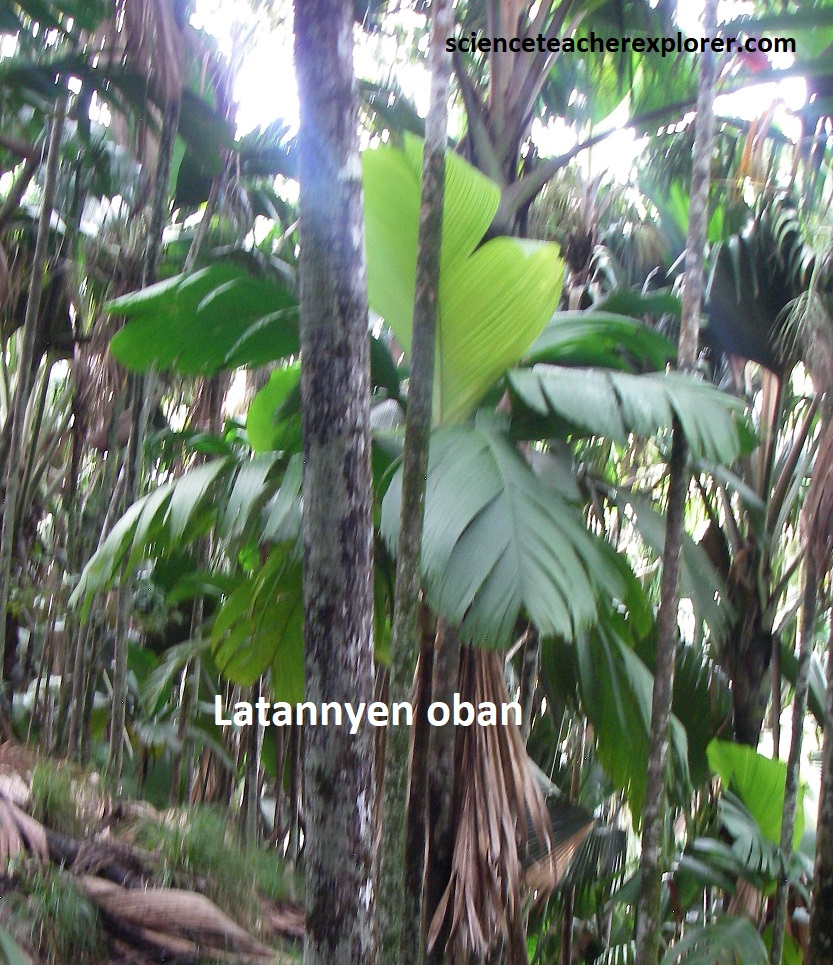
[Pictured above, the local Creole name ‘Latannyen oban’ derives from the French ‘latanier’ meaning once again ‘fan palm’ and ‘hauban’ meaning ‘rope’ or ‘wire’, i.e. ‘the fan palm (with) supporting wires’ referring to the supporting stilt roots.
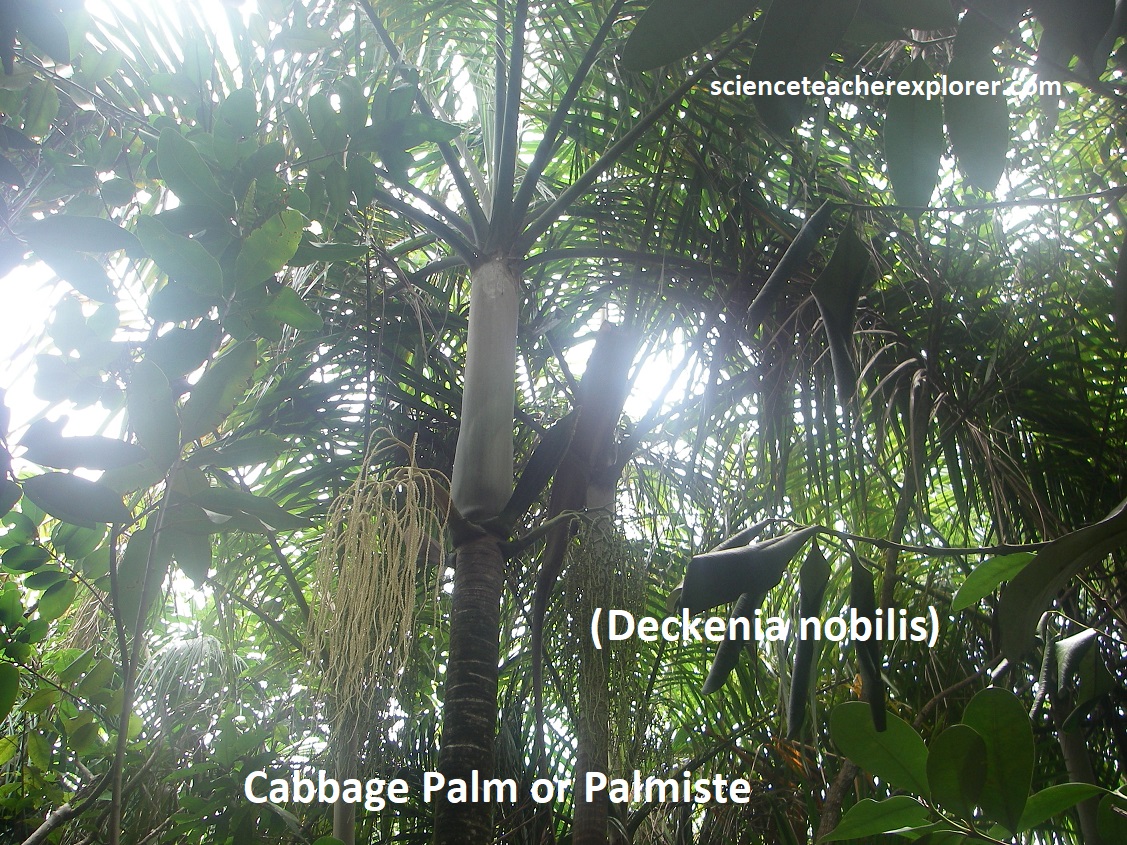
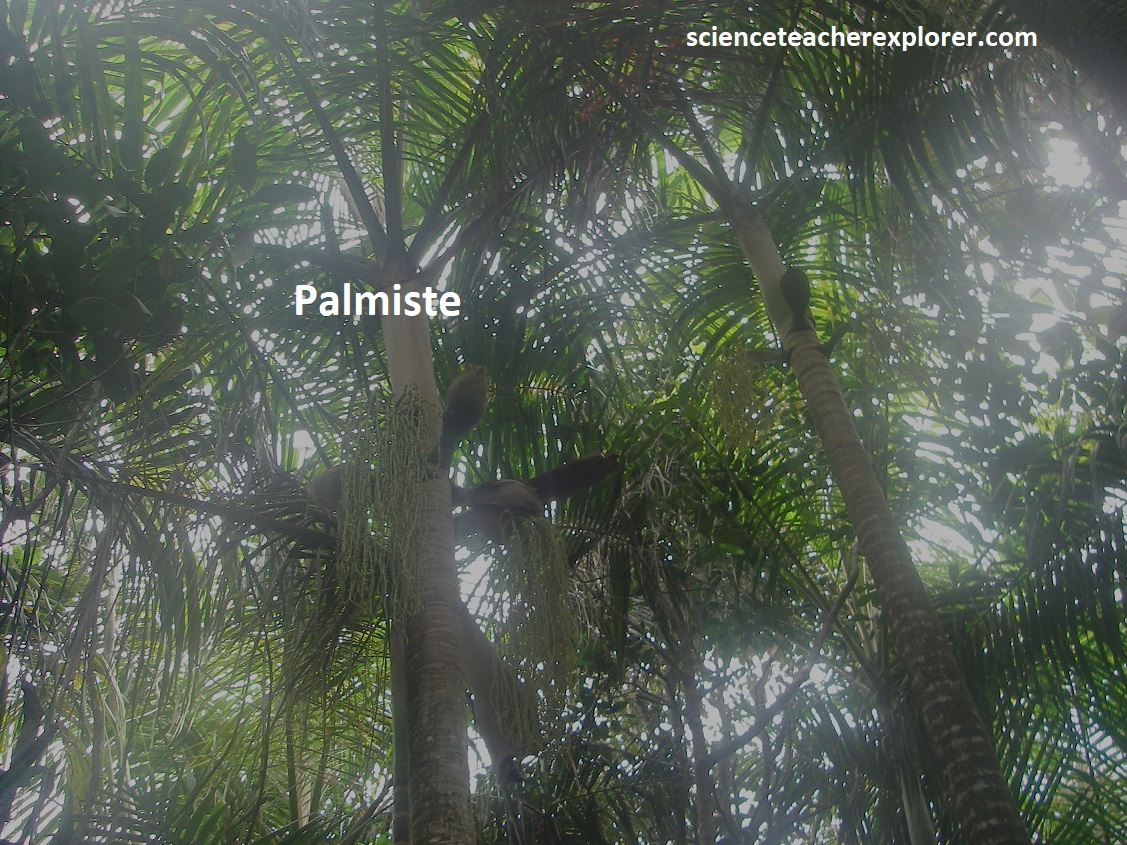
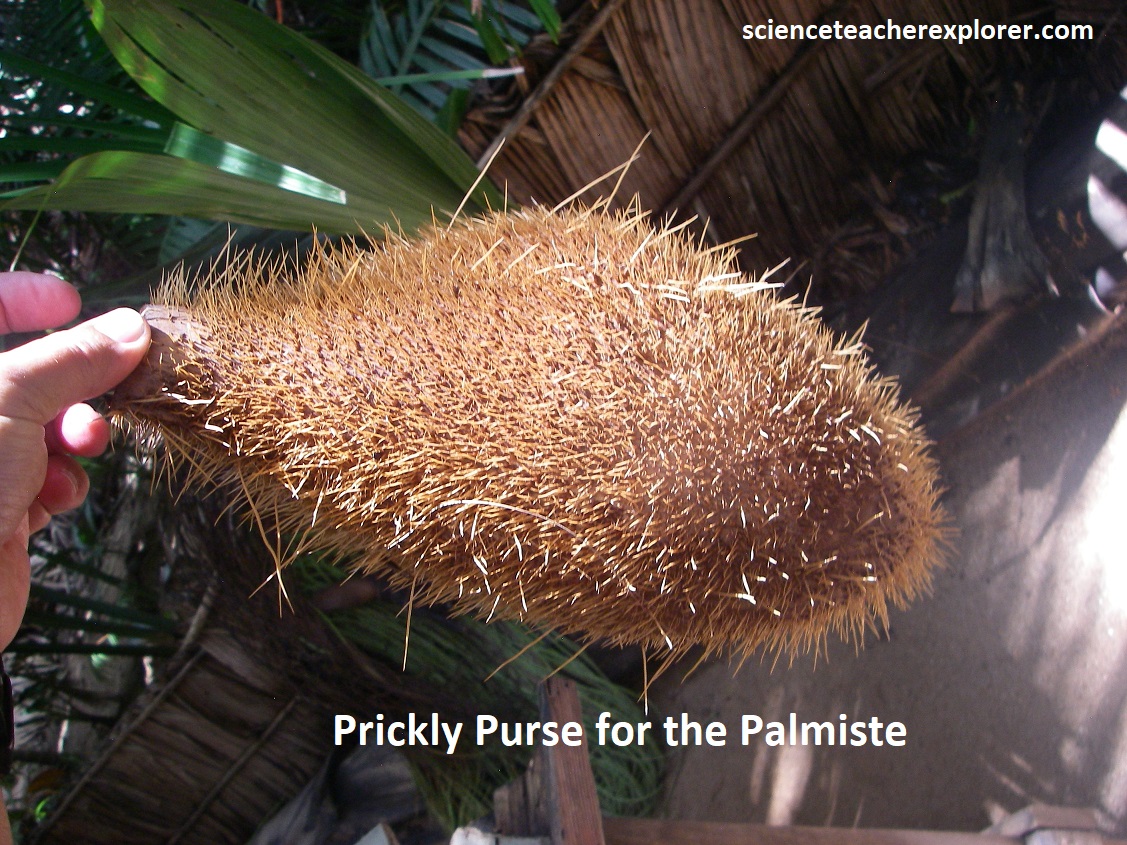
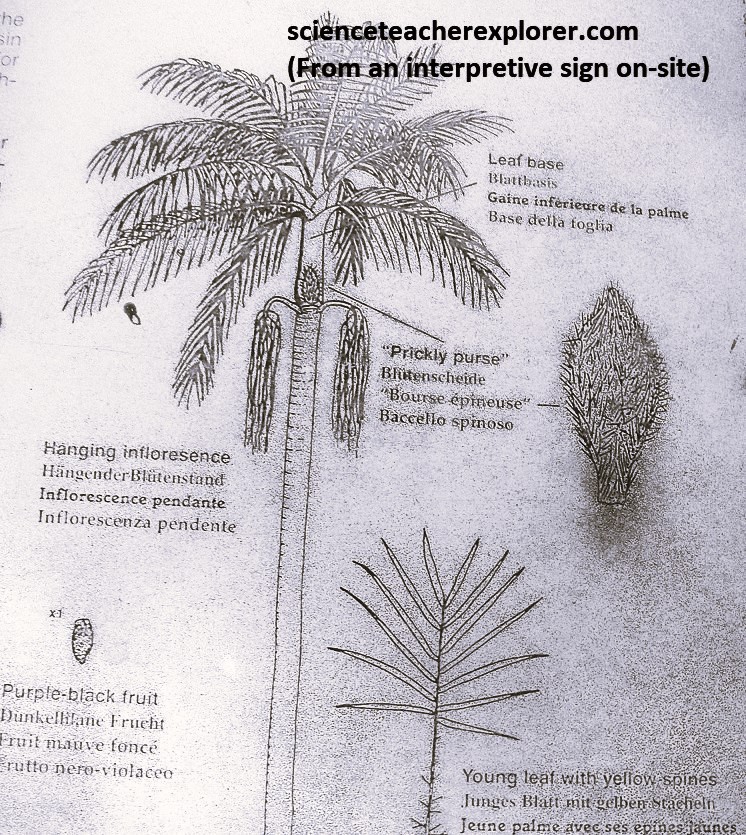
III. The Cabbage Palm or Palmiste (Deckenia nobilis) is a stout, statuesque and tall palm to impressive 40m with a slender, unbranched trunk full of conspicuous leaf scars, (pictured above). Yellow spines at the stem bases of seedings and young plants. Very large, pinnate leaves to 5m long being feathery divided into 60 or more pairs of equally long, narrow and pointed leaflets. Long, green, cylindrical and stem base. Drooping inflorescences of tiny but creamy flowers emerging from a prickly spathe, sheath or protecting ‘purse’ held at right angles to the trunk and hereafter drooping. The palm hearts are edible and sought after. Very common in Praslin.
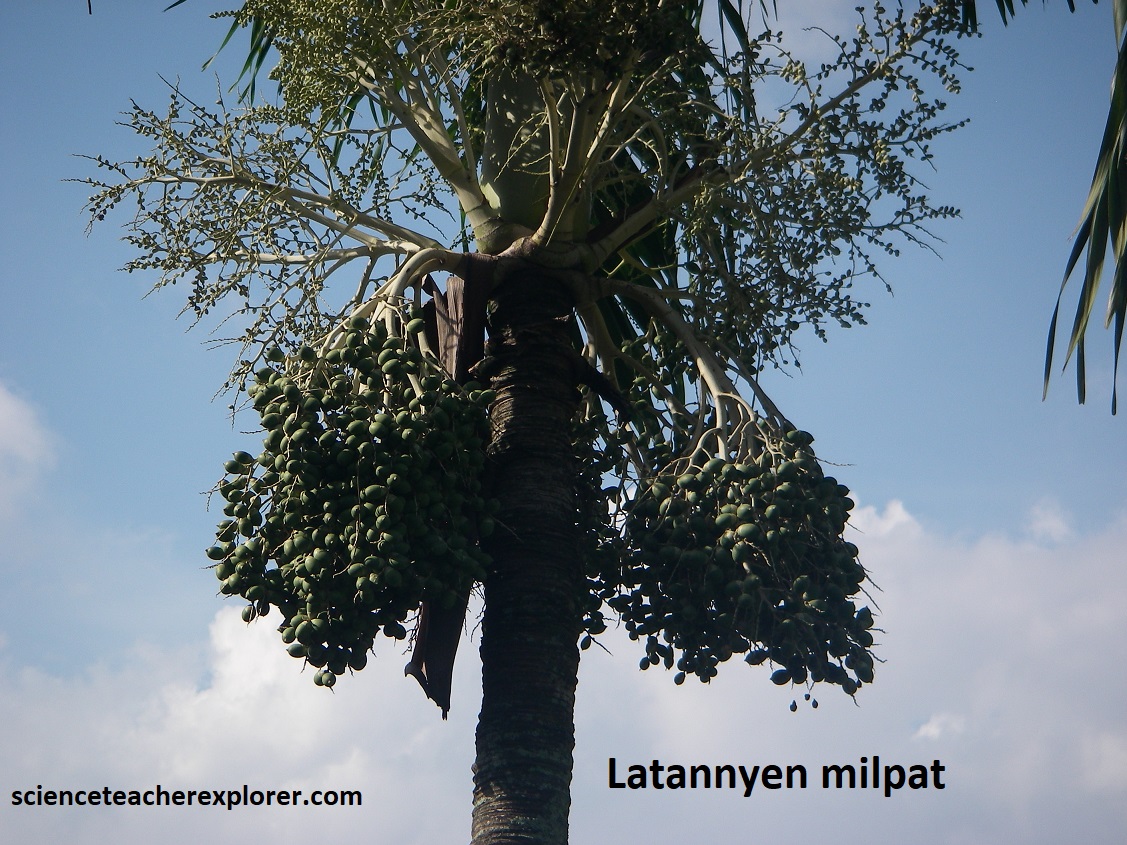
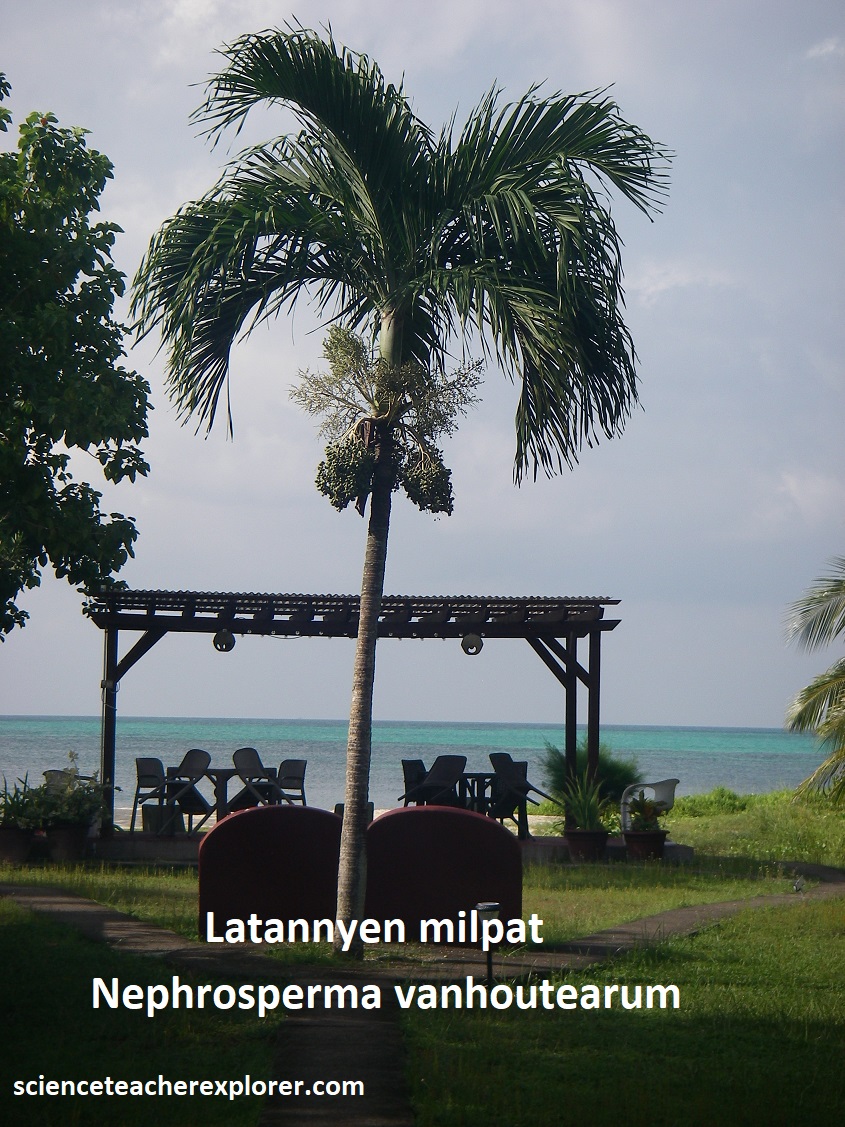
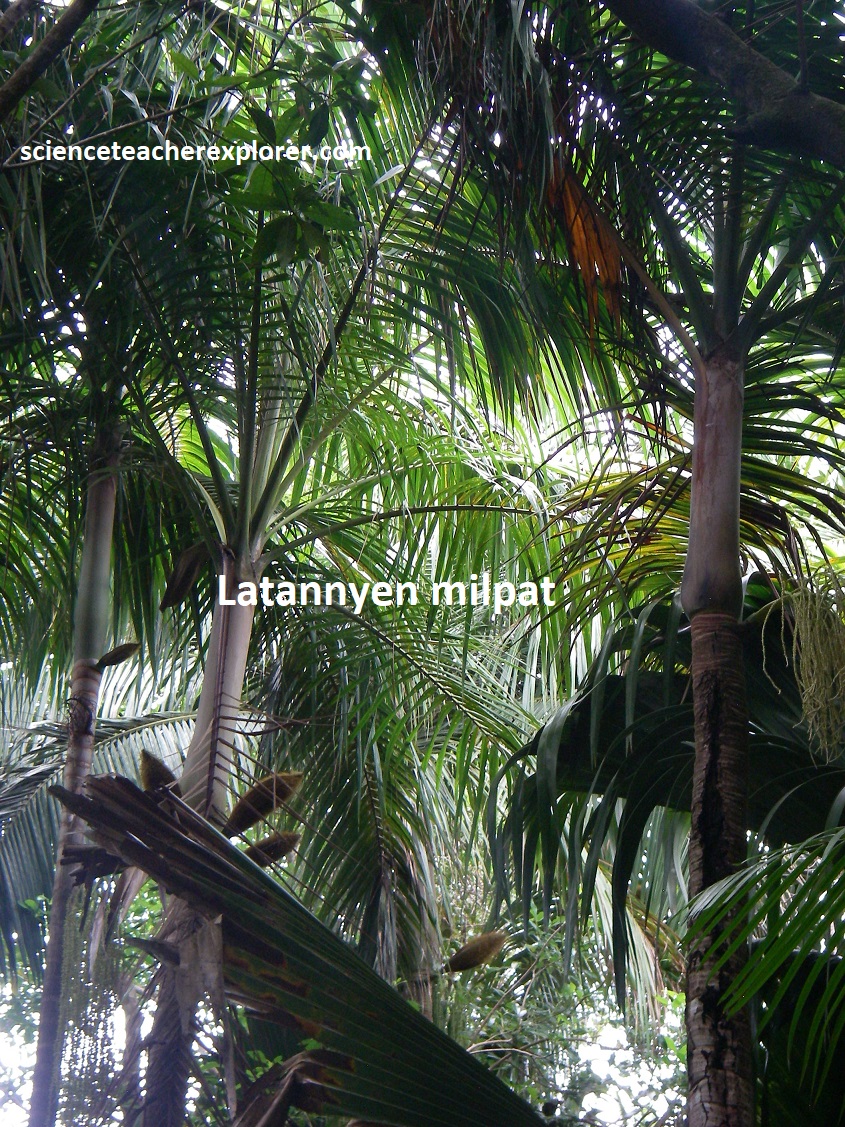
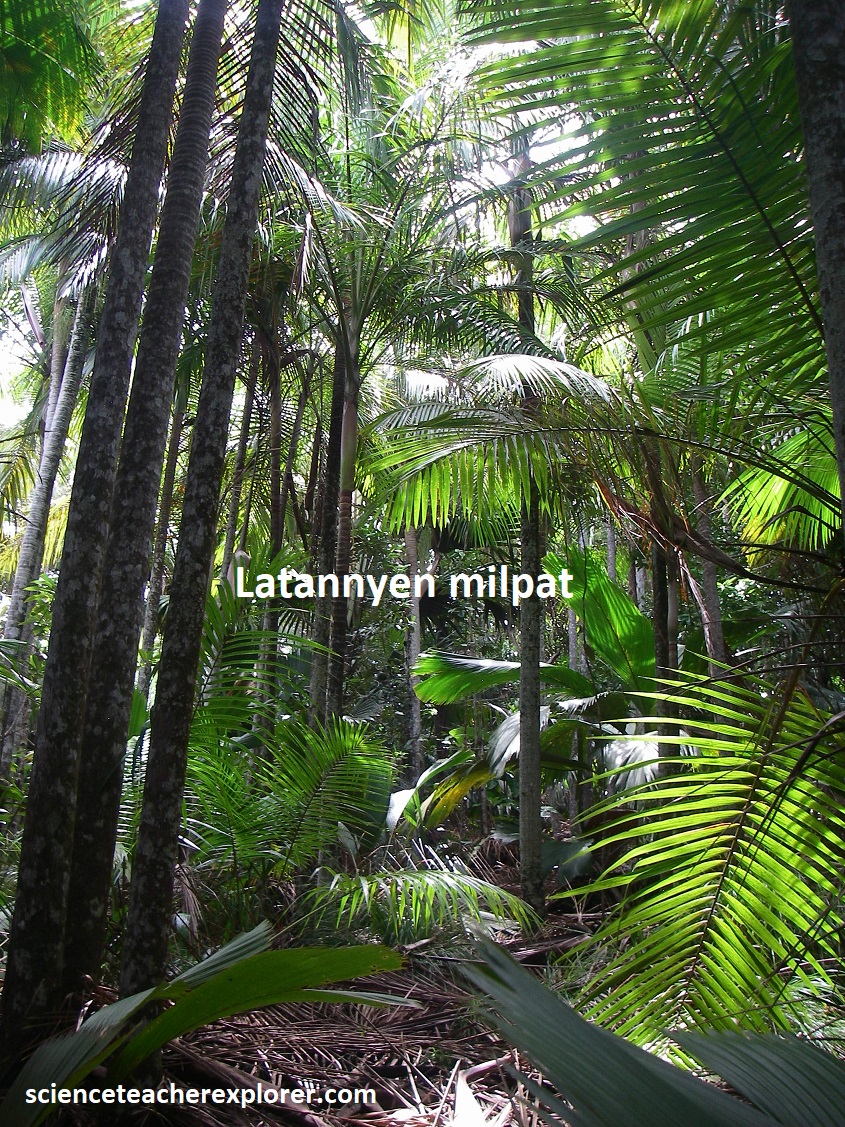
IV. The Latannyen milpat (Nephrosperma vanhoutearum) is an erect, slender, unbranched and to 14m tall palm, (sometimes with small stilt roots). Pictured above, the leaves are very large, lax and pinnate being divided into some 40 long and narrow pairs of leaflets. The inflorescences are very long, to 2.5m, upright, stiff, open branched and mingled among the crown leaves. The individual flowers are yellow but tiny if not almost inconspicuous and in cluster of three (one female and two male flowers).
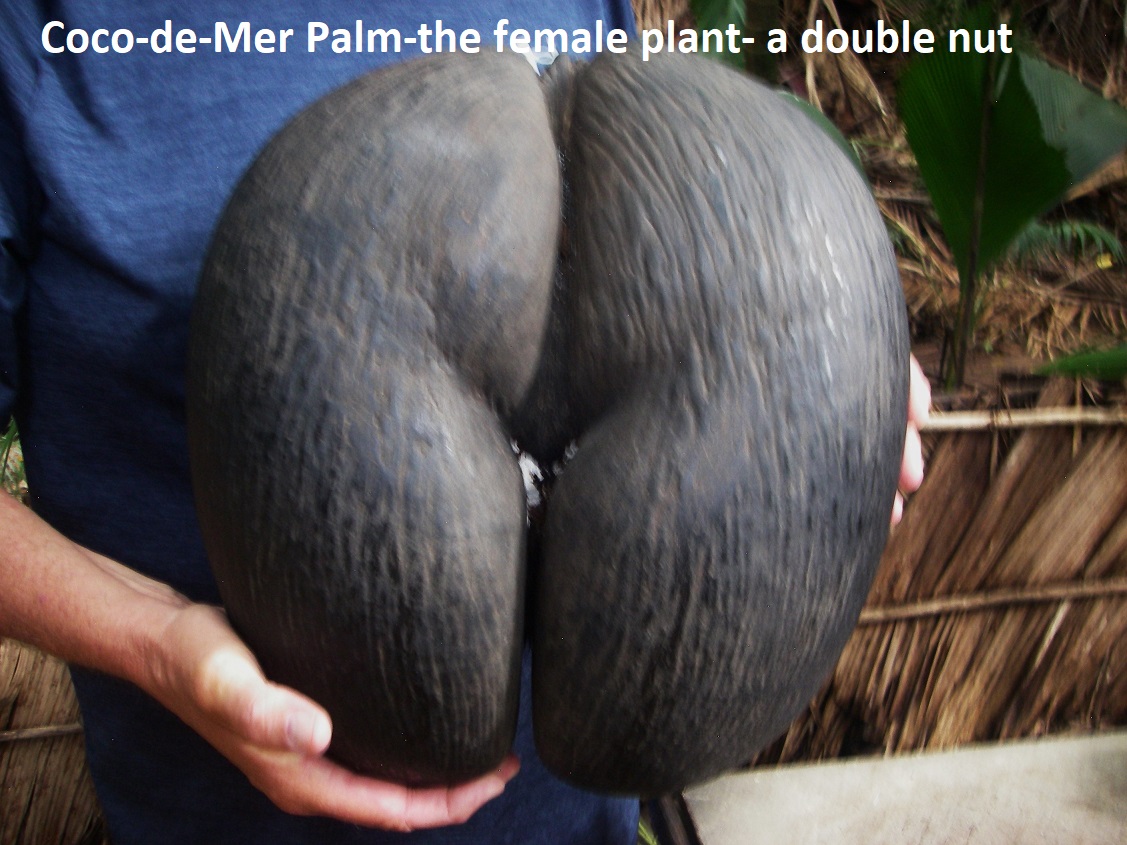
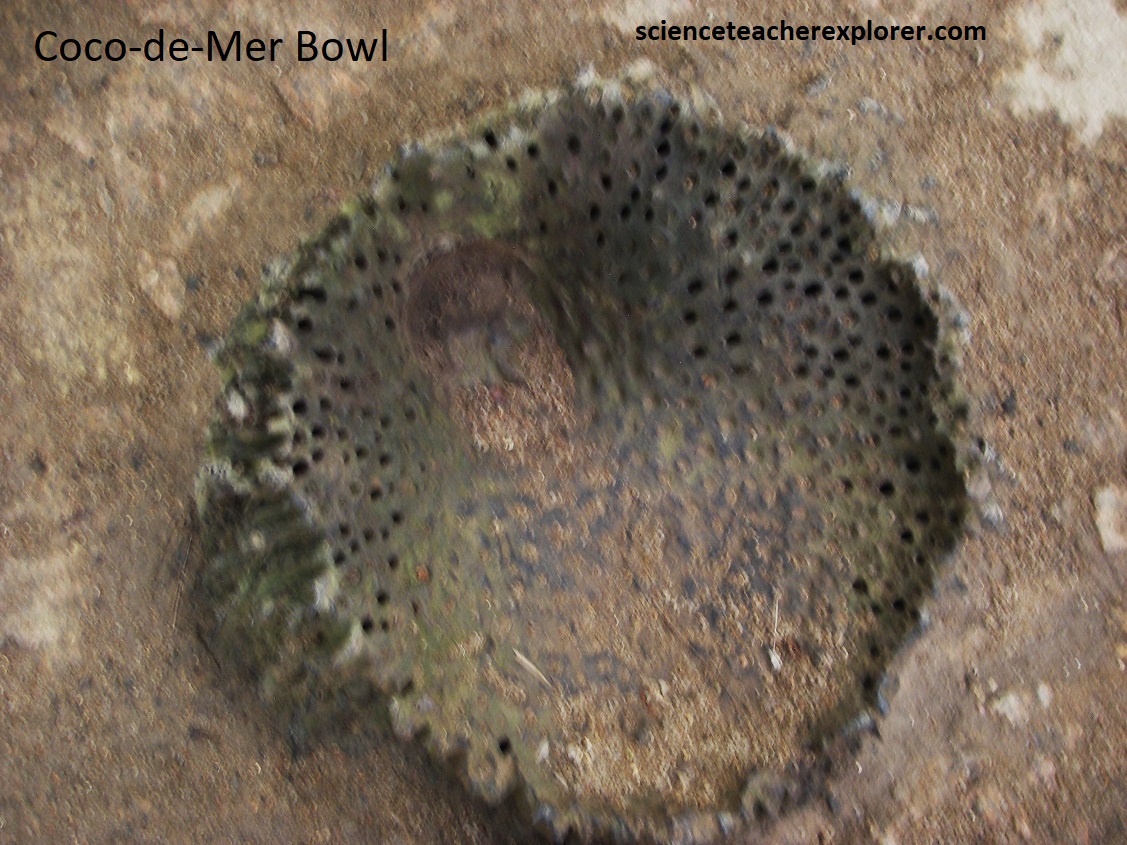
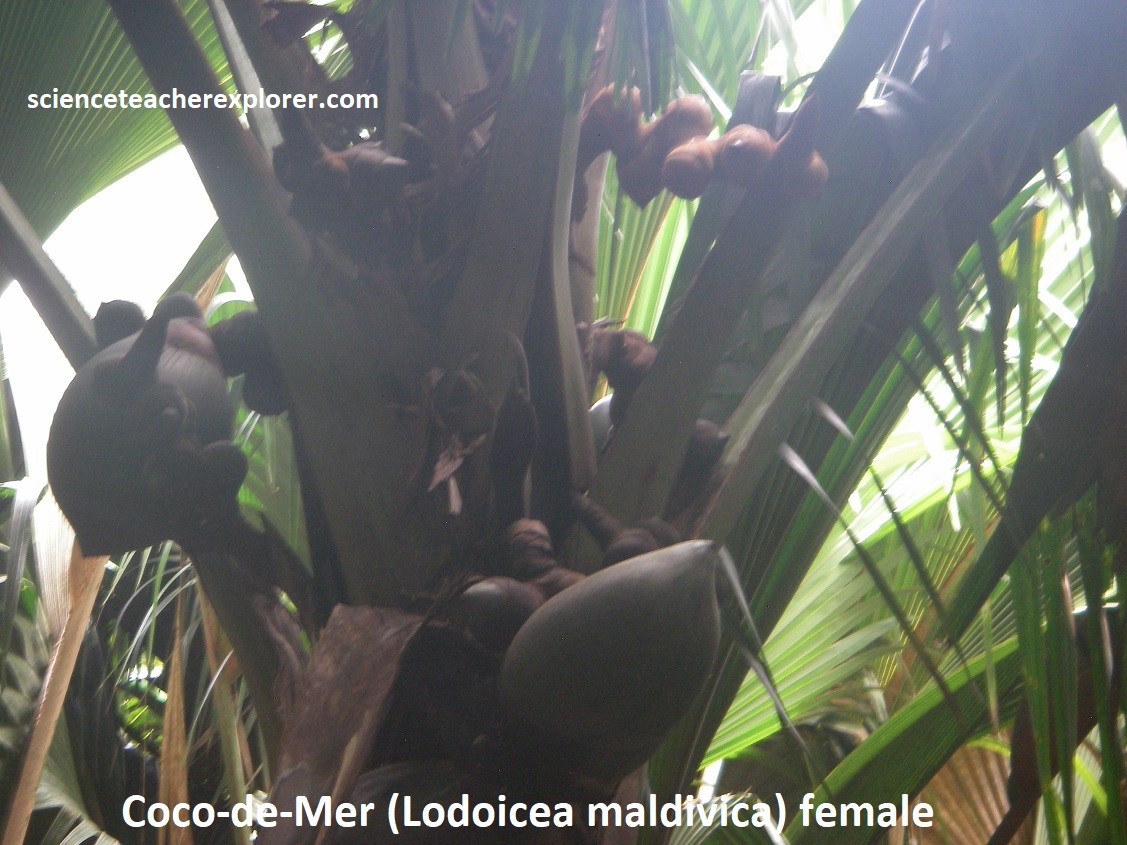
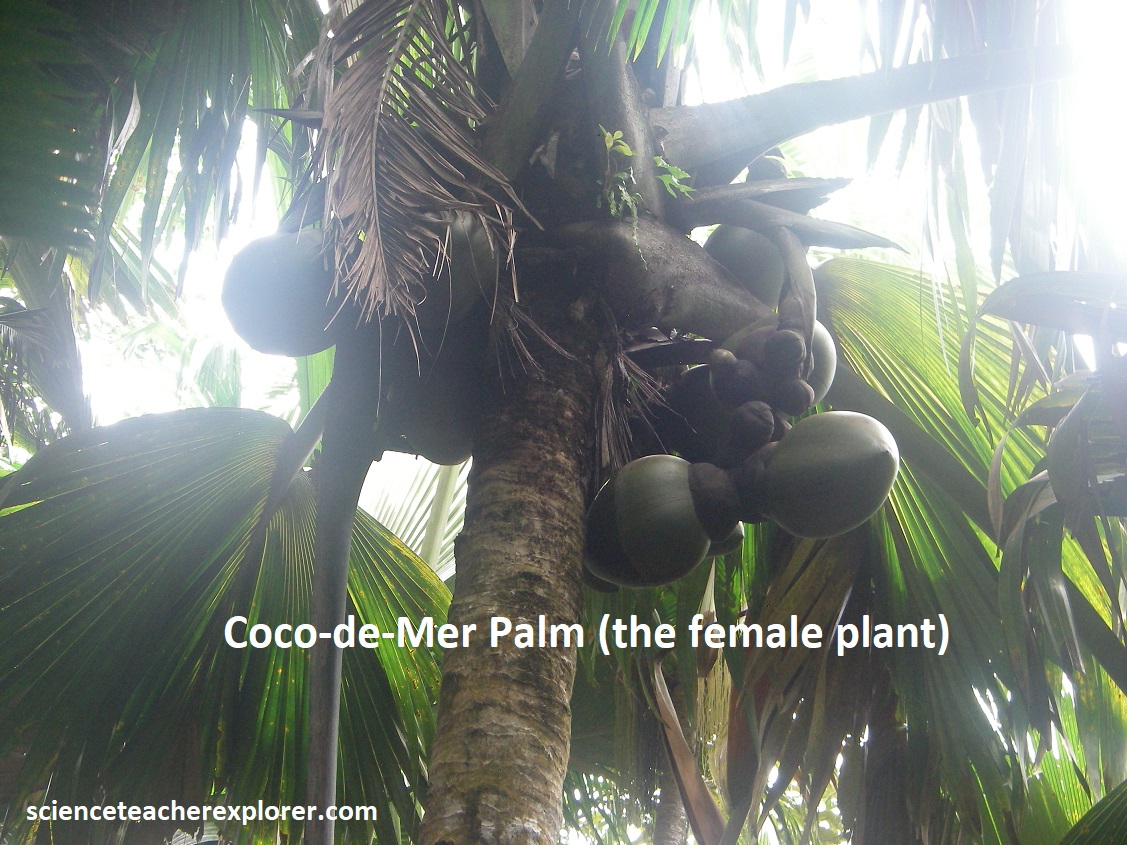
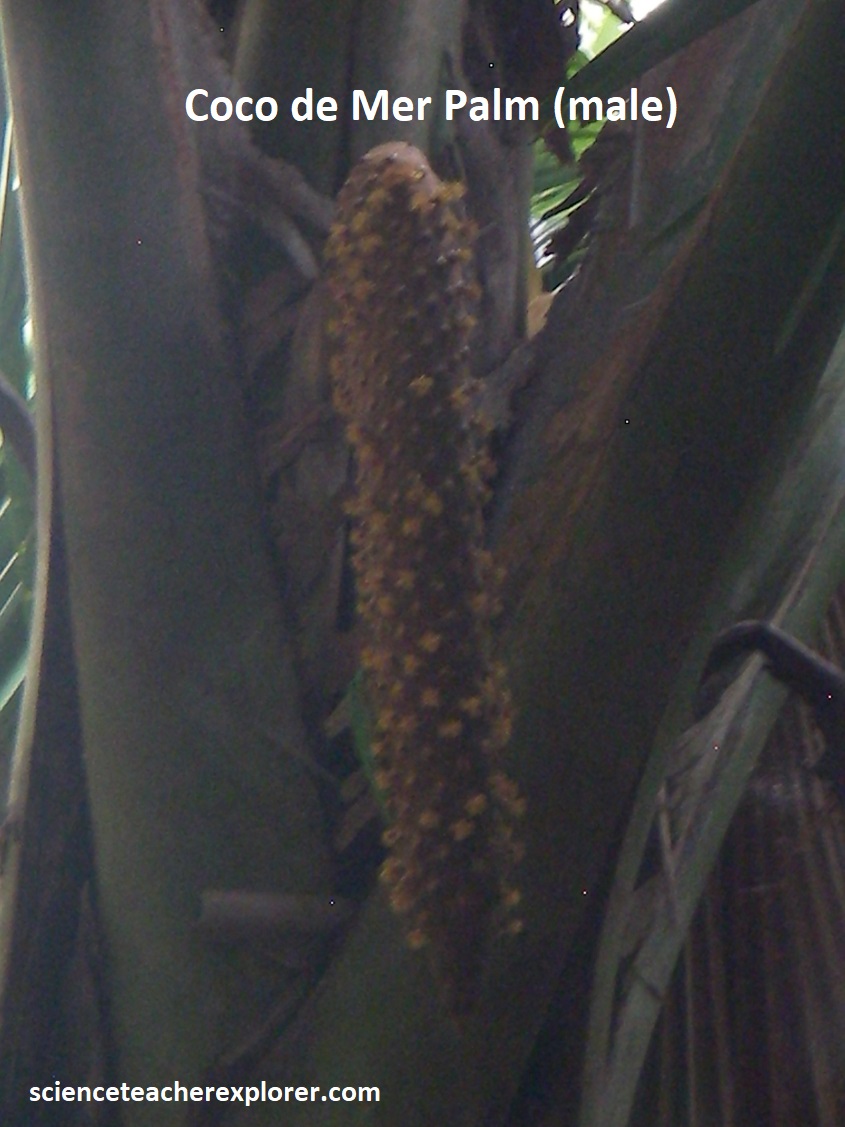
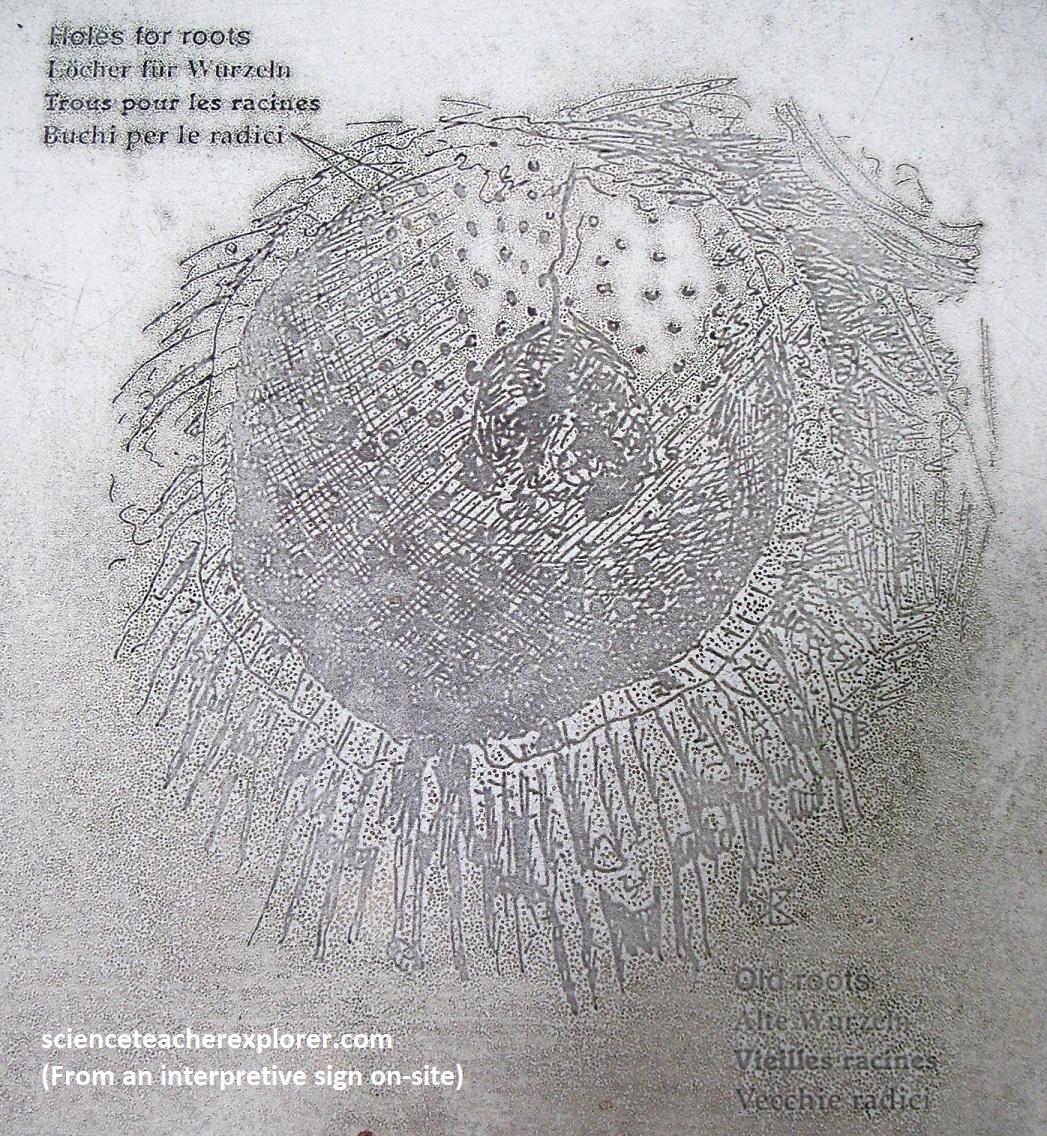
V. The Coco-de-Mer Palm (Lodoicea maldivica) is without doubt the palm of the Vallee-de-Mai and the most famous of them all. This tree produces a double nut, the largest in the world, shaped like a female pelvis. The spike-shaped male inflorescence is also highly suggestive. A single nut can weigh 18kg and take 10 years to germinate. The Coco-de-mer is a very slow growing palm with a complicated life cycle. It can mature as early as 15 years, but usually between 20-30 years. The leaf also holds the record for the world’s largest at 3.3 square meters in size. Until the Valle-de-Mai was found, people beyond the Seychelles thought the strange nuts came from the bottom of the sea, (hence, the French name meaning “sea coconut”. Mature palms can grow to over 25m tall. Male and female parts occur on separate plants. The male catkins contain lots of pollen, providing a food source for animals. At the base of a Coco-de-Mer palm is an extremely dense and durable “bowl” which is punctured by numerous finger-sized holes, and resembles a huge collander. The bowl forms a socket, into which tits the bulbous base of the trunk. The tough, flexible, rop-like roots pass through the holes in the bowl, anchoring the palm to the ground. It is thought that this arrangement allows an certain amount of movement of the trunk in strong winds, for the trunk itself is inflexible and cannot bend in the wind like other palms. {Dead standing Coco-de-Mer trunks slowly decay and are the favored nesting site of the Seychelles black parrot.
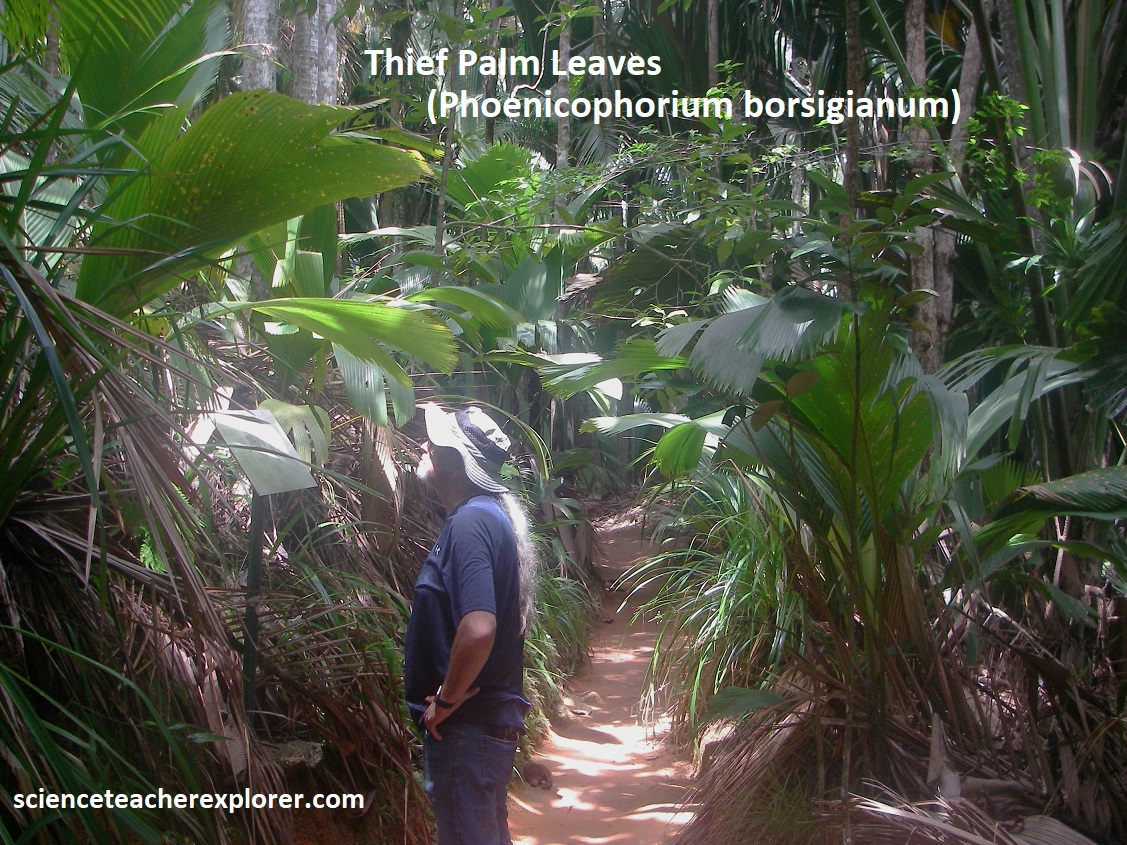
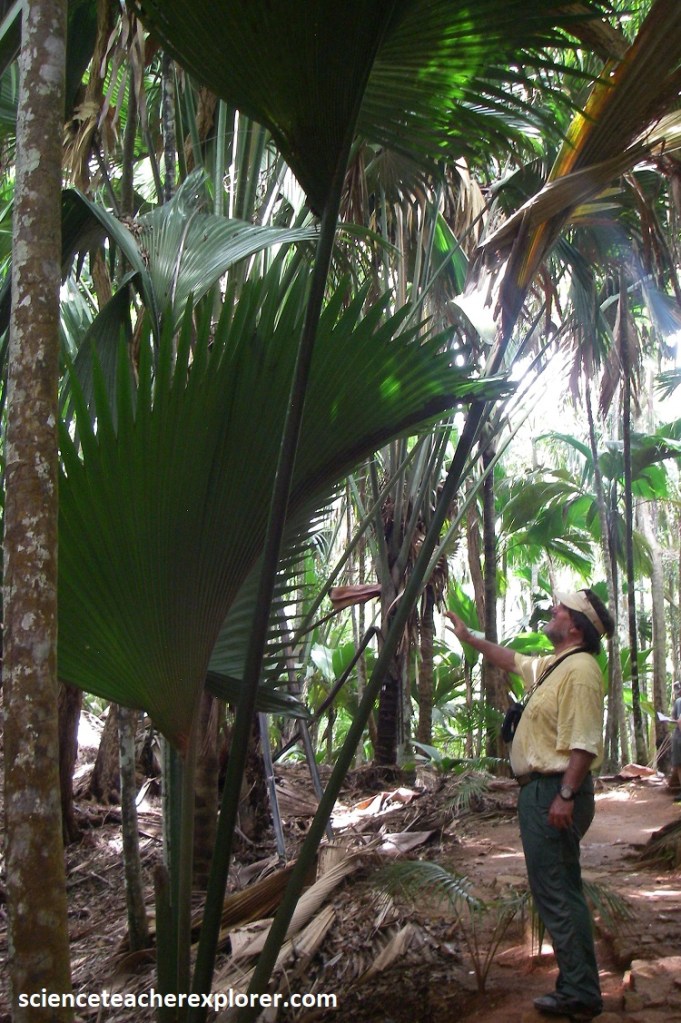
{Pictured above is Mike Stevens looking at and identifying the Thief Palm}
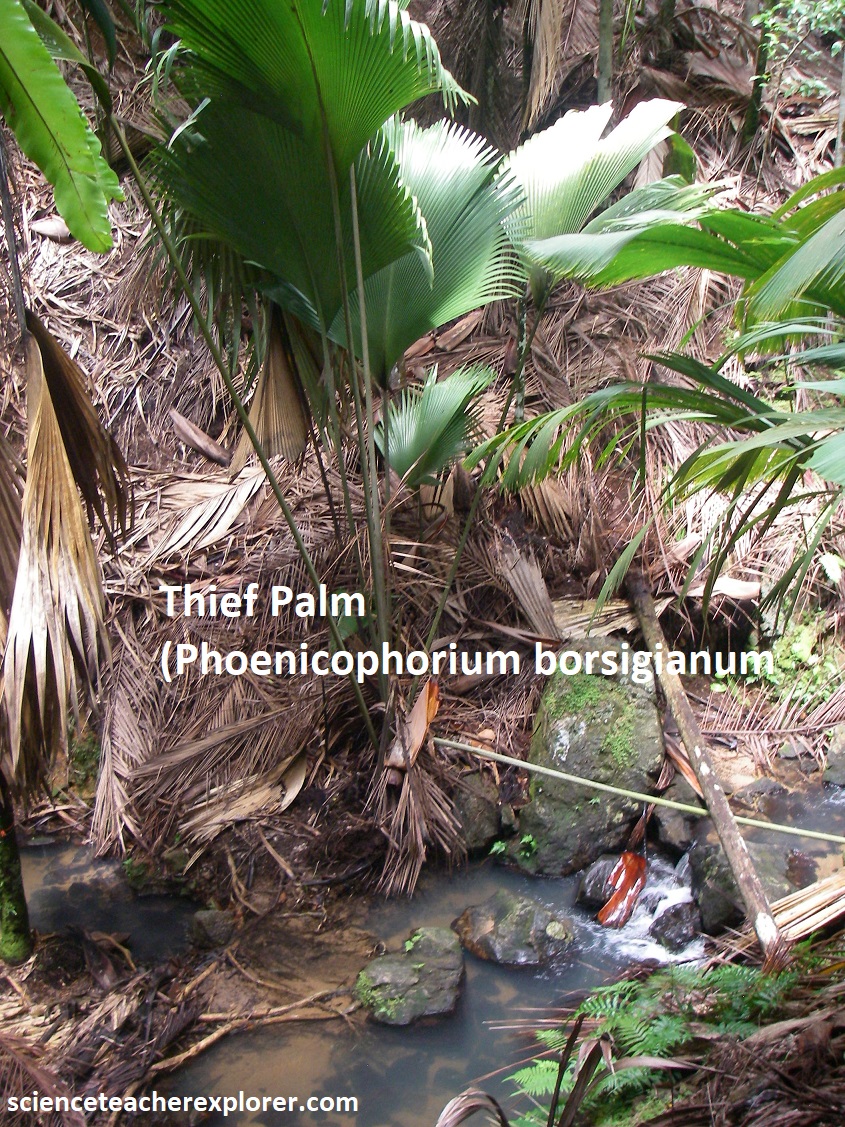
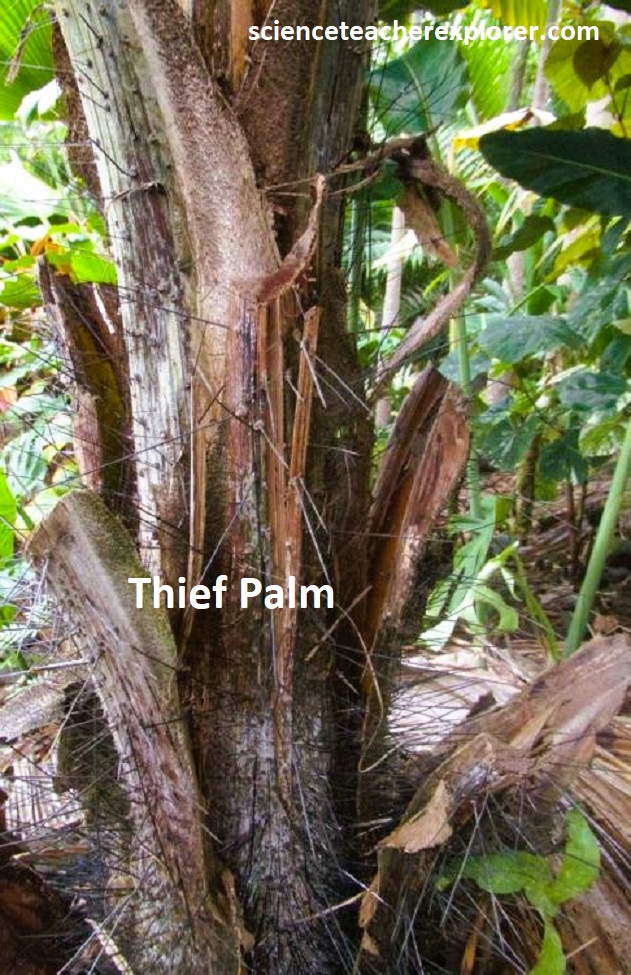
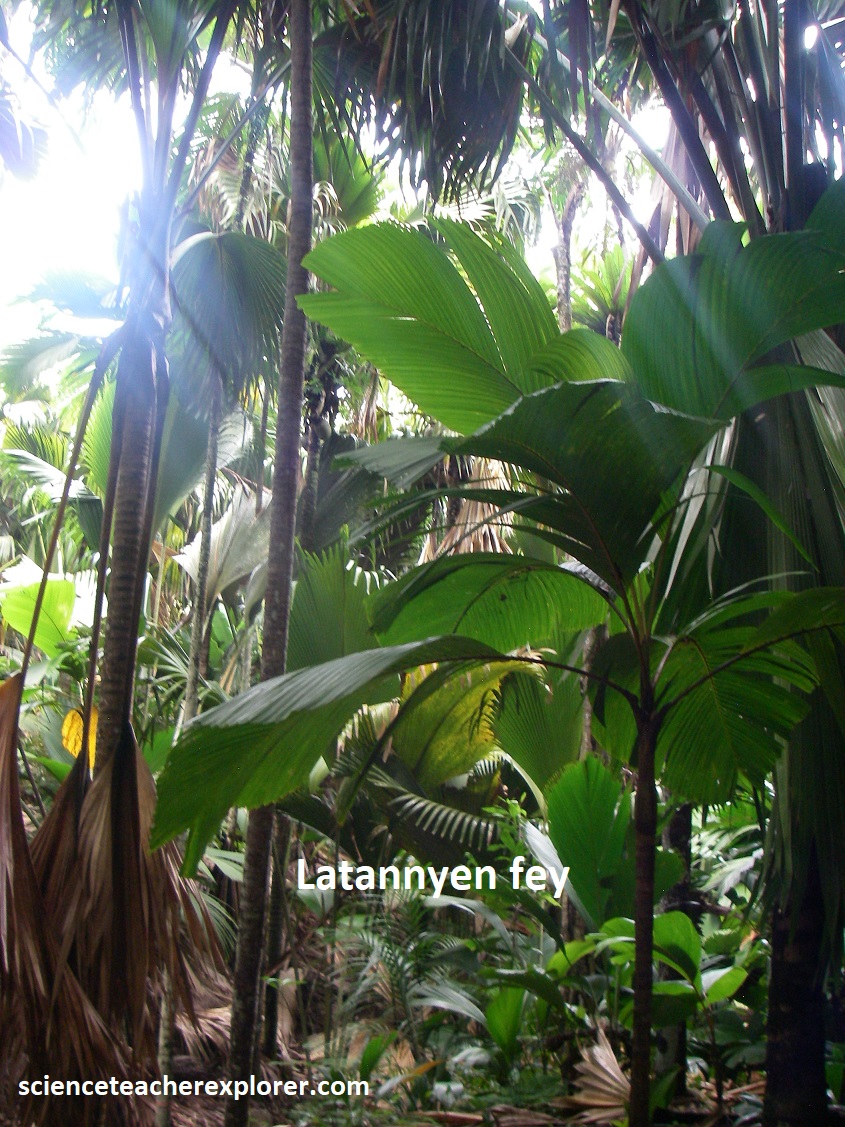
VI. The Thief Palm (Phoenicophorium borsigianum) is a fairly tall, to 15m high, palm with stems heavily ringed of leaf scars. No stilt roots, but black spines on the trunks when young. Very large leaves to 2m and split with an open and deep “V” at the tip. Sometimes with orange edged serrations which are not regular toothed. The inflorescence is stiff branched but often softly curved downwards, (unable to photo this), and consisting of many, tiny, yellow male and female flowers on each ‘branch’, arranged in triads with on female for every two males. [The Creoloe name ‘Latannyen fey’ derives from the french ‘latanier’ meaning ‘fan palm’ and ‘feuille’ meaning useful ‘leaf’, for thatching.
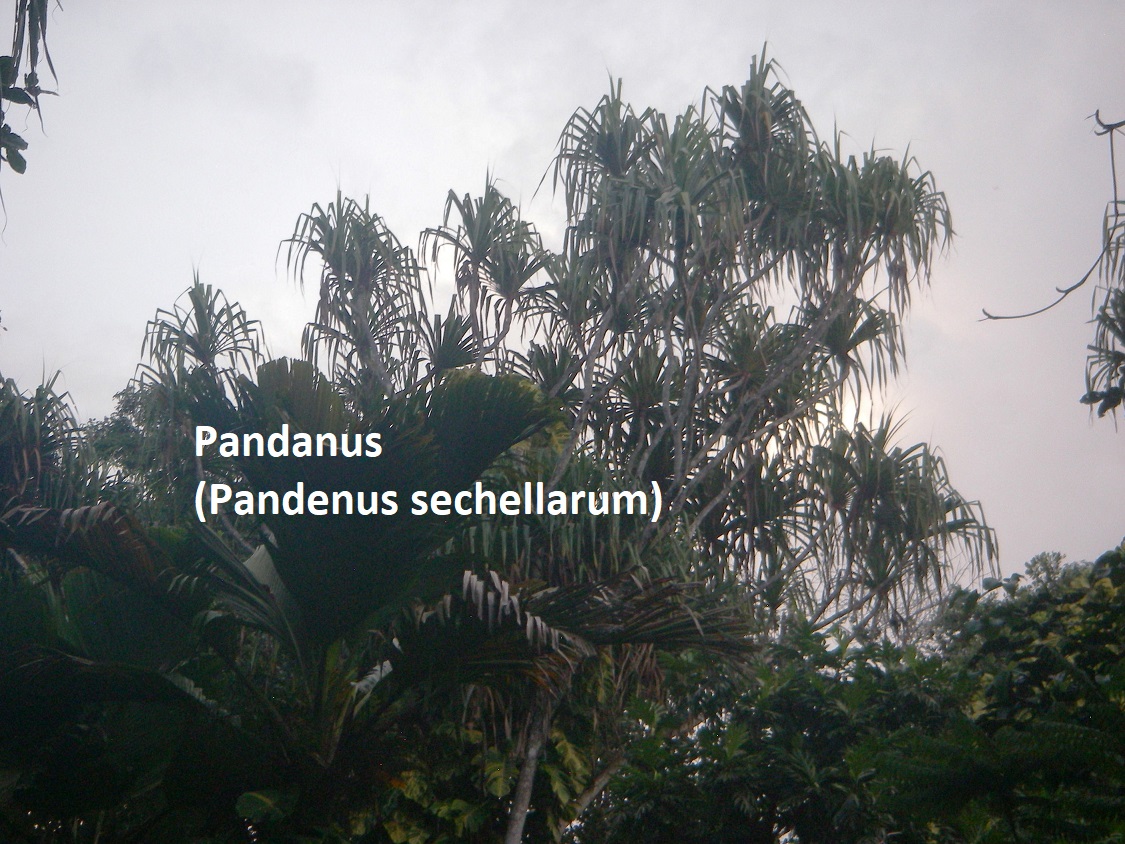
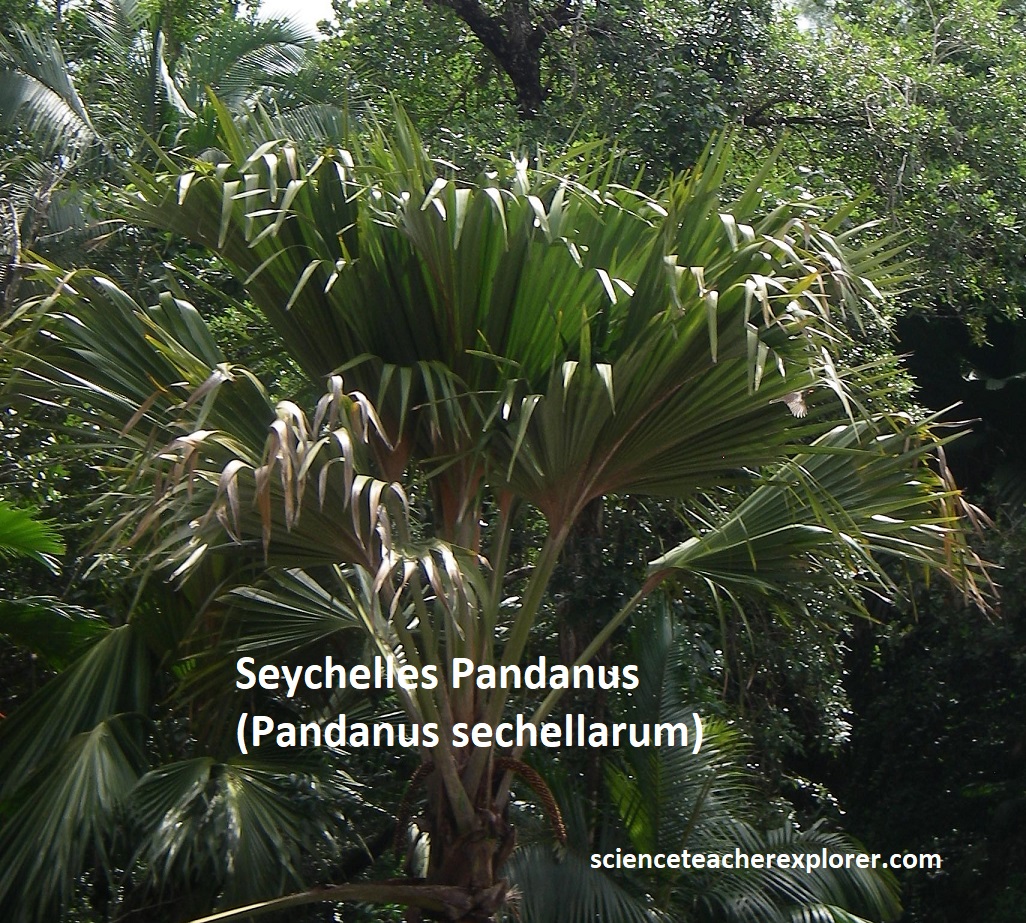
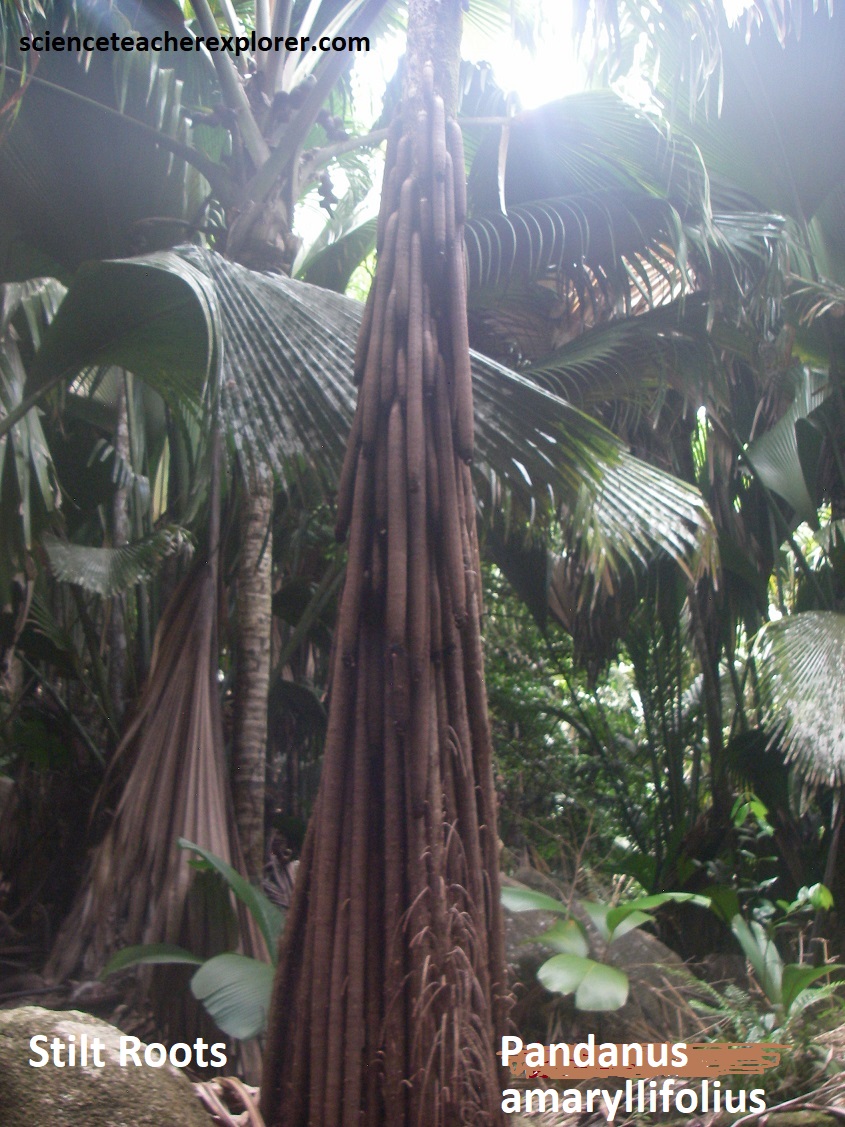
An additional palm-like plant found in the Vallee de Mai is the Seychelles Pandanus (Pandanus sechellarum). Actually this is not a genuine palm but a screwpine that is 15m tall with many, vert long, stout, widely spaced and downward growing stilt roots to 10m emerging from the main stem. Very long, narrow to linear, leathery, prickly and light green leaves to 1.5m long with whitish spines on the margins and mid ribs. Male and female flowers on separate trees,
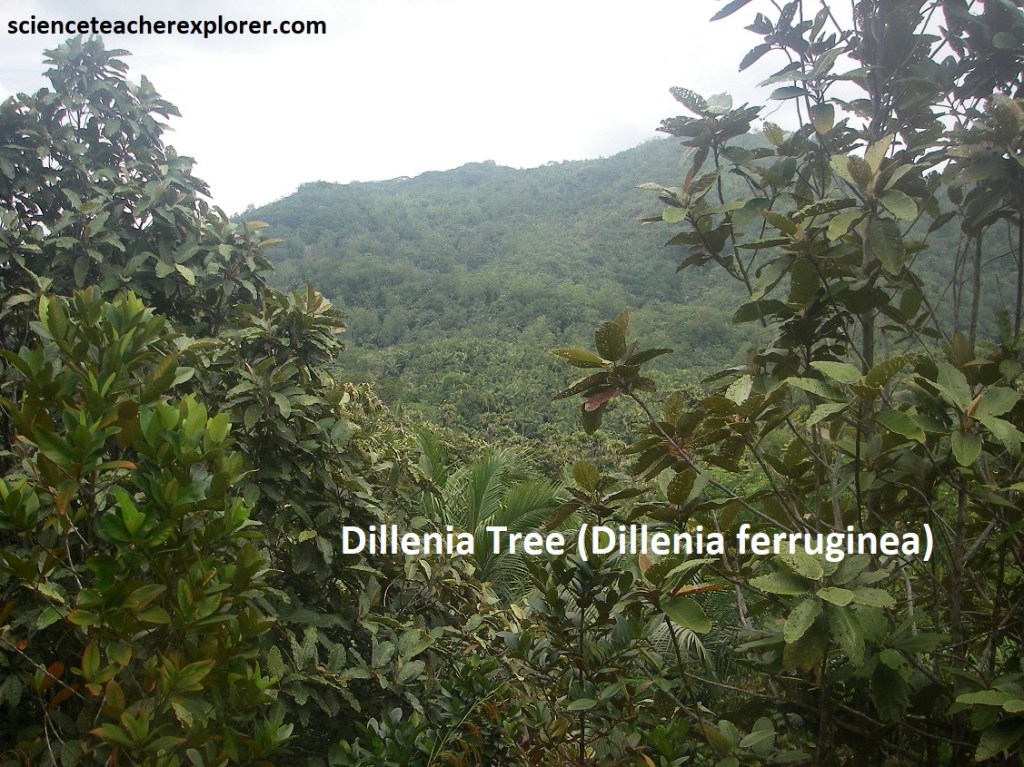
Along the ridge-tip of the park, Mike and I came across a grove of Dillenia (Dillenia ferruginea) Trees. The beautiful and striking Dillenia Tree was easily recognized on the rough leaves with prominent veins on the upper-side, most often rusty on the underside and being almost always damaged by insects. The tree, which is quite common in the Sechelles and can grow to some 20 tall, is name after the German scientist, Johan Jacob Dllenius (1687-1747). This tree has contributed much to the construction materials in the Seychelles. It is quite fire-resistant.
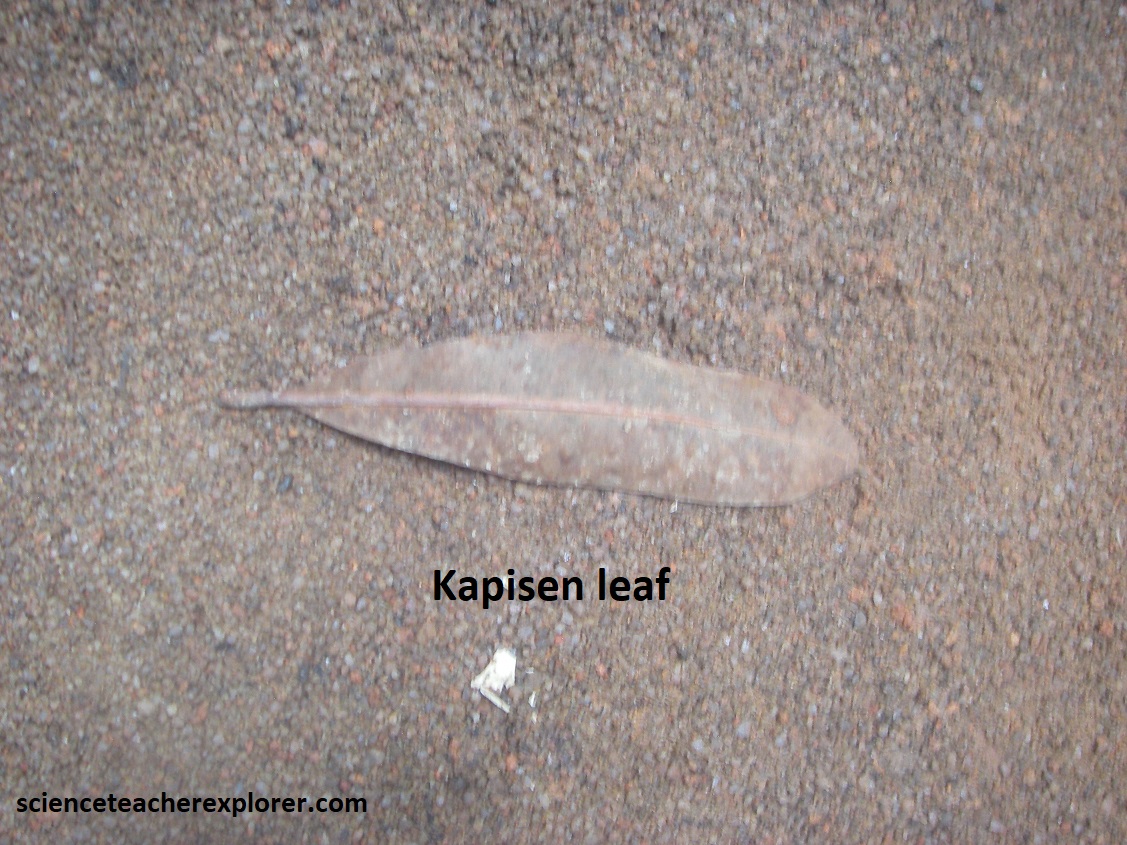
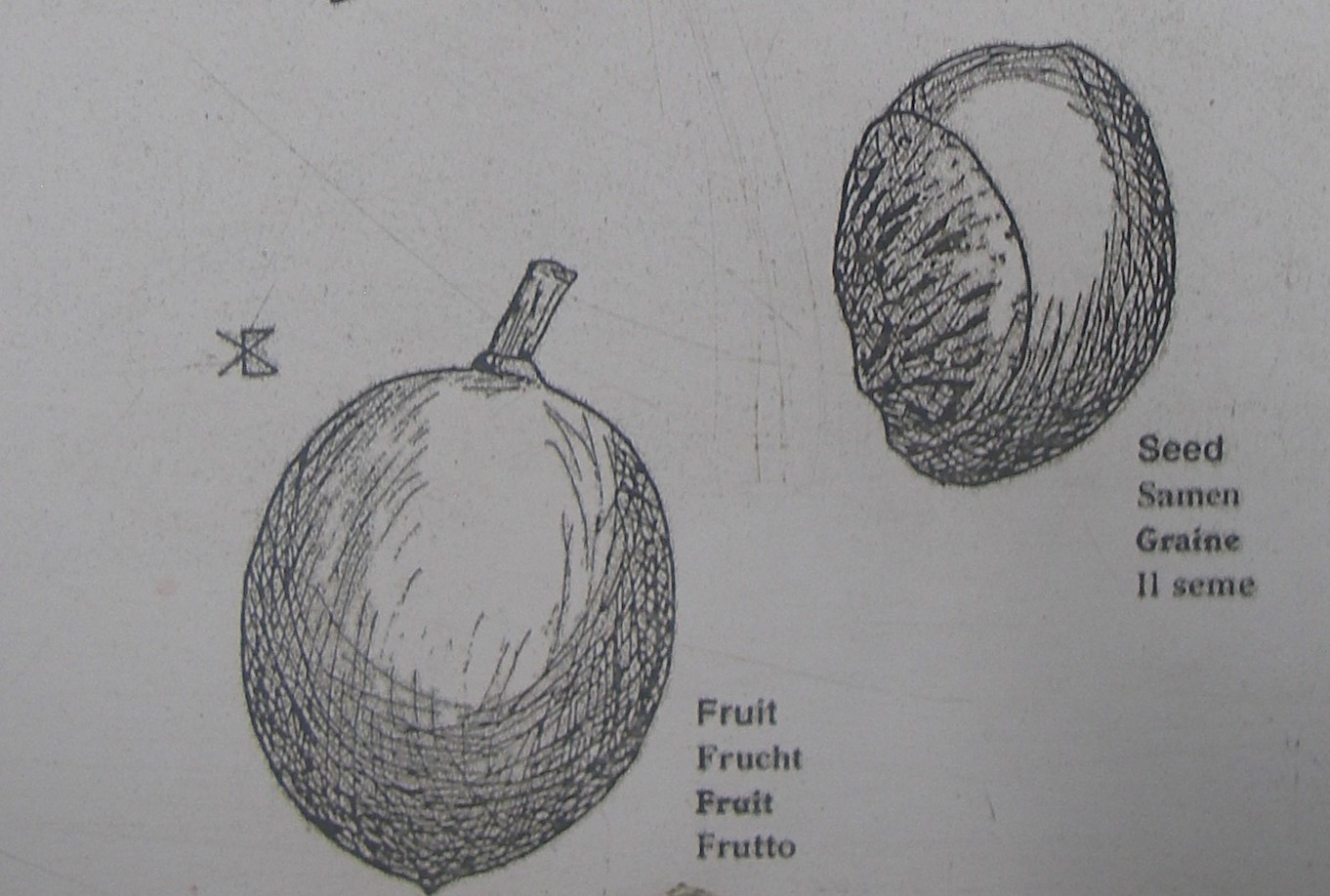
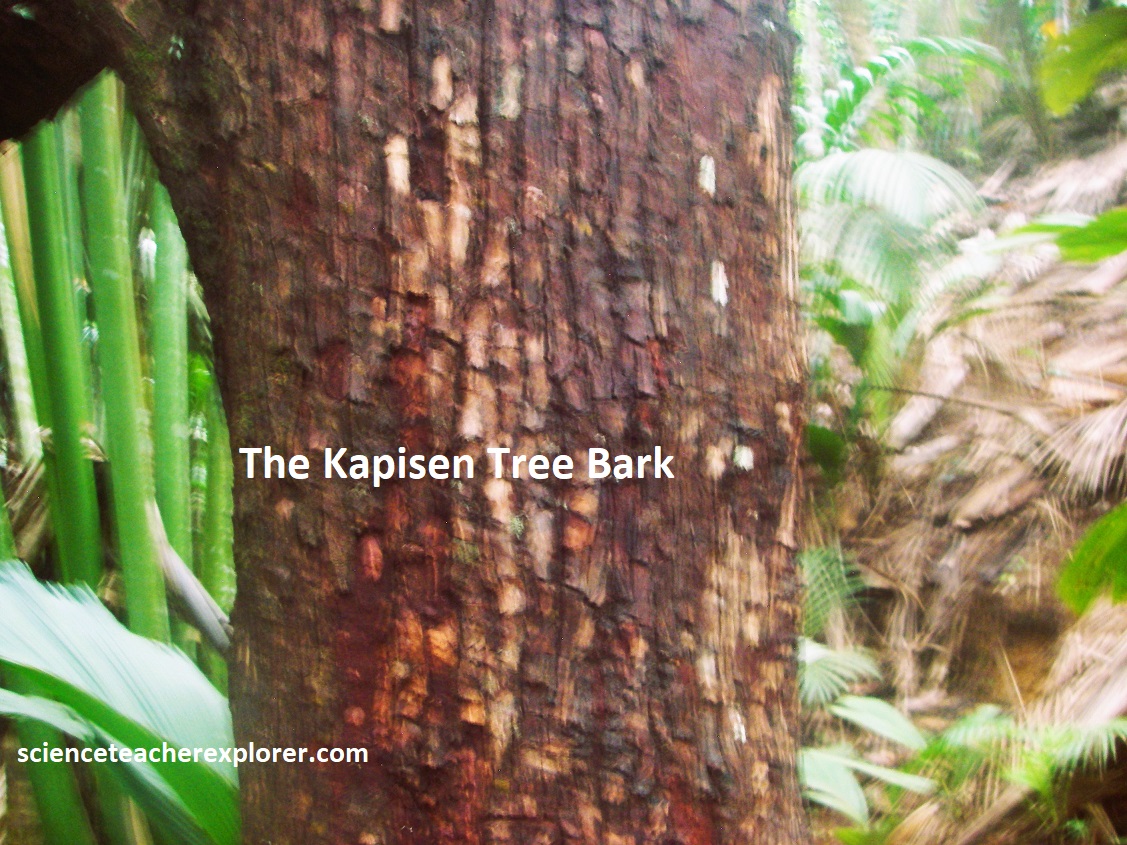
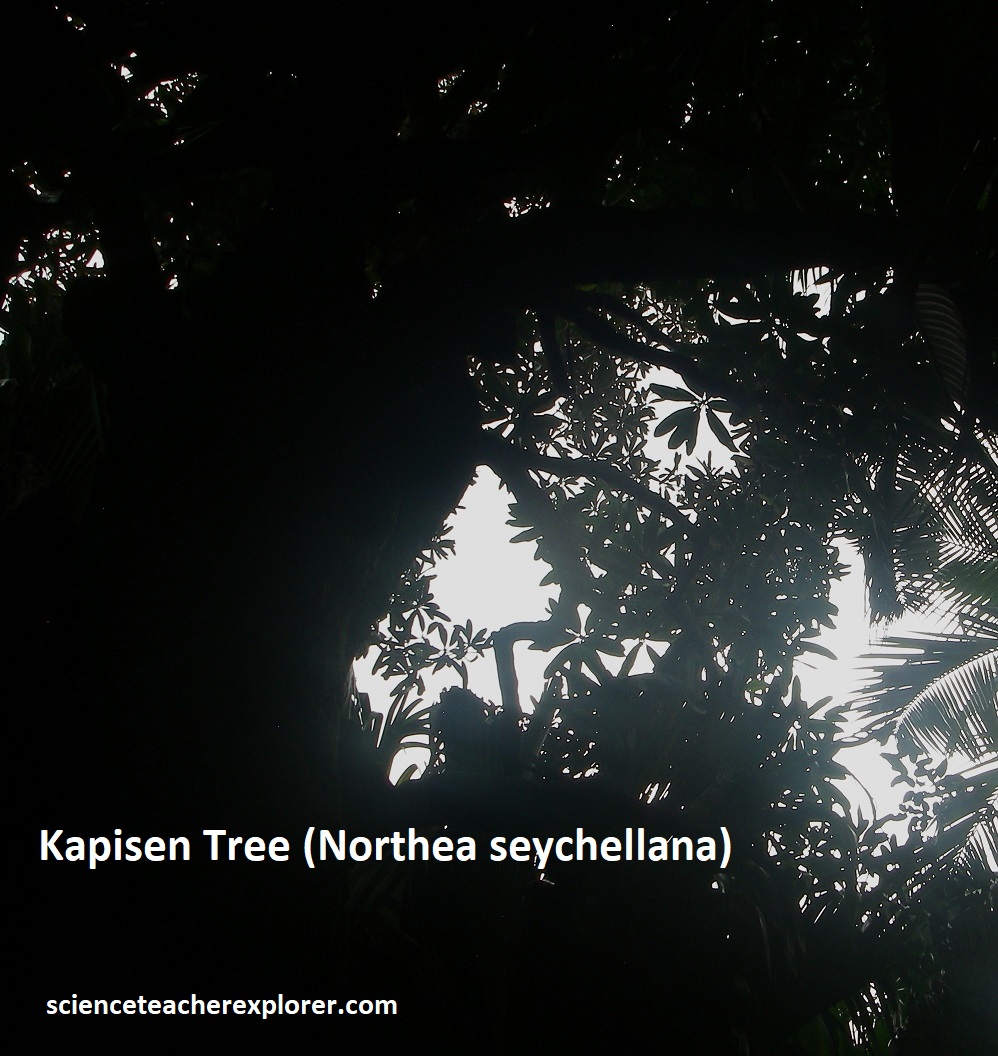
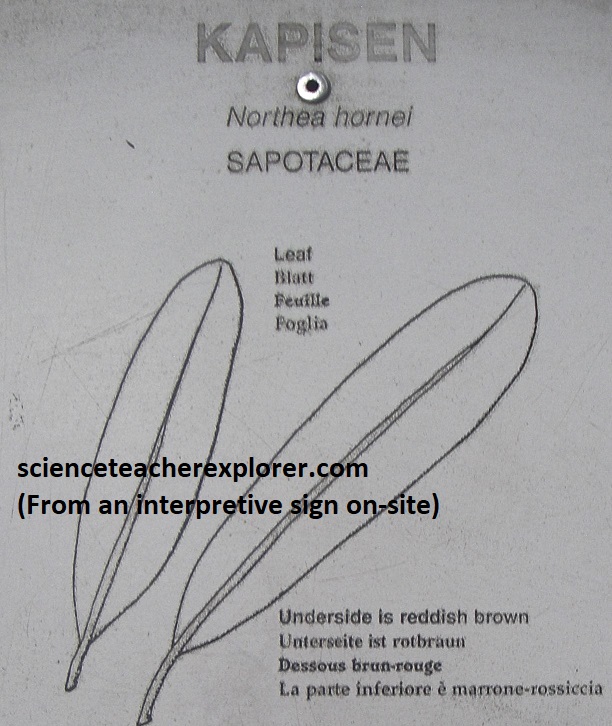
Apart from palms and screwpines, there are other endemics growing in the Vallee de Mai. Picture above, the Kapisen Tree or Northea (Northea seychellana) is common in the mountains above 600m, (pictured above). However in the lower hills, including Vallee de Mai, only scattered trees remain because the time is high valued and almost all tall trees have been cut. An intrepid Victorian artist, Marianne North, painted Kapisen trees and sent specimens back to England for identification. The tree was named Northea after her. The Creole name, capucin, is derived from the form of the large seed, which bears a resemblance to the head of a cowled Capuchin monk. Other distinctive features are the dark reddish brown bark and the reddish brown underside of the mature leaves. The flowers are inconspicuous. Fruit bats eat the outer fleshy part of the fruit. The stout Northea tree, which come to 20m tall, has a thick, stumpy and gnarled twigs and white latex.
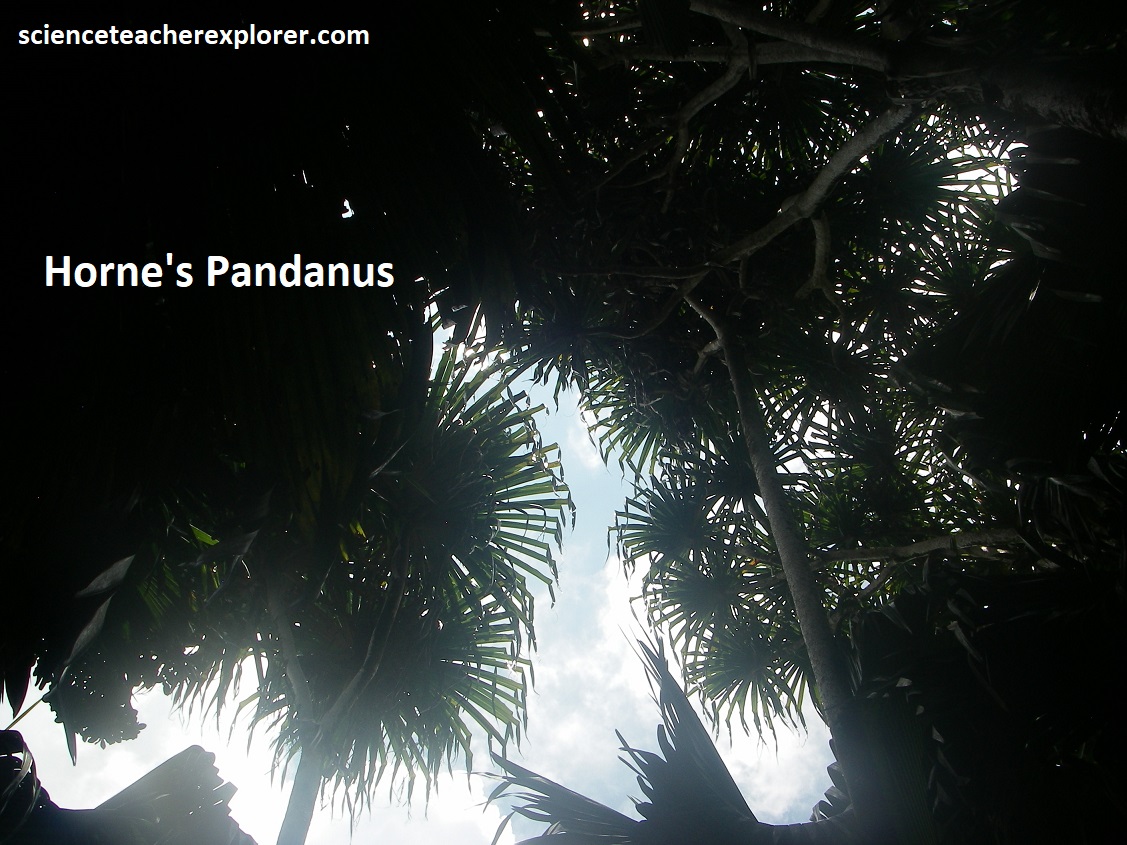
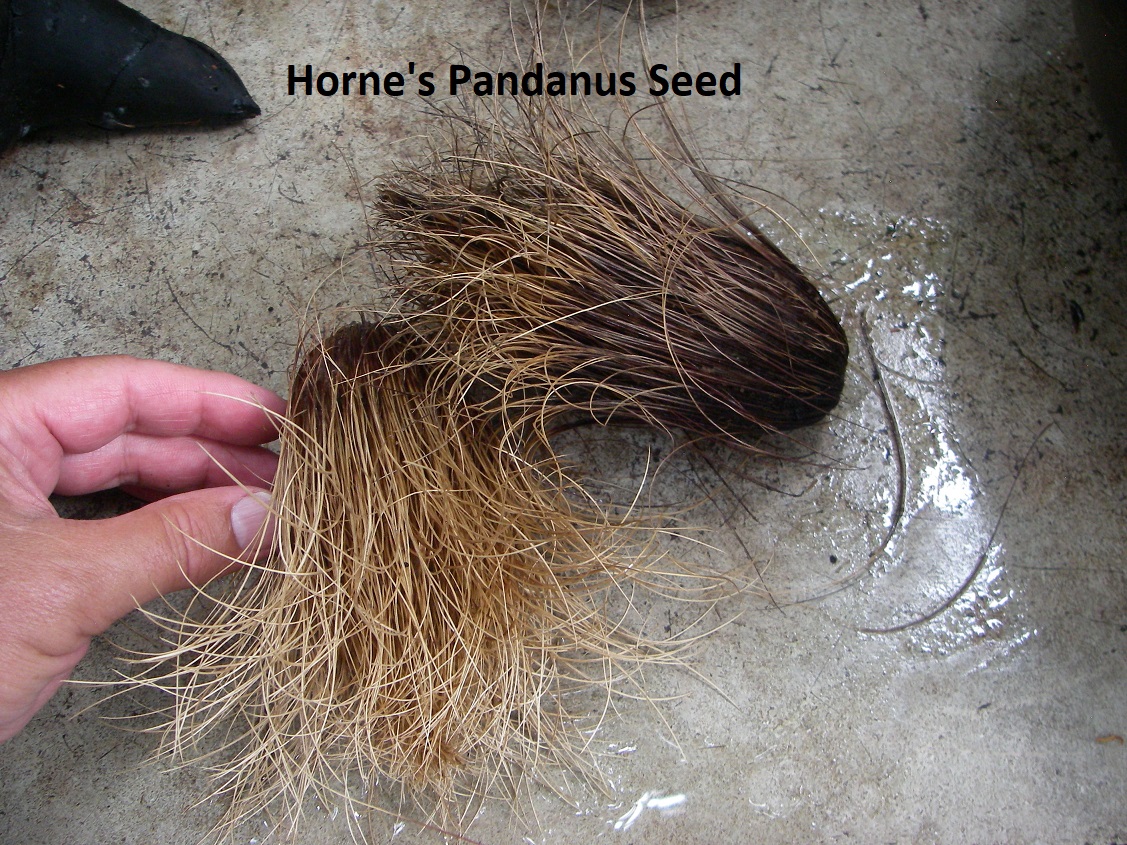
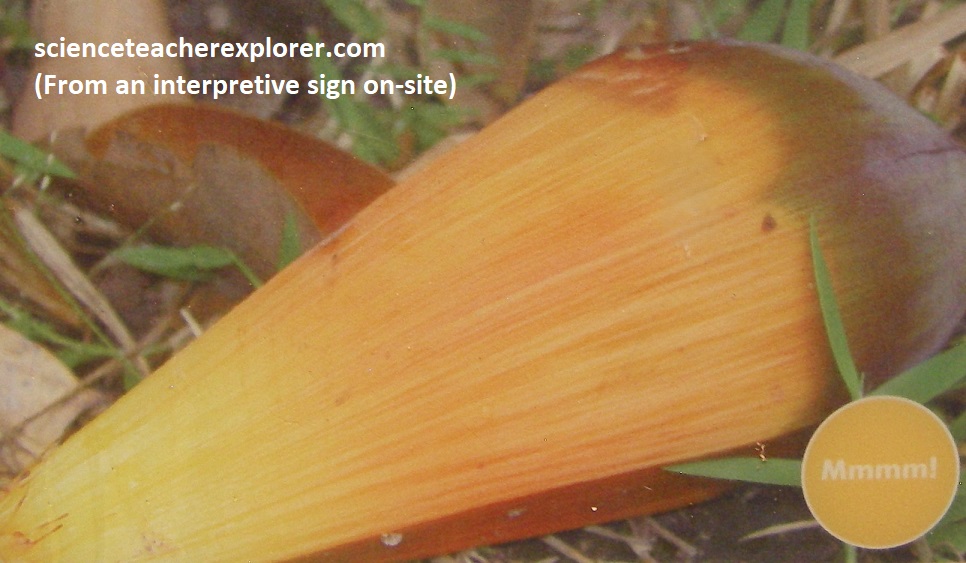
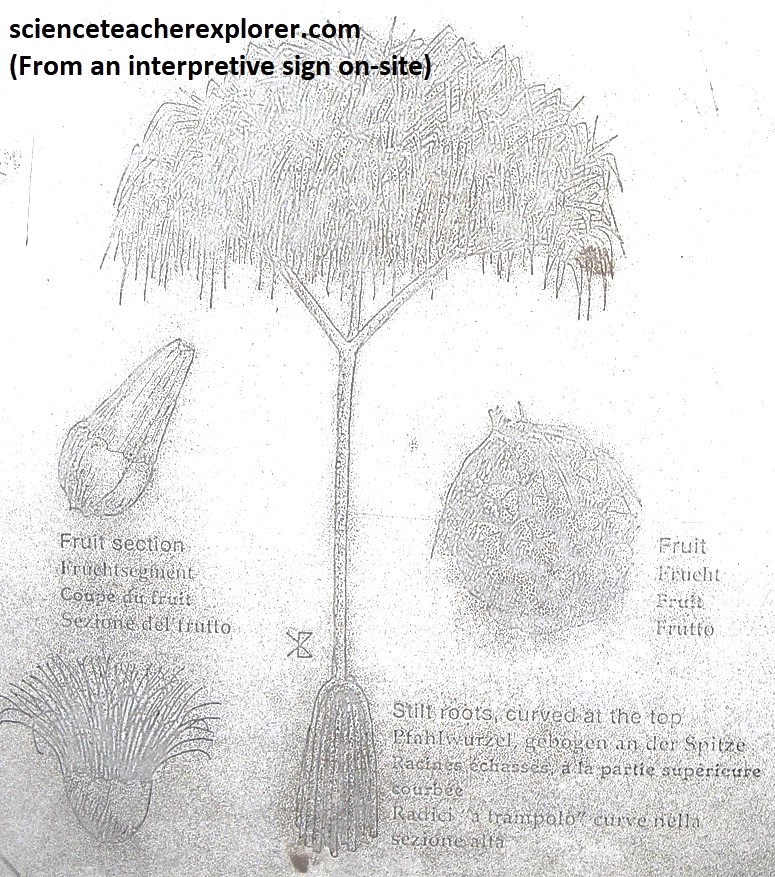
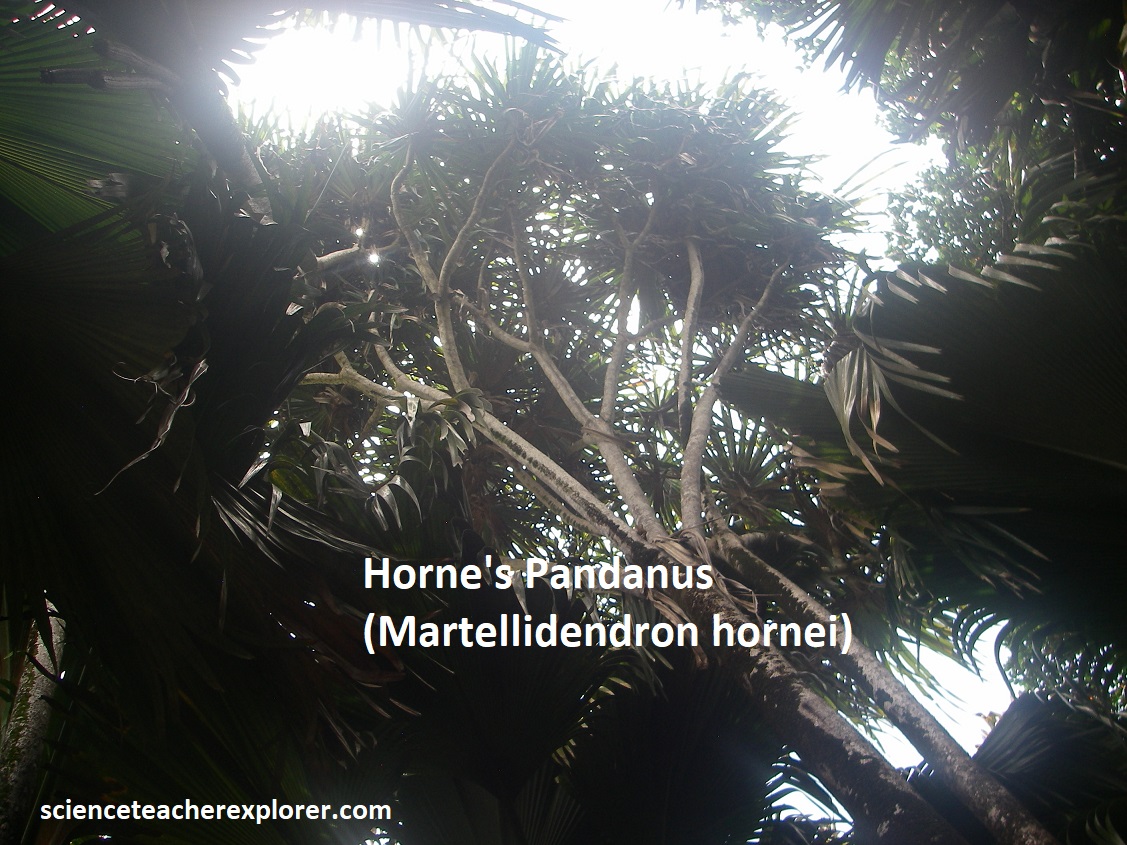
Pictured above, another native palm tree to the Seychelles is the Horne’s Pandanus (Martellidendron hornei), but this time the plant is claimed native to Madagascar as well, thus ‘only’ indigenous to Seychelles. However, this palm is a striking screwpine to 15m tall, with a smooth, but annual scarred main stem, being usually ongoing branched in 3’s and with the crown distinctive umbrella shaped. Stilt roots at the base of the trunk, and very long, dark green, leathery, linear and prickly leaves with red, marginal spines and spiny mid ribs. Male and female flowers on separate trees. The fruits are shaving brush structures on the forest floors around the palm and are easily recognizable, since the ‘hairs’ are normally very strait and not reflexed. (Popular with the fruit bats).
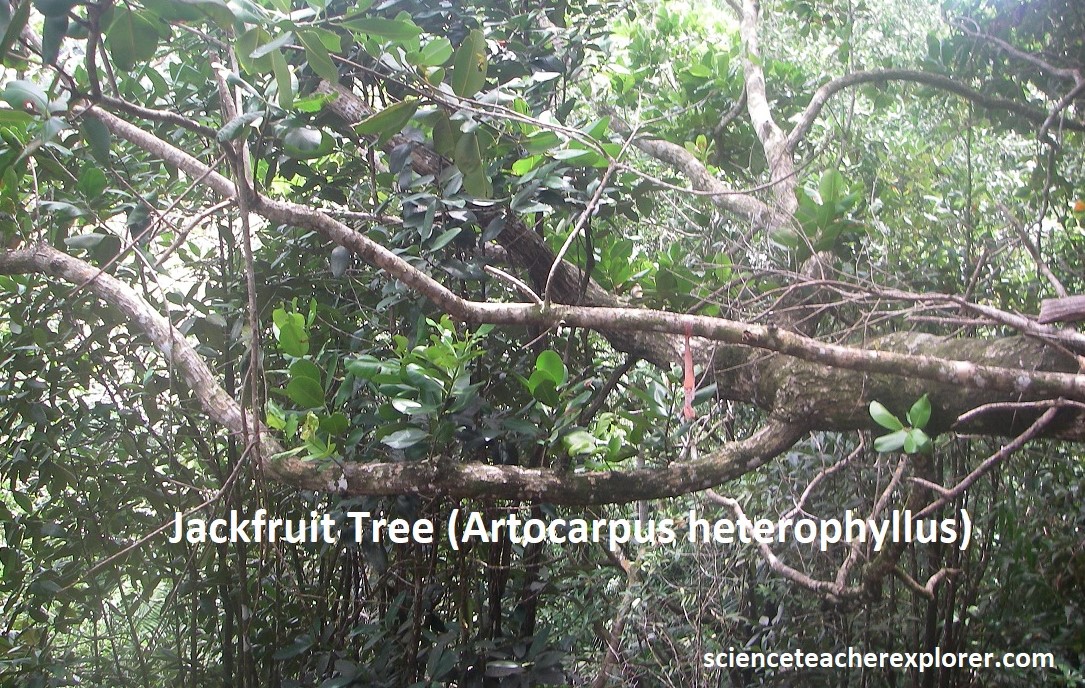
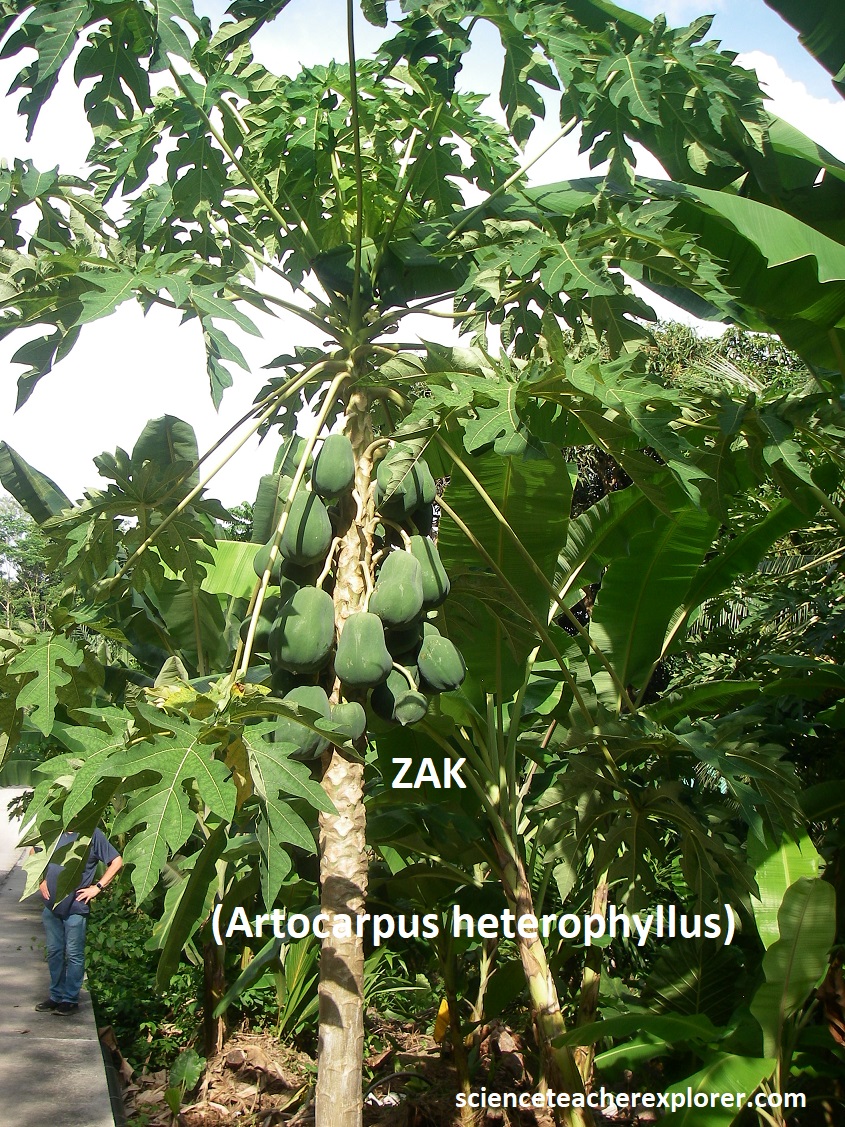
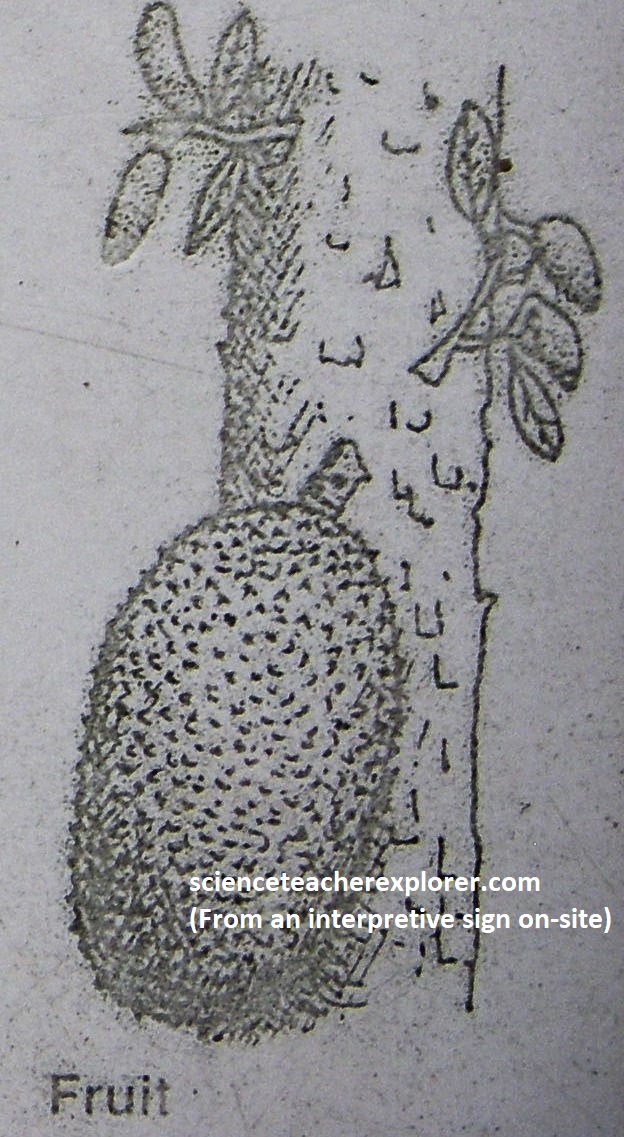
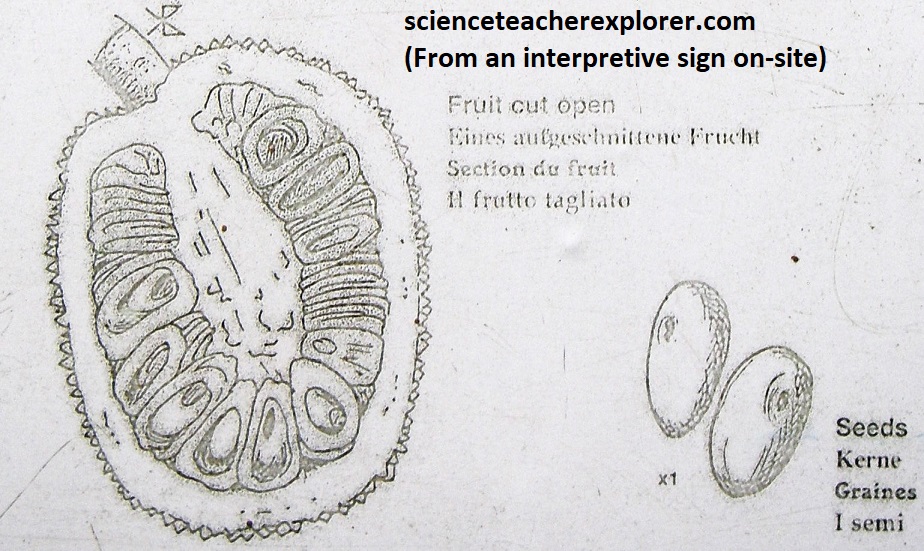
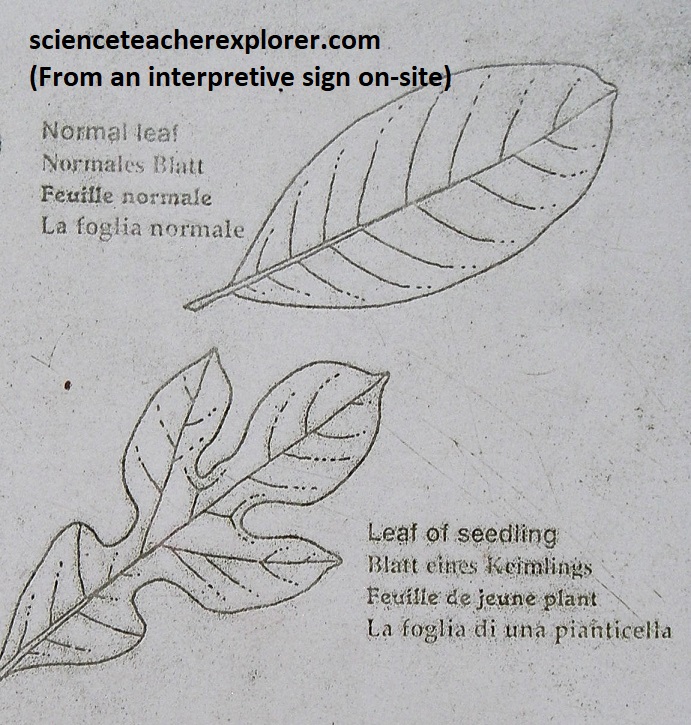
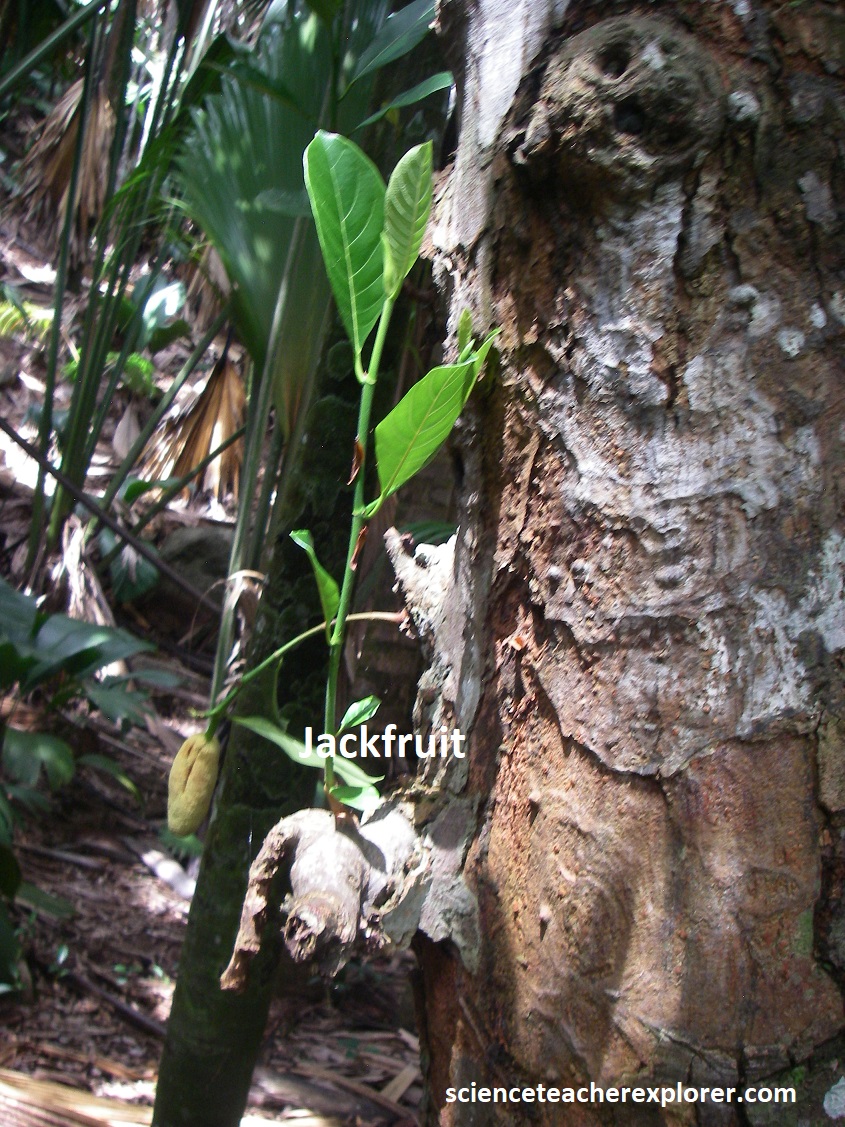
Other than native plants the Vallee de Mai host some quite remarkable ones of which is the Jackfruit (Artocarpus heterophyllus). Pictured above, originally from South East Asia, this introduced tree is conspicuous because of the very large fruits, (36kg), which grow directly from the trunk and the larger branches. It is related to the breadfruit tree, also introduced. The fruit has a strong smell when ripe. The sweet yellow inner flesh surrounding each seed is removed from the sticky outer flesh and eaten raw. The seeds are eaten, either roasted or curried, immature fruit can also be cooked as a curry. Seeds often start to germinate before the fallen fruit has rotted and seedlings are numerous. Jack fruit has become naturalized in the forests of Seychelles and the timber is sometimes used for furniture and doors.
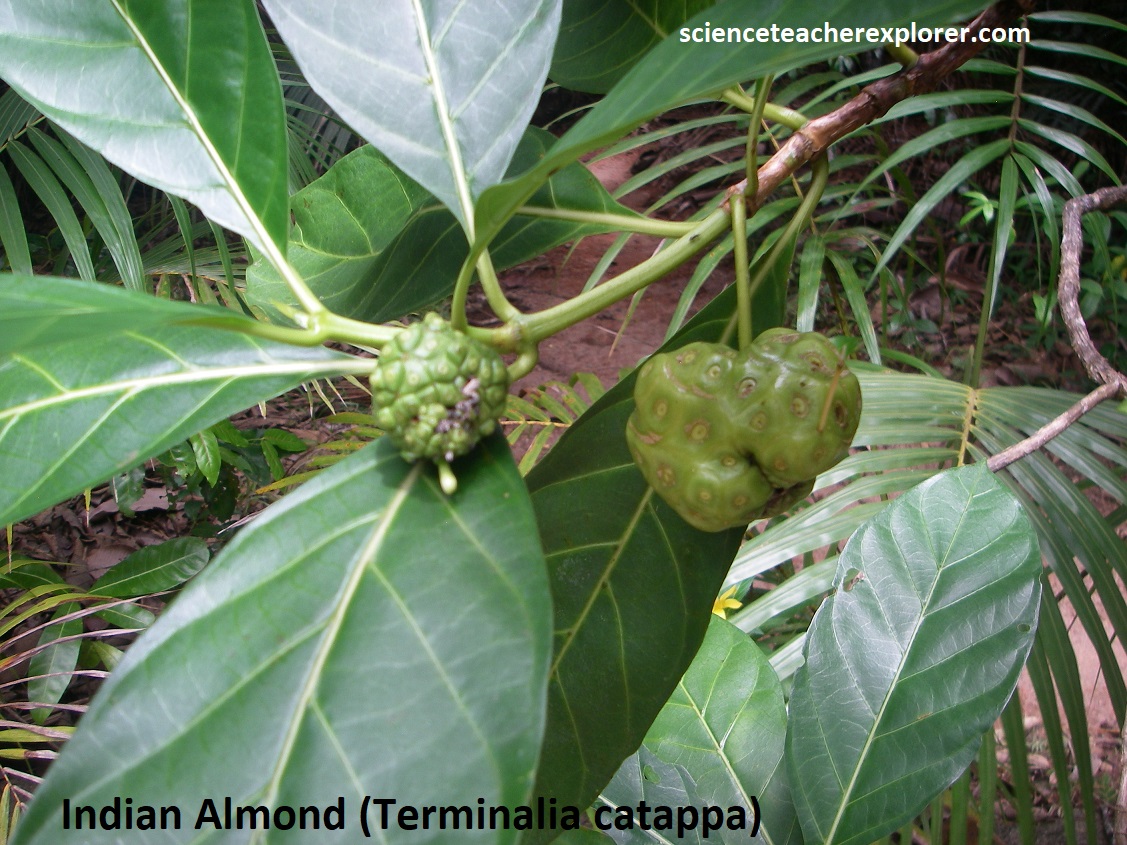
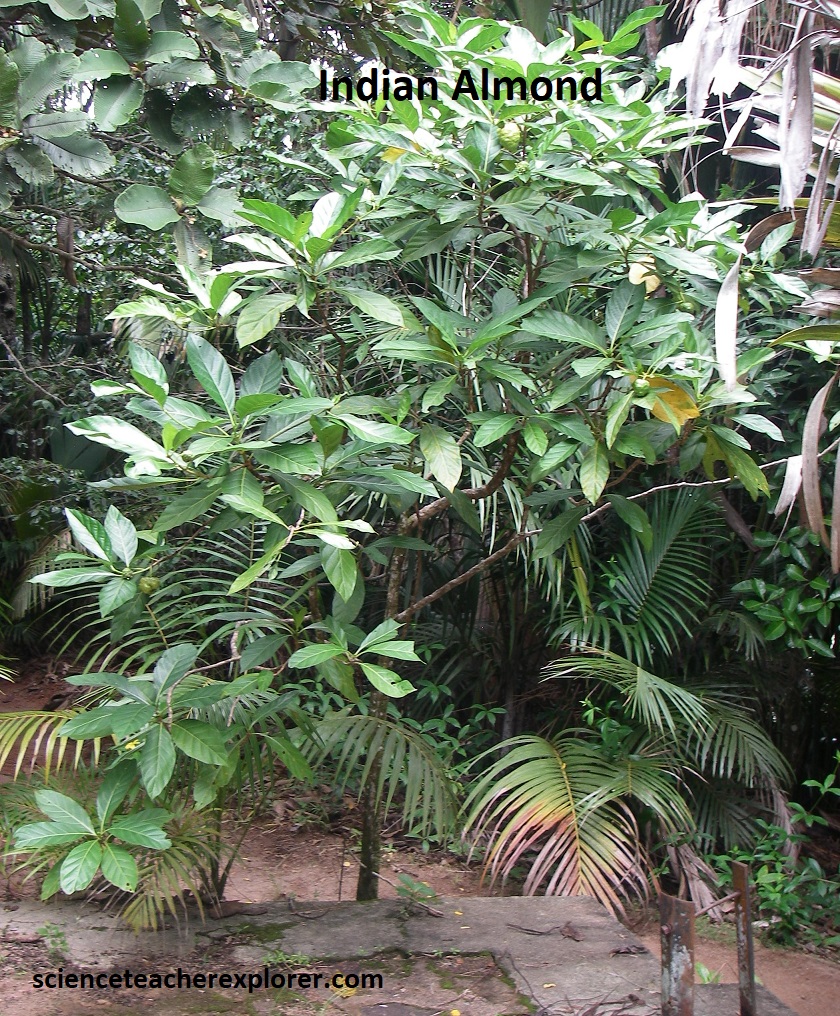
Pictured above, the Indian Almond (Terminalia catappa) is a very common, large, spreading, 20m tree with an upright, symmetrical but horizontally levelled crown due to the young branches emerging horizontally from the straight central trunk. Large, obovate, glossy, dark green and leathery leaves in bunches at the ends of the branches. The wood is red, solid and has a high water resistance. Thus, it can be used for canoe making. The fruits hava a distinctive sweetish almond-smell, which are edible. A tea from the leaves is said to be useful against pimples, fungal skin ailments, hypertension, diabetes, dysentery and diarrhoea.
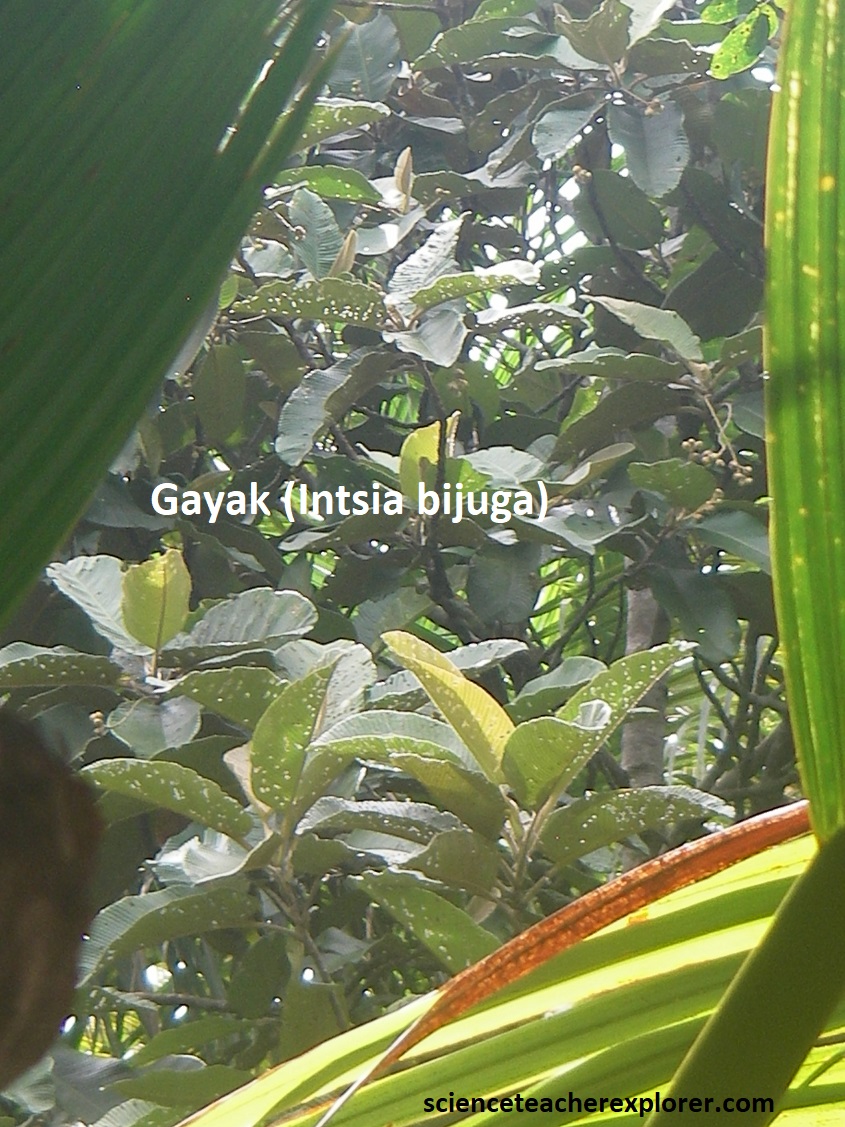
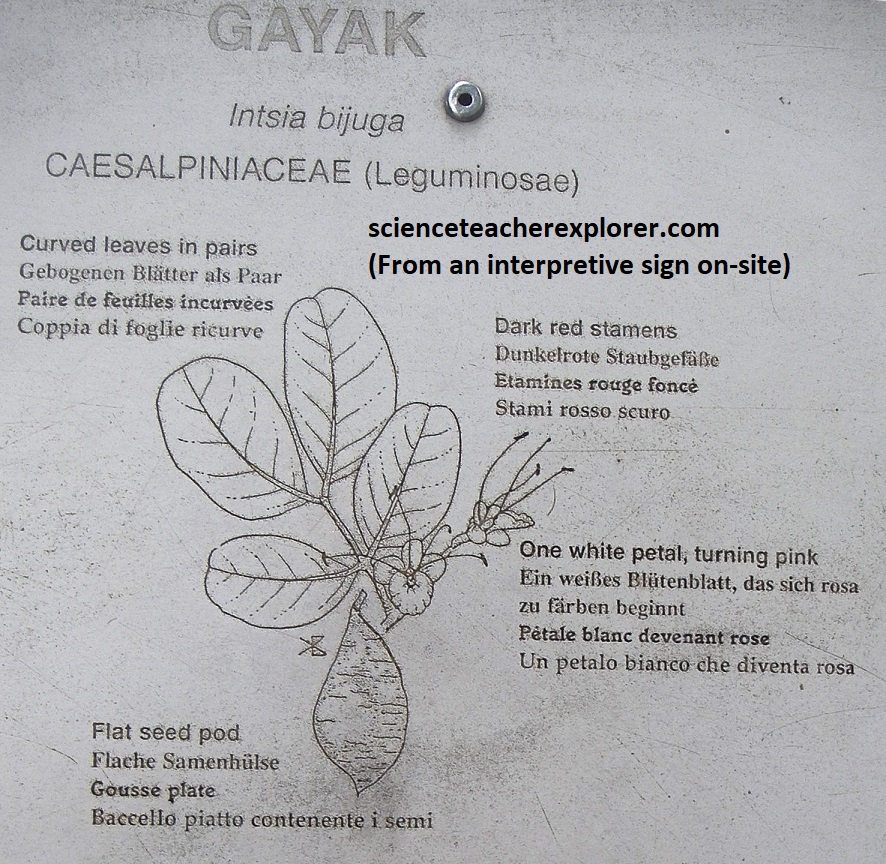
Pictured above, the Gayac is a native tree, which is also found in coastal areas of the Indo-Pacific region. It has a smooth, pale colored bark which peels off in small irregular plates, The fine-grained timber is excellent for ship building, resembling the timber of a Central American tree called gayac, hence its original name “false gayac”.
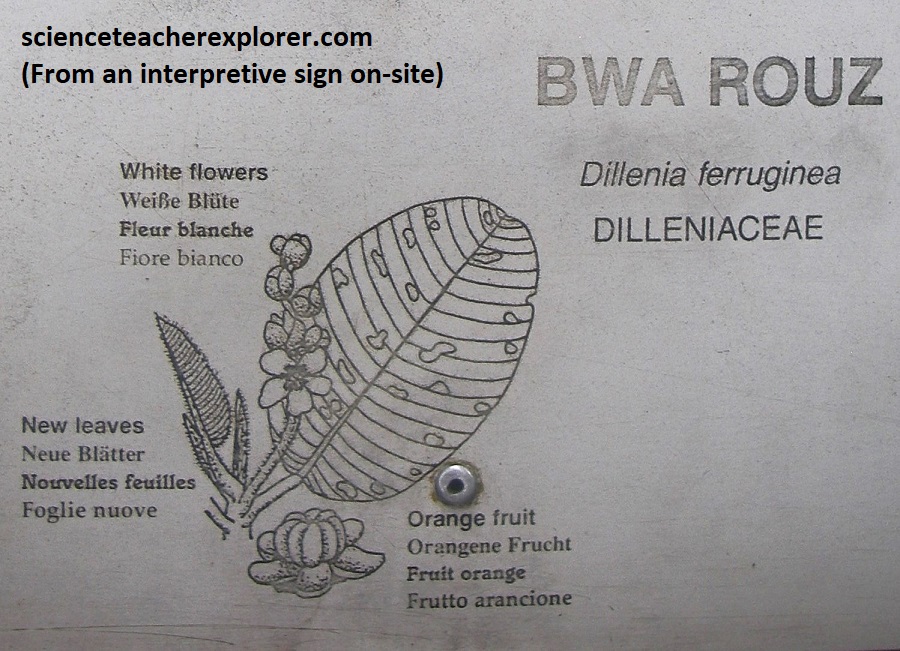
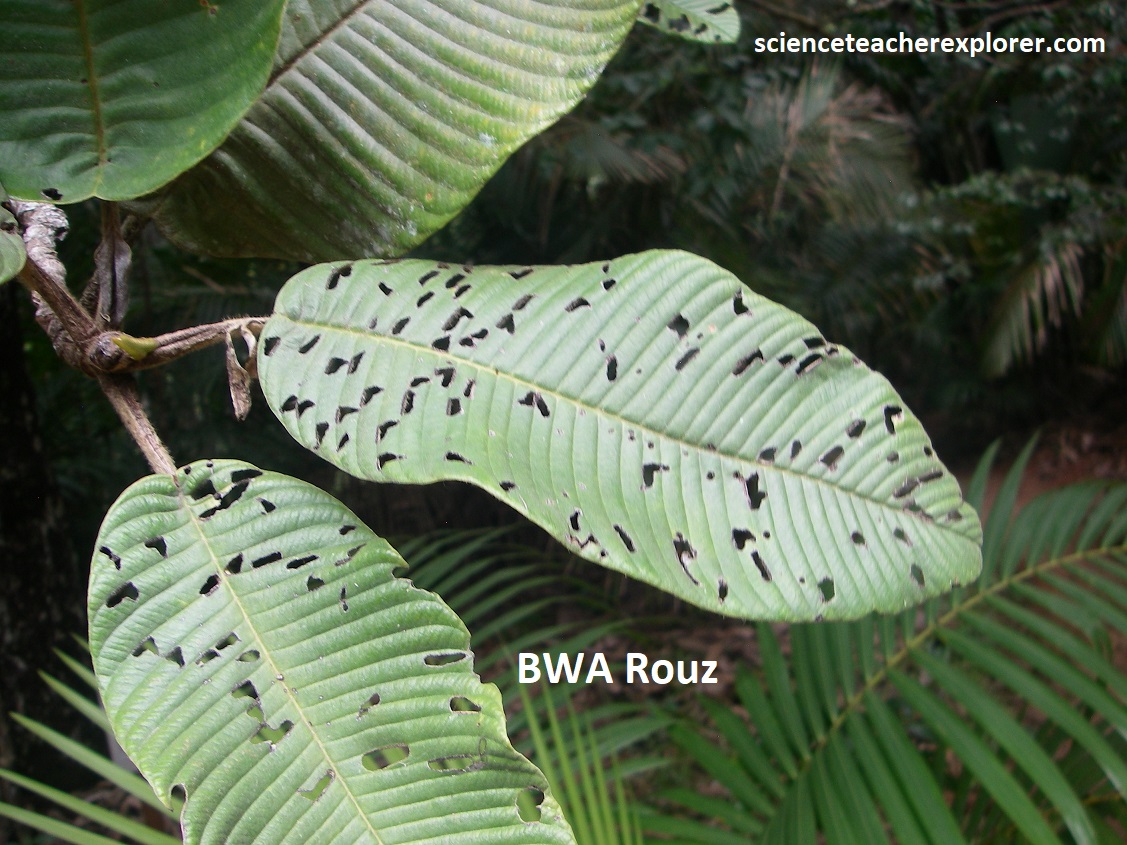
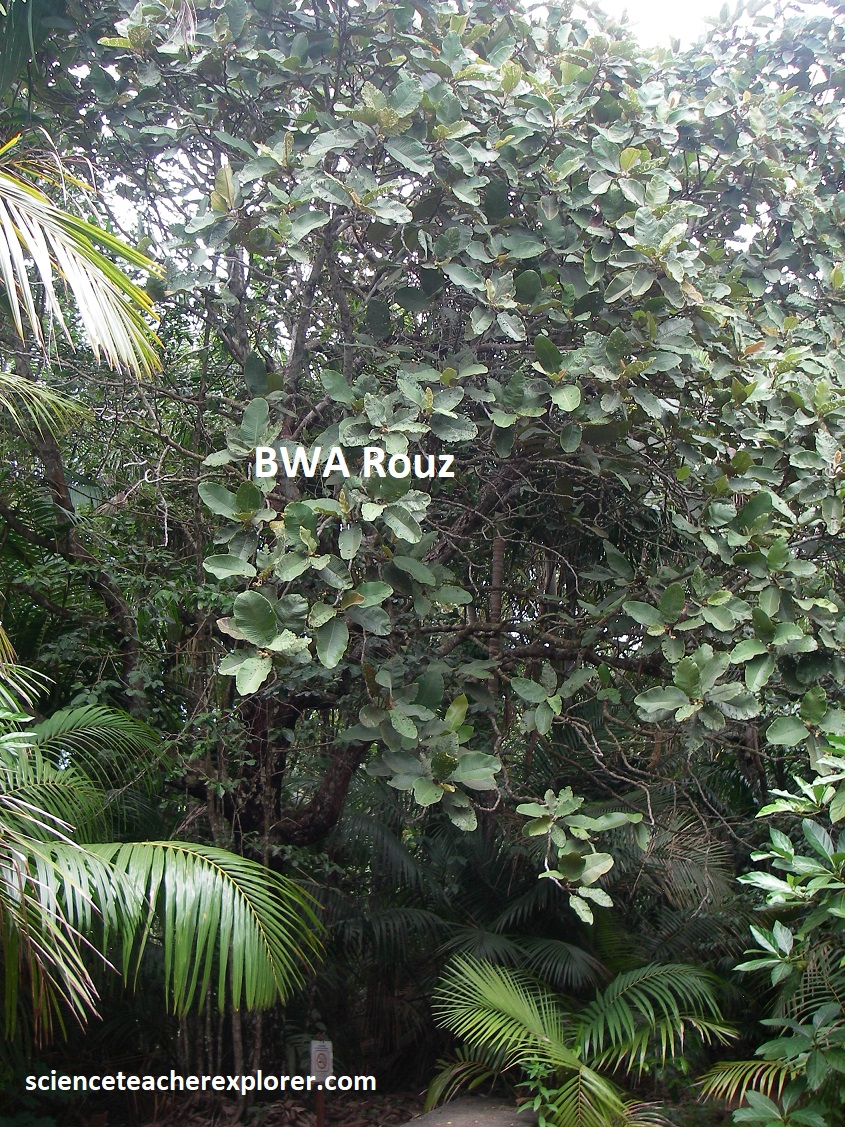
Pictured above is the Bois Rouge (Dillenia ferruginea). It is an endemic Tree that is found only in the hills of the Seychelles. It is a shrub or tree that can grow up to 15 meters tall. The leaves of the Bois Rouge plant are heterophyllous, meaning that the young leaves look different from the adult leaves. The young leaves are red in color. The Bois Rouge plant produces small fruits that resemble drupes. The fruits turn dark blue to black when they are ripe. The Bois Rouge plant is often seen with many holes in its leaves.
The video above depicts a forest floor and its litter that is a delicate ecosystem within the bigger ecosystem of the forest itself and is nothing but essential of providing the plants and the trees with new degraded available and thus recycling nutrients. Besides requiring millipedes, termites, crickets, grasshoppers, and others to carry out a very first step in the decomposing process by ‘cutting’ the different litters into smaller pieces increasing in that way the surface area for different attacking bacteria and fungus, which are the next step in the degrading process, it take a correct moisture of temperature, humidity and oxygen content to proceed successfully. And here the many dead branches and leaves piled on top of one another come in to secure the correct climate next to being part of the degrading process itself on the longer run.
Apart from that the bottom floor is a home, a breeding ground, a shelter, a hide away, a depot for nesting materials and a feeding place to many small and smaller animals such as worms, snails, beetles, millipedes, centipedes, ants, termites and other insects, to scorpions, beetles, chameleons skinks, geckos snakes, frogs hedgehogs and even to quite many birds, which all have developed a harmonious home on the forest floor and its litter that depends on their life cycle.
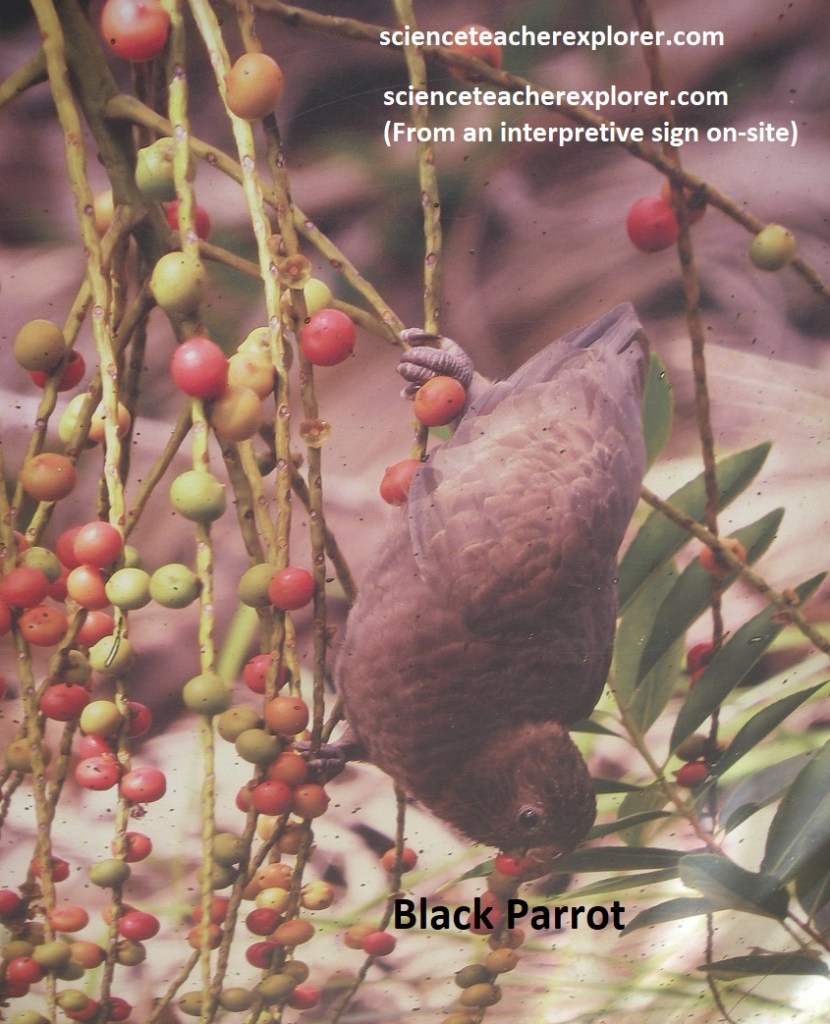
Pictured above, the Seychelles’ national bird, the Seychelles Black Parrot (Coracopsis barblyi), which is actually grey-brown, survives only in the palm forests of the Praslin Island’s interior. It’s a charismatic species, best seen feeding on fruits high in the canopy of Vallee de Mai, even though we didn’t see one, its melodious whistling call often filled the forest. With only between 520 and 900 thought to survive in the world, the species (the last surviving parrot species of the Seychelles) is under threat from non-native species such as the echo parakeet, habitat loss and also the ever-present danger of catastrophic fire that could wipe out the entire species in one go.
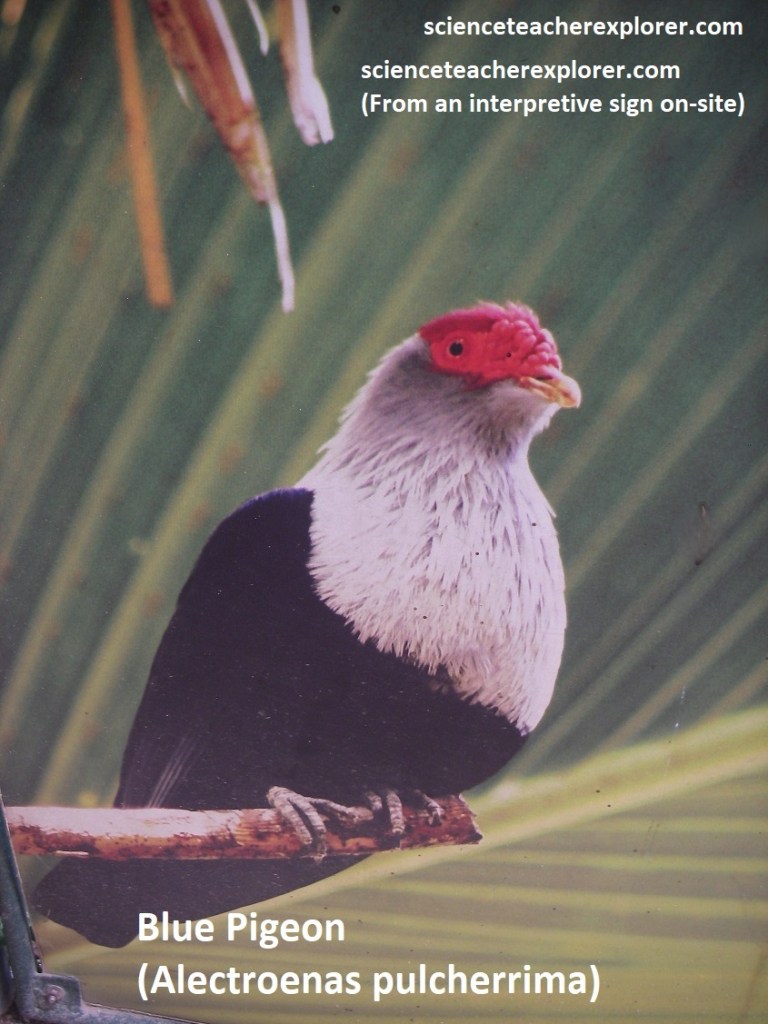
Pictured above, found only in the Seychelles, the Seychelles Blue Pigeon (Alectroenas pulcherrima) is most commonly seen on the Praslin Island. Mike and I had no luck in finding it in the Vallee de Mai, but were told they were commonly seen in the morning near the entrance. I was also told that its easy to spot perched on the power lines along the coast road on the wet side. However, the bird proclaims its territory by a low pitched and percussive song ‘kok ko ko ko ko ko’ as well as by long ascending flights followed by glides and wings bend downwards. Since we spent most of our time in the Vallee de Mai, we didn’t witness this.
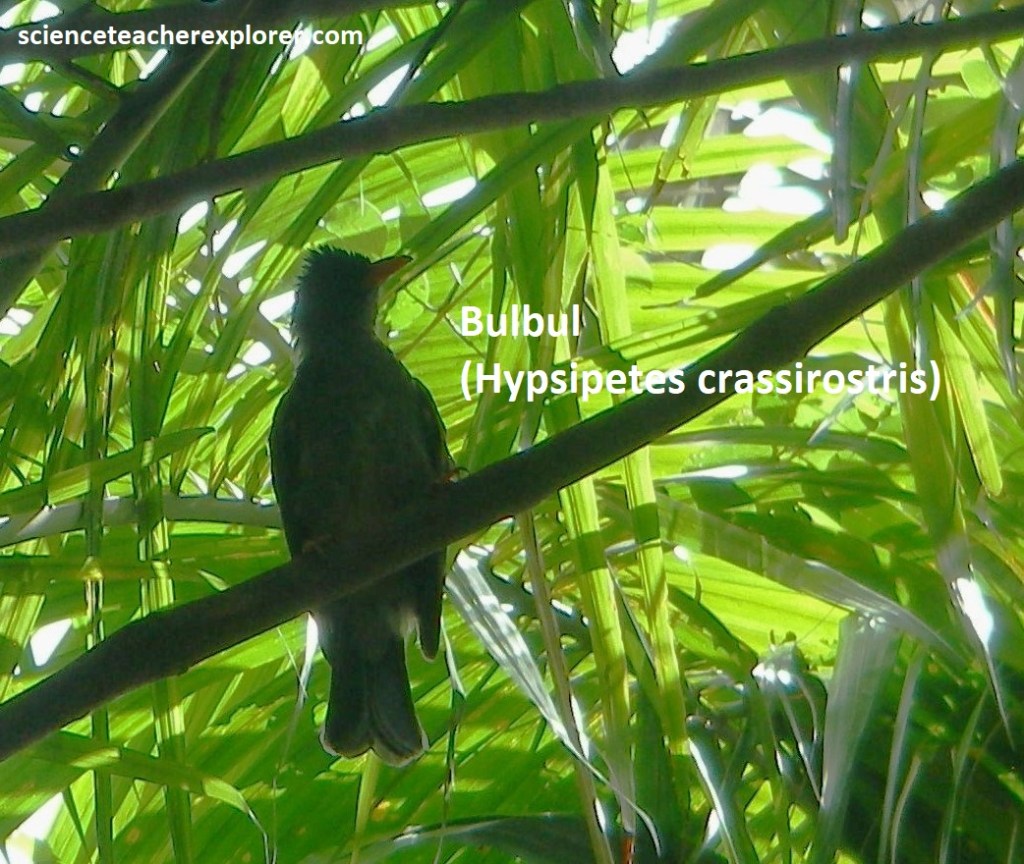
Pictured above, the Seychelles Bulbul (Hypsipetes crassirostris) is a curious and very alert, noisy bird, that we heard on your walk in the forest. It produced a succession of cackling and harsh nasal calls that alternate between low-pitched and melodious notes.
{Three additional endemic-birds are usually found within the palm forest of Vallee de Mai, but we didn’t see or here any of these: Seychelles Sunbird; Seychelles Kestrel & the Seychelles Swiftlet.}
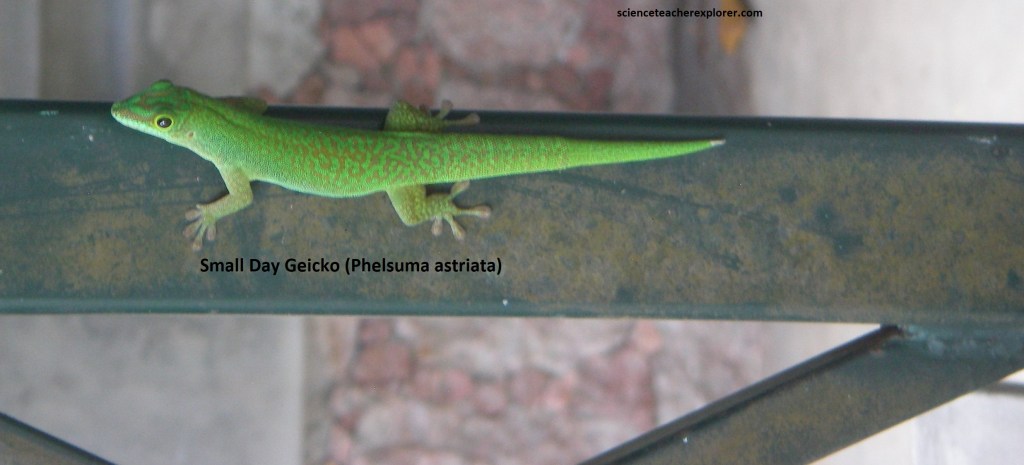
The Vallee de Mai has a surprisingly high representation of endemic reptiles. Fairly fast rooming around being part of the remarkable reptile world in the forest are the Day Geckos, the Bronze Geckos, the Seychelles Skink, two types of Snakes, two types of Chameleons and two types of Frogs. Pictured above is the Seychelles Small Day Gecko (Phelsuma astriata) with a white belly and green or yellow-green eyering. The dorsal side had irregular red markings, usually including a red chevron or angel on the head and two narrow transverse red bars on the neck with scattered red spots on the back.
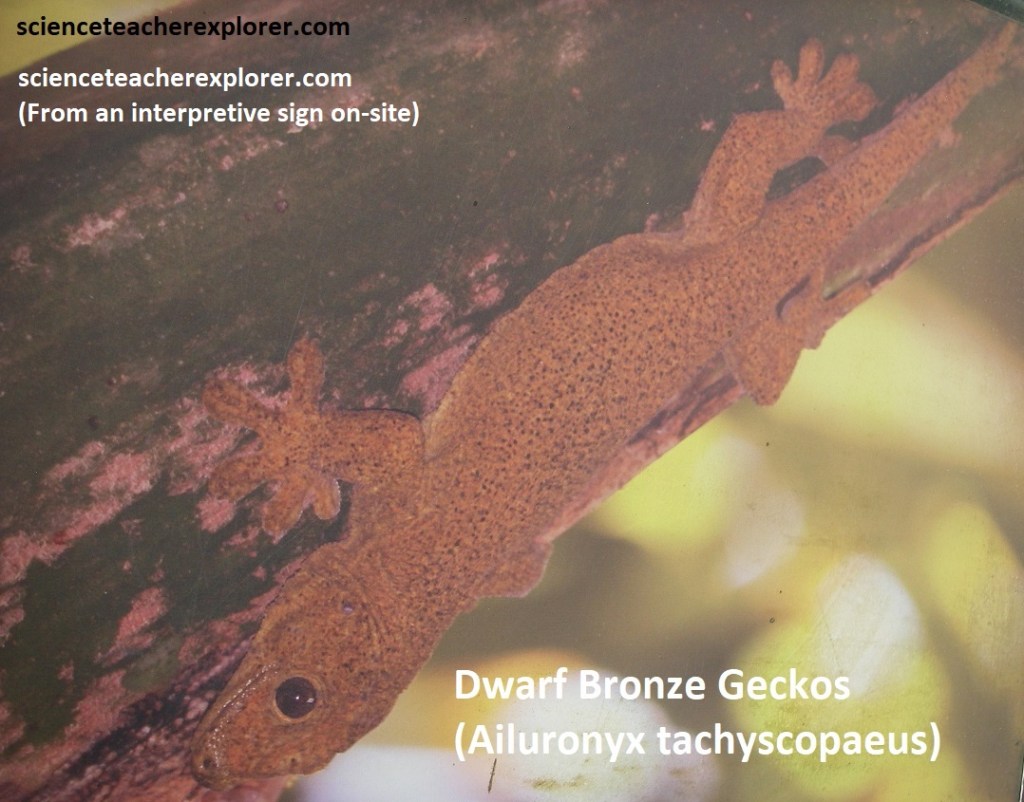
Pictured above, the Dwarf Bronze Geckos is endemic to the Vallee de Mia. It is a bulky, arboreal gecko with warty skin patterned in pale yellow to brown colors with metallic brown eyes. It feeds on nectar, insects, carrions and bird’s eggs.
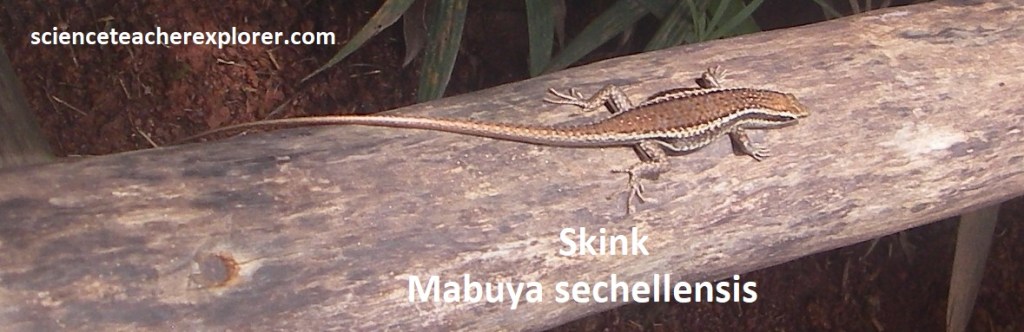
Pictured above, the Seychelles Skink (Mabuya sechellensis) was seen clambering along the fallen trees of the forest for of the Vallee de Mai. It is one of 3 endemic skinks in the Valle de Mai. This fairly small and slim skink had a very distinct black stripe along its side. It feeds on fallen eggs and chicks, insects, fruits and food scraps.
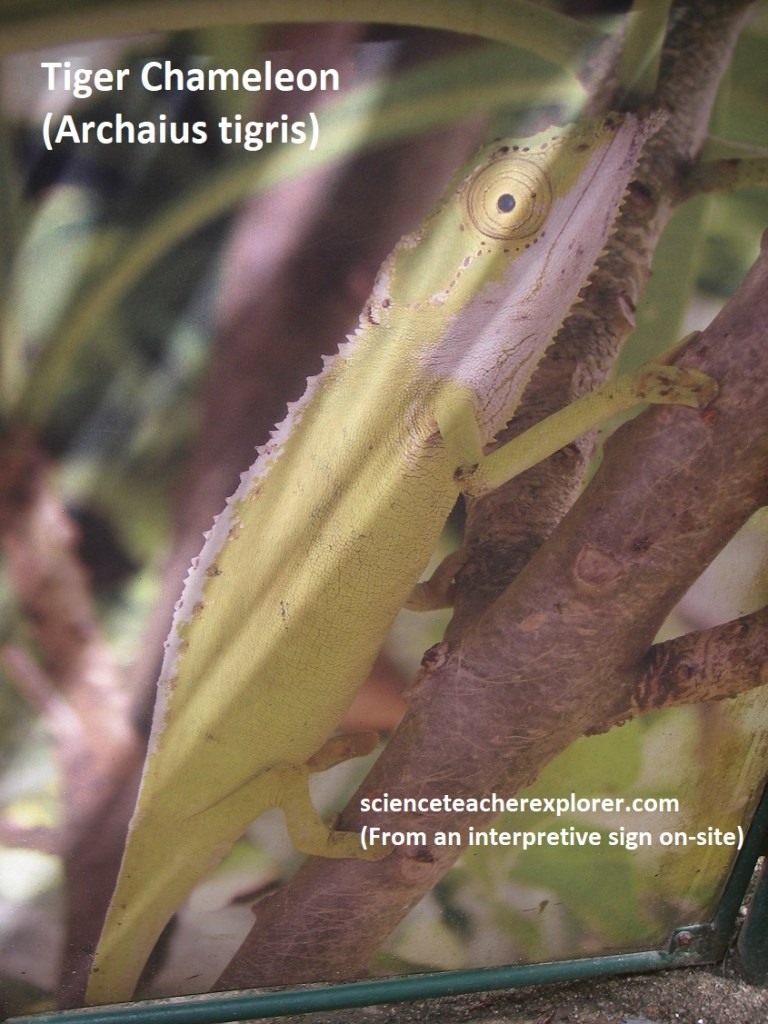
Still on all fours but now really slow moving are the chameleons, which together with their outstanding developed camouflage mechanisms making them able to blend in with the surroundings or the present background in just a split second. Pictured above, the Seychelles Tiger Chameleon (Archaius tigris) has the bright yellow and black colors. It spends most of its life climbing in vegetation. It feeds on small insects caught by its long tongue. On the global Red-List of threatened species it has now been categorized as being ‘endangered’ which means that it faces a high risk of extinction in the wild in the near future, if nothing is done to help improving its living conditions. (Apparently the Wolf Snake is an issue).
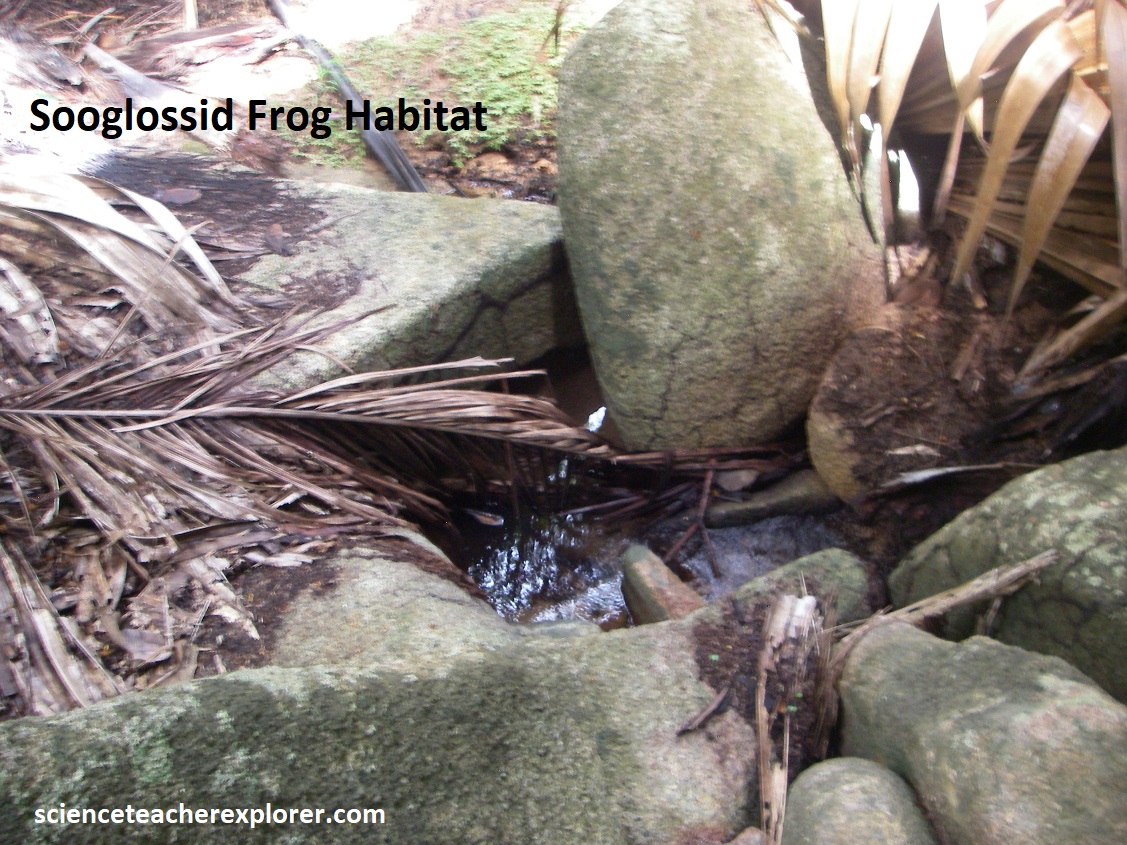
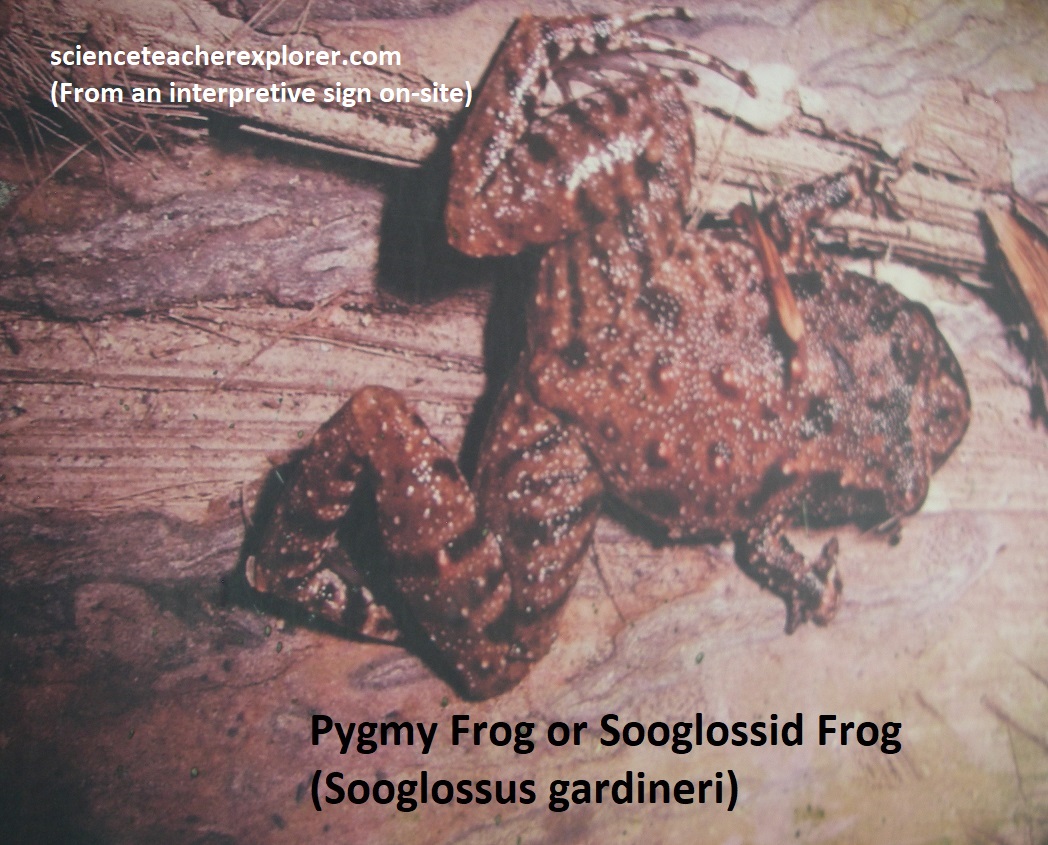
Pictured above is the habitat and the tiny endemic Seychelles Pygmy or Sooglossid Frog. It is 1.2 cm long and is to be found in a tiny stream at the Vallee de Mai, Due to its tiny size, we were able to hear it and not see it. It’s high-pitched peep resembles an insect call and could be heard during the day as we walked by.
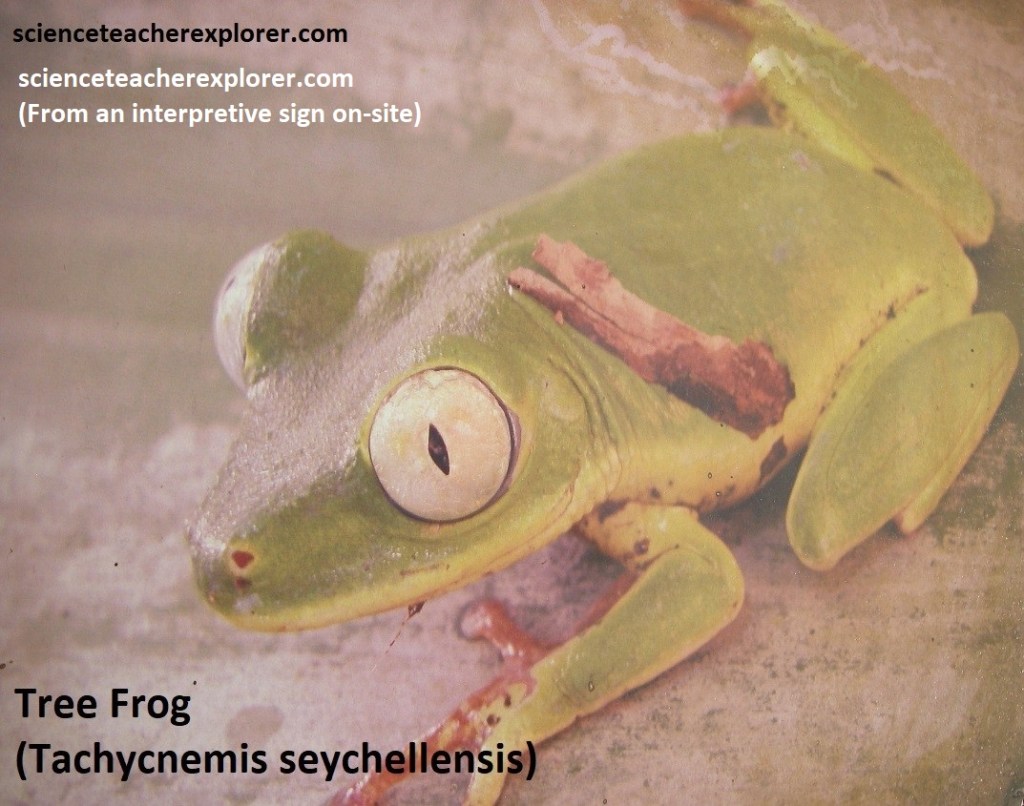
Pictured above is the Seychelles Tree Frog (Tachycnemis seychellensis). It is a 4cm long endemic tree fog that is found in the mid-altitude forest like the Vallee de Mai, where it is very common. When active during the night the males are usually red-brown and the females green, (making it easy to find each other). However, they both become waxy and pale during the day when it is time to hide away on tree leaves, (the pictured frog above would be a female during the day).
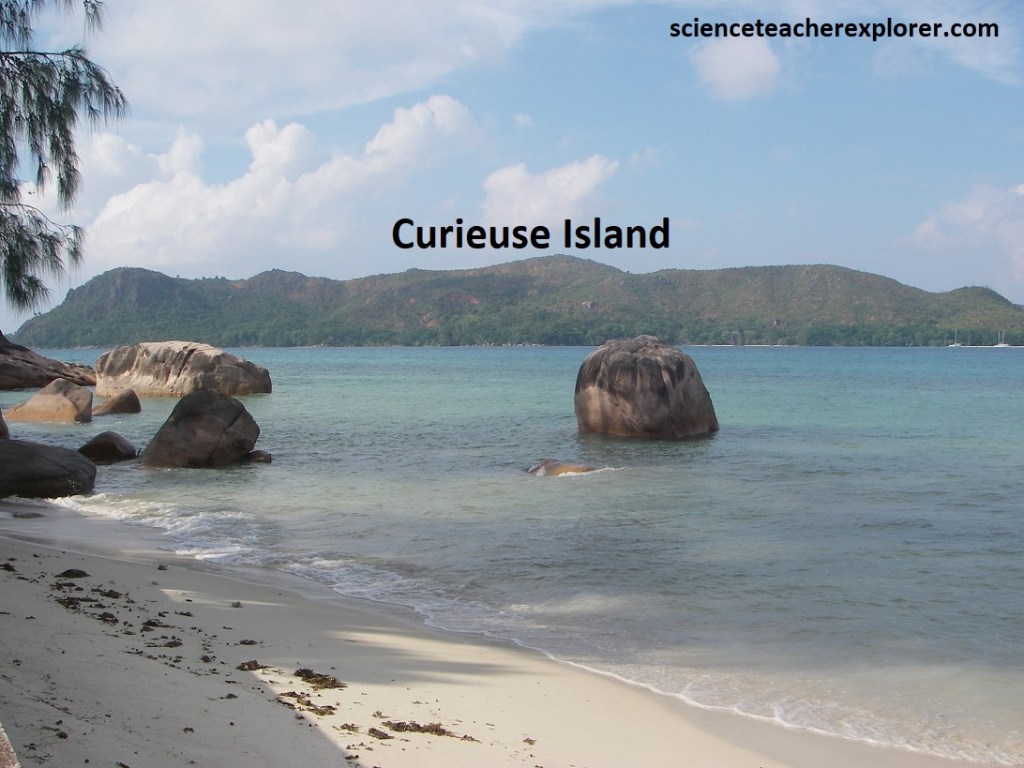
Pictured above is Curieuse Island from the northeastern shores of Praslin Island of the Seychelles. Curieuse Island is a granite island 1.5km off Praslin’s north coast. A leper colony fomr 1833 until 1965, Curieuse is today used as a breeding center for giant Aldabra tortoises. The wardens at the “Giant Tortoise Farm” show visitors around the pens. We didn’t have the time to arrange the tour. However, the giant tortoises of Aldabra were almost wiped out by the end of the 19th century, but have made a remarkable comeback, with more than 150,000 today in the Seychelles. One of two remaining species of giant tortoise on Earth, the Aldabra Giant Tortoise, is the last extant species of a group of giant tortoise that inhabited islands of the Western Indian Ocean. They shared a common ancestor with the Galapagos Tortoise around 25-30 million years ago. Origins of the species branch back approximately 17.5 million years to Madagascar from where they dispersed to islands of the Seychelles. This truly giant species, a classic case of so-called island gigantism, is distinguishable from their cousins in Galápagos by their narrow faces and pronounced domed carapace (top shell). Adult male Aldabra Giant Tortoises can reach up to 1.3m (4ft) in length and can weigh up to 350kg (770lbs) in captivity and live to 180 years.
 Explorer/Trekker